Saturday, April 07, 2007
246 families escape from Tal Afar to Mosul
Humanitarian
(VOI) – A total of 246 families from Talafar, whose houses were destroyed in the March 27 bombing incidents, arrived in the city of Mosul, Iraq's Red Crescent Society said on Friday."The society provided shelters for the families, composed of 1250 people, at a camp set up next to Ninawa's eastern wall and more families will follow," Shamil Muwaffaq, the Society's official in charge of security in Mosul, told the independent news agency Voices of Iraq (VOI).
He said the camp has got all the humanitarian needs: water, foodstuffs, medicine and blanket.Talafar was the scene of bloody incidents last week when several car bombs blew up in areas inhabited by a Shiite majority, followed by nighttime armed militias' raids on houses of Sunnis, who were led outdoors and executed.
Labels: Iraqi Red Crescent Society, IRCS, Mosul, Tal Afar


Monday, March 19, 2007
Iraqi Red Crescent Society - humanitarian relief deliveries improve
Security, Humanitarian
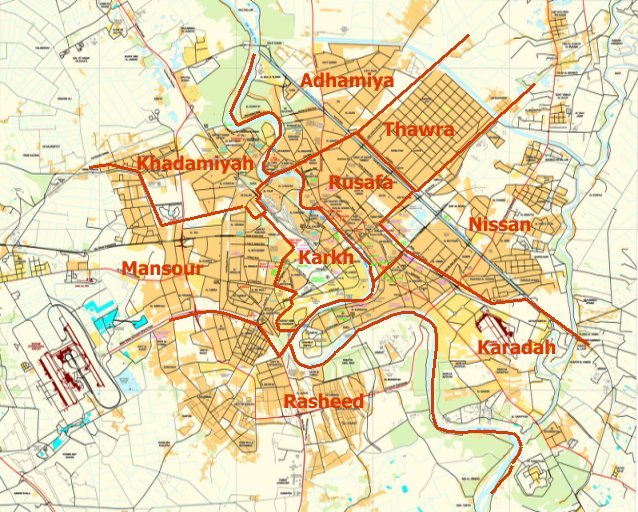
(IRIN) - Baghdad's month-old new security plan is showing signs of progress as the capital's death toll has dropped by 30 percent and execution-style slayings have halved, say specialists. As such, access for humanitarian relief deliveries has improved, say aid workers. However, car bombs and suicide attacks are still commonplace.
The Iraqi Red Crescent Society (IRCS), the country's only aid agency operating throughout the country, said that its teams are working like "bees" through its 40 offices in Baghdad. "We are still able to reach anyone who needs our help and our movement has not been hampered… It's better than before," Mazin Abdullah Saloom, a Red Crescent spokesman said. "We still have access to displaced families in Baghdad and its suburbs while medicine and essential items are still being brought into hospitals," Saloom added.
For the first time in many months, downtown shoppers have returned to Baghdad's outdoor markets as the rattle of gunfire and the blasts of bombs can be heard much less frequently. On 14 March, Brig. Gen. Qassim al-Moussawi, spokesman of the US-Iraqi security plan, said the number of civilians killed in the capital since the operation started a month before had plunged to 265, compared with 1,440 people killed during the previous month.
Moussawi also said 94 militants had been killed while 713 militants and 1,152 other suspects had been arrested since 14 February. In the same period, 24 kidnap victims had been released and more than 2,000 displaced families had returned to their homes.
However, despite the improvement in security, Baghdad residents said that Shia militias and Sunni insurgents were still around, lying low or hiding outside the city until the new security operation is over. The absence of Sunni insurgents and the radical Shia leader Muqtada al-Sadr and his fearful militiamen is considered one of the reasons behind the reduced violence in the capital.
"But this doesn't mean they are gone forever; they are just adopting a new tactic by bowing to the storm to reorganise themselves more to resurface later," said Baghdad-based analyst Mohammed Abbas al-Hamad. "Key leaders [of Shia militiamen and Sunni insurgents] have left the country or the capital while others are still around but have frozen their activities for the time being," al-Hamad added.
Labels: aid, Brig. Gen. Qassim al-Moussawi, insurgents, Iraqi Red Crescent Society, IRCS, militias