Monday, July 16, 2007
Provincial Councils Of Iraq Reject The Draft Oil Law
Oil
(Al Mutamar Newspaper) - 16 JUL - Ten Iraq Provincial Councils from central and southern Iraq announced their rejection of the draft oil law. This decision came after an emergency meeting in Basrah. The Provincial Council organization’s spokesman, Aqil Talib, said that many articles in the oil law must be changed.
The Provincial Council organization held this meeting to express their rejection of the draft oil law which has been presented by the Prime Minister. The Provincial Council organization rejects some articles in the draft oil law, such as the election of governors because this is an improper mechanism to elect a governor. Also, the oil law does not allow the provinces benefit from the oil income because all of the income will go to the central government.
In a related issue, Shiite Alliance Parliament member, Daghir Al Musawi, confirmed that the Parliament is working to give more authority to the provinces and the oil law is not unconstitutional. He added, “We want to give more authority to the provinces and the regions as well as to decrease the authority of the central government.”
In a related issue, Shiite Alliance Parliament member, Daghir Al Musawi, confirmed that the Parliament is working to give more authority to the provinces and the oil law is not unconstitutional. He added, “We want to give more authority to the provinces and the regions as well as to decrease the authority of the central government.”
Basrah Provincial Council chief, Mohammed Saddoun Al Abadi pointed out that the new oil law states that the provinces should have new elections for governors. Al Abadi indicated that the emergency meeting had some recommendations which are: to decrease the central government’s authority and to give more authority to the provincial councils.
Labels: Aqil Talib, draft oil law, provincial councils


Monday, March 12, 2007
Delay in holding provincial elections irks Sunnis
Politics
(Los Angeles Times) The long delay in holding provincial elections in Iraq has shut out Sunni Arab majorities and exacerbated sectarian tensions in provincial capitals such as Kirkuk and Baqoubah and in mixed neighborhoods of Baghdad. A Sunni boycott of elections in 2005 has left the religious sect under-represented in some provincial councils, allowing Shia politicians to dominate.
The stark political imbalance is a key driver of sectarian violence between Sunni and Shia Muslims in some of Iraq's most strategically important and heterogeneous cities, Iraqi politicians and U.S. officials say. Plans to draft legislation for local balloting have been put off indefinitely by the Shia-dominated parliament, intensifying tensions.
The stark political imbalance is a key driver of sectarian violence between Sunni and Shia Muslims in some of Iraq's most strategically important and heterogeneous cities, Iraqi politicians and U.S. officials say. Plans to draft legislation for local balloting have been put off indefinitely by the Shia-dominated parliament, intensifying tensions.
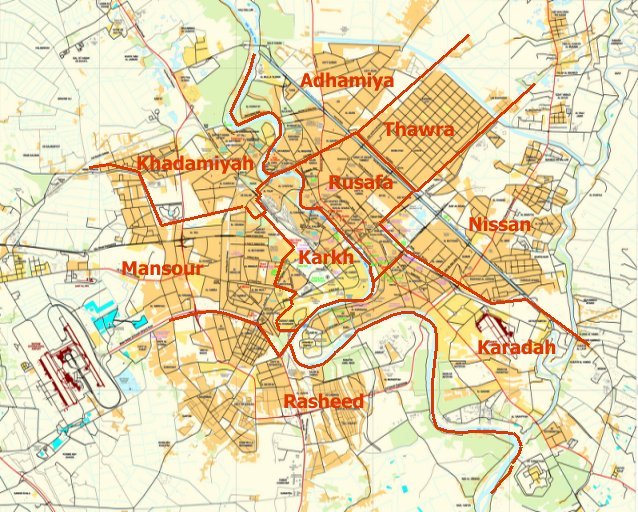
Sunni Arabs constitute at least 40 percent of Baghdad's population, but only one of the 51 members of the local provincial council is Sunni. "The absence of Sunnis on the council has an absolutely negative effect," said Azhar Abdul Majeed Hussein, the sole Sunni council member in Baghdad. "When Sunnis turn to the council for even simple needs, they find they have no representatives. This makes them feel marginalized. There is a clear sectarian spirit in the council." That sectarian spirit extends to the greater Iraqi society, Iraqi leaders and U.S. officials say, overlaying the combustible political strife.
Sunni Arabs are also under-represented in Diyala province, to the northeast, where they are believed to make up 60 percent of the population but hold only about one-third of the provincial seats. In the disputed northern city of Kirkuk, Sunni Arabs and Shias constitute about 25 percent of the population but only 15 percent of the Kurdish-dominated provincial council.
Diyala Deputy Gov. Aouf Rahoumi said Shia domination of the provincial council, which sits in Baqoubah, had a direct effect on security because Shias, partly as a result of this political strength, also dominate the army and police in the area. "The governor is Shiite, the police commander is Shiite, the army commander is Shiite, the major crimes unit commander is Shiite, the intelligence commander is Shiite, most of the division commanders are Shiite," Rahoumi, a Sunni, said. "So there are problems because they are a minority ruling over a majority."
Labels: Diyala, Kirkuk, provincial councils, provincial elections