Tuesday, June 26, 2007
Tribal leaders killed in Monday's blast named
Security, Tribal
(Voices of Iraq) - Iraqi police sources unveiled on Monday the names of the tribal chiefs who were killed in the suicide bomb attack that targeted al-Mansour hotel in central Baghdad. "The names of (five) tribal chiefs who were killed in the blast are: Sheikh Fesal al-Kaaood, one of al-Bounamr tribe's sheikhs, Sheikh Tareq al-Essafi of al-Bouasaf tribe, Sheikh Abdul Aziz al-Fahdawi of al-Bofahd, Sheikh Hussein al-Shaalan al-Khezaai of Khuzaa tribe and Sheikh Aziz al-Yaseri of al-Bouyasser tribe," a police source told the independent news agency Voices of Iraq (VOI).
"A number of tribal chiefs were wounded in the attack, including Sheikh Ali Khaliefa, Sheikh Ryah al-Elwani and Sheikh Daham al-Ubeidi," the source added. A police source said earlier that the death toll from the suicide bomb attack had risen to 12 dead, including six tribal chiefs. The official al-Iraqi satellite television also said that Poet Rahim al-Maliki, a program producer and presenter for the TV channel, was among them.
"The bomber was wearing an explosive belt and blew himself up inside a hall where leaders of clans from the Sunni province of Anbar were meeting," a police source said. A spokesman for the U.S. army said that "preliminary reports assert the killing of six tribal chiefs." Eyewitness said that Iraqi army forces arrived at the scene and arrested the hotel security guards, including policemen.
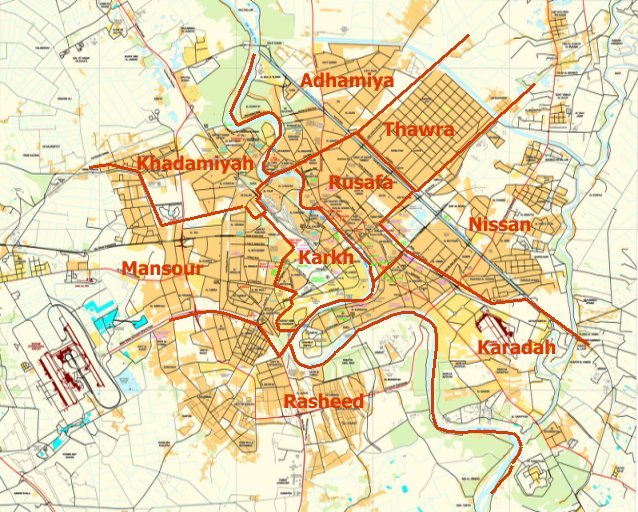
U.S. and Iraqi forces cordoned off the entire area. The Iraqi parliament strongly denounced the attack on the Anbar tribal chiefs, describing it as a criminal act. The hotel is located in central Baghdad on the western bank of the Tigris River.
Labels: al-Bofahd, al-Bounamr, Khuzaa tribe, Rahim al-Maliki, Sheikh Abdul Aziz al-Fahdawi, Sheikh Aziz al-Yaseri, Sheikh Fesal al-Kaaood, Sheikh Hussein al-Shaalan al-Khezaai, Sheikh Tareq al-Essafi


Monday, June 25, 2007
12 killed in Mansour Hotel bombing
Security
(AP) - A suicide bomber who penetrated layers of security blew himself up in the busy lobby of a leading Baghdad hotel on Monday, killing at least 12 people, including a U.S.-allied tribal sheik, police reported. The attack, in which 21 others were wounded, was just one in a surge of five suicide and other bombings Monday that killed at least 32 people across Iraq.
In an equally deadly attack, a suicide truck bomber targeted an Iraqi police station shared with U.S. troops in Beiji, 155 miles north of Baghdad, killing nine people. Five American soldiers suffered minor wounds, the U.S. command said.
The bombing at the high-rise Mansour Hotel, on the west bank of the Tigris River in central Baghdad, struck at about noon as the lobby bustled with members of news media organizations headquartered at the hotel and other guests, witnesses said. A man wearing a belt of explosives walked into the lobby, approached the reception desk and detonated his bomb, police reported.
"It was a great breach of security because there are three checkpoints, one outside and two inside," said hotel worker Saif al-Rubaie, 28, who witnessed the blast and said all the casualties were Iraqis, most employees in the reception area.
Police said the dead included hotel resident Fassal al-Guood, a Ramadi tribal sheik and former governor of Anbar province who was a leader of the Anbar Salvation Council, which has partnered with U.S. and Iraqi officials to fight al-Qaida influence in Anbar. A noted Iraqi poet, Rahim al-Maliki, also was killed, said Iraqi Media Net, the government organization on whose television network al-Maliki appeared. Reports that al-Guood was a target of the bombing, possibly along with other Salvation Council sheiks, could not be confirmed.
The Mansour, which also houses the Chinese Embassy and is the Baghdad home for a number of Iraqi parliament members, is just a half-mile from the heavily fortified International Zone, where the U.S. Embassy and Iraqi government offices are situated. The attack was the fifth in a string of suicide and other bombings Monday morning, from Mosul and Beiji in the north to Hillah in the south. Two were aimed at U.S. targets.
Labels: Anbar Salvation Council, Beiji, Fassal al-Guood, Hillah, Mansour Hotel, Rahim al-Maliki, Siniyah, suicide bomber