Wednesday, October 10, 2007
Census to be carried out in Kirkuk in November
(RFE/RL) - A full census will be carried out in the contested oil-rich governorate of Kirkuk in mid-November, said Narmin Uthman, the deputy head of the Higher Commission for the Implementation of Article 140 of the constitution, Kurdish media reported on October 4. Article 140 concerns repatriation of those displaced under Saddam Hussein's regime to their original homes. As it applies to Kirkuk, the article paves the way for thousands of Kurds displaced from their homes to return to the governorate. It also requires that tens of thousands of Arab families resettled in Kirkuk under Hussein must return to their homes and villages in the south of the country.
The census, called for in the constitution, will be followed by a referendum by residents in Kirkuk to decide whether to join the Kurdistan region or remain outside it. International media reported this week that the commission has begun to compensate Arab families for leaving their homes in Kirkuk. The government is offering 20 million dinars (around $16,000) to each family that leaves Kirkuk and relocates to their original homes. The number of Arab families living in Kirkuk is not known, but estimates run between 70,000 and 135,000 families.
Labels: Article 140, census, Kirkuk, Narmin Uthman


Wednesday, August 22, 2007
Ministry of Interior to carry out population census
Government
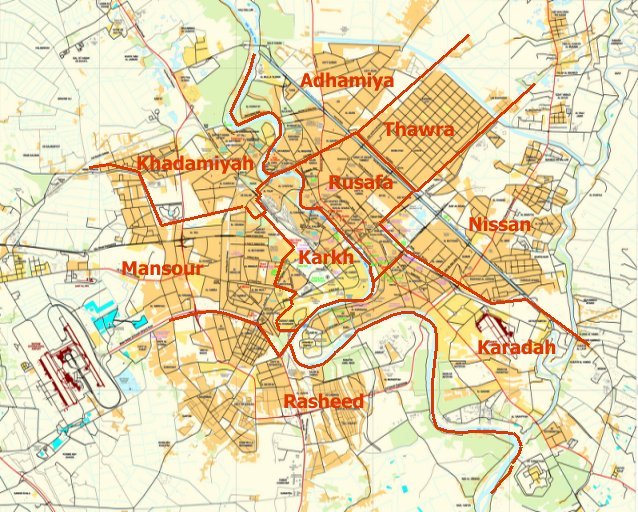
(Azzaman) - The Ministry of Interior is to carry out a count of the population in violence-stricken areas including the capital Baghdad. The aim, according to the ministry, is to have a reliable register of those permanently residing in these areas and those staying for short periods of time. “It is important to draw a line between permanent inhabitants and the newcomers,” Brigadier Qassem Atta said.
He said each citizen in Baghdad and other restive areas will be given an identity card indicating the area they permanently reside in. In Baghdad, home to more than 6 million people, 50 police stations as well as the city’s municipal councils will be involved in the count, Atta added. The term, ‘restive areas’, normally refers to towns and villages in central and northern parts of the country – a region where Sunni Muslims are the majority.
Atta said the count was part of the U.S.-led campaign to pacify Baghdad. However, he did not say whether such large-scale count will be without risks in some places including certain quarters of Baghdad where the government practically has no authority. Atta said the government will slap curfews in areas and districts that will be covered by the census. He did not say when the count will start in earnest and which cities or areas will be the first to cover.
He said each citizen in Baghdad and other restive areas will be given an identity card indicating the area they permanently reside in. In Baghdad, home to more than 6 million people, 50 police stations as well as the city’s municipal councils will be involved in the count, Atta added. The term, ‘restive areas’, normally refers to towns and villages in central and northern parts of the country – a region where Sunni Muslims are the majority.
Atta said the count was part of the U.S.-led campaign to pacify Baghdad. However, he did not say whether such large-scale count will be without risks in some places including certain quarters of Baghdad where the government practically has no authority. Atta said the government will slap curfews in areas and districts that will be covered by the census. He did not say when the count will start in earnest and which cities or areas will be the first to cover.
Labels: Brigaier Qassem Atta, census, ID cards, Iraq, Ministry of Interior
Wednesday, July 04, 2007
Contractors outnumber U.S. troops in Iraq
(Los Angeles Times) - The number of U.S.-paid private contractors in Iraq now exceeds that of American combat troops, newly released figures show, raising fresh questions about the privatization of the war effort and the government's capacity to carry out military and rebuilding campaigns. More than 180,000 civilians — including Americans, foreigners and Iraqis — are working in Iraq under U.S. contracts, according to State and Defense department figures obtained by the Los Angeles Times.
Including the recent troop buildup, 160,000 soldiers and a few thousand civilian government employees are stationed in Iraq. The total number of private contractors, far higher than previously reported, shows how heavily the Bush administration has relied on corporations to carry out the occupation of Iraq — a mission criticized as being undermanned.
"These numbers are big," said Peter Singer, a Brookings Institution scholar who has written on military contracting. "They illustrate better than anything that we went in without enough troops. This is not the coalition of the willing. It's the coalition of the billing." The numbers include at least 21,000 Americans, 43,000 foreign contractors and about 118,000 Iraqis — all employed in Iraq by U.S. tax dollars, according to the most recent government data.
The array of private workers promises to be a factor in debates on a range of policy issues, including the privatization of military jobs and the number of Iraqi refugees allowed to resettle in the U.S. But there are also signs that even those mounting numbers may not capture the full picture. Private security contractors, who are hired to protect government officials and buildings, were not fully counted in the survey, according to industry and government officials.
Continuing uncertainty over the numbers of armed contractors drew special criticism from military experts. "We don't have control of all the coalition guns in Iraq. That's dangerous for our country," said William Nash, a retired Army general and reconstruction expert. The Pentagon "is hiring guns. You can rationalize it all you want, but that's obscene." Although private companies have played a role in conflicts since the American Revolution, the U.S. has relied more on contractors in Iraq than in any other war, according to military experts. Contractors perform functions including construction, security and weapons system maintenance.
Military officials say contractors cut costs while allowing troops to focus on fighting rather than on other tasks. "The only reason we have contractors is to support the war fighter," said Gary Motsek, the assistant deputy undersecretary of Defense who oversees contractors. "Fundamentally, they're supporting the mission as required.
Adding an element of potential confusion, no single agency keeps track of the number or location of contractors. In response to demands from Congress, the U.S. Central Command began a census last year of the number of contractors working on U.S. and Iraqi bases to determine how much food, water and shelter was needed. That census, provided to The Times under the Freedom of Information Act, shows about 130,000 contractors and subcontractors of different nationalities working at U.S. and Iraqi military bases. However, U.S. military officials acknowledged that the census did not include other government agencies, including the U.S. Agency for International Development and the State Department.
Labels: census, Centcom, contractors, Gary Motsek, Iraq, U.S. troops
Thursday, March 29, 2007
Independent research institute to begin undertaking census of Iraqis in Jordan
Humanitarian
(IRIN) - The huge influx of Iraqis in Jordan over the past year has caused the creation of an illegal employment market that is undercutting the wages of ordinary Jordanians and sometimes robbing them of their jobs, local officials say.`In addition, some Jordanians blame incoming Iraqis for property price rises, and increasingly overburdened education and health systems. "Iraqis who are educated can easily get good jobs in the black market but they are not well paid, and are exploited by working longer hours without being compensated," Mustafa Abdel-Kadder, a spokesman for the Association of Iraqis in Jordan (AIJ), said.
"They [Iraqis] accept these conditions to keep their families in the country and avoid deportation," he added. About 750,000 Iraqis of different religious persuasions and ethnic backgrounds have found refuge in Jordan after fleeing the uncontrolled violence in their country, according to the UN Refugee Agency, UNHCR. Only 250,000 are officially registered as refugees, the agency says.
"They [Iraqis] accept these conditions to keep their families in the country and avoid deportation," he added. About 750,000 Iraqis of different religious persuasions and ethnic backgrounds have found refuge in Jordan after fleeing the uncontrolled violence in their country, according to the UN Refugee Agency, UNHCR. Only 250,000 are officially registered as refugees, the agency says.
To determine the exact numbers of Iraqis in Jordan and their respective needs, the Jordanian government and Fafo Foundation, a Norwegian independent research institute, will begin undertaking a census of Iraqis in Jordan from 1 April. The government hopes an internationally recognized study would persuade donors to grant Jordan the support it needs to accommodate the refugees and their respective needs. The survey is expected to take two months to complete and Jordanian authorities have said any Iraqis who do not cooperate will be deported.`According to specialists, most of the Iraqis in Jordan work in 'black market jobs', without proper documentation or government approval. With a huge pool of Iraqis willing to do menial jobs, business owners prefer to hire illegal Iraqi workers at a lower pay.
While Iraqi refugees are scattered all over Jordan, many live in the capital, Amman. This surge of people looking for refuge in the kingdom has led to huge price increases in the property market and in many other areas of the economy."
Labels: census, Fafo Foundation, Iraqi refugees, Jordan, UNHCR