Wednesday, October 10, 2007
Iraqi women languish in jail without trial
(Azzaman) - A visit to a women prison in a Baghdad neighborhood has revealed that Iraqi authorities are paying lip service to human rights and rule of law. The visit by Vice-President Tareq al-Hashemi found the jail over crowded with many women afflicted with contagious diseases due to lack of medicine and medical care.
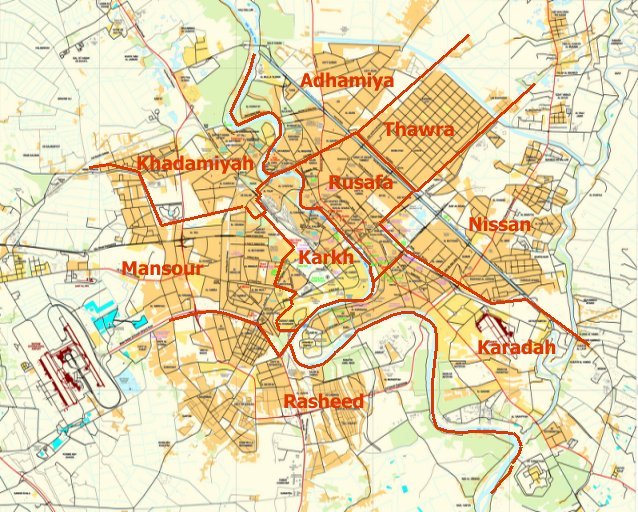
“The tour has exposed a difficult and tragic situation in the whole process, starting with detention and ending with the horrific conditions of the prison,” a statement by Hashemi’s office said. The prison is in the neighborhood of Kadhimiya and is believed to hold mainly Sunni Muslim women. Many of the prisoners, the statement said, were detained because their husbands or sons were suspected of having links to forces resisting U.S. occupation.
“This means if anything that the women are taken hostages to exert pressure on their husbands who are wanted by the authorities,” the statement said. There were teenage women among the prisoners some of whom had spent several years behind bars, the statement added.
One women prisoner, Suaad Aziz, had told Hashemi that she was arrested while looking for her son who had disappeared for more than one year. “I was a principal of a school in the Amiriya district of Baghdad. They have sentenced me to death and no one has ever asked me a single question why I was here,” the statement reported Aziz as saying.
Thousands of Iraqis languish in scores of prisons in Iraq. U.S. troops have their own jails which they have constructed specifically to detain suspects. Iraqi authorities run their own prisons. There are more than 30,000 Iraqis in jails run by the U.S. and Iraqi government and most of them have been incarcerated merely on suspicion and held without trial.
“The tour has exposed a difficult and tragic situation in the whole process, starting with detention and ending with the horrific conditions of the prison,” a statement by Hashemi’s office said. The prison is in the neighborhood of Kadhimiya and is believed to hold mainly Sunni Muslim women. Many of the prisoners, the statement said, were detained because their husbands or sons were suspected of having links to forces resisting U.S. occupation.
“This means if anything that the women are taken hostages to exert pressure on their husbands who are wanted by the authorities,” the statement said. There were teenage women among the prisoners some of whom had spent several years behind bars, the statement added.
One women prisoner, Suaad Aziz, had told Hashemi that she was arrested while looking for her son who had disappeared for more than one year. “I was a principal of a school in the Amiriya district of Baghdad. They have sentenced me to death and no one has ever asked me a single question why I was here,” the statement reported Aziz as saying.
Thousands of Iraqis languish in scores of prisons in Iraq. U.S. troops have their own jails which they have constructed specifically to detain suspects. Iraqi authorities run their own prisons. There are more than 30,000 Iraqis in jails run by the U.S. and Iraqi government and most of them have been incarcerated merely on suspicion and held without trial.
Labels: Kadhimiya, prisons, Tareq al-Hashemi, women


Friday, June 22, 2007
Prisons raided by militias and prisoners executed
Security
(Dar Al Salam Newspaper) - 21 JUN - Iraqi security sources have confirmed that many prisons have been raided almost every night, by militias. The militias conduct these raids with the assistance of the prisons’ guards. Later, the militias execute the prisoners, and then, dump the bodies in city streets and squares.
The sources added that the majority of these “executed prisoners” are from prisons in Rasafa, which are controlled by militias and the government. The sources pointed out that Rasafa’s “Prison Number Six” is the worst and it experiences many “randomized” execution operations. The prisoners in this prison (Rasafa #6) have announced a hunger strike, they would rather die of hunger in their jail cells than be killed by militias.
The sources added that Rasafa “Prison Number Six” consists of 14 “halls” (large cells), which contain hundreds of prisoners in each of the “halls”. The prisoners have not been taken to court; and, some prisoners have been kidnapped and killed by MOI Commandos and militias. Rasafa’s “Prison Number Six” is one of 10 prisons in the Rasafa area, this includes such places as the: Jadriya, Qanat, and Tasfirat prisons which all belong to the MOI.
These prisons include “thousands and thousands of Iraqi prisoners” who are not allowed to see their families. The sources also confirmed that “arresting and releasing operations” are not being conducted in accordance with judicial orders; rather, they are being conducted in accordance with deals (between the) militias and police. Militias help some of the worst criminals to escape from the prisons without the government’s knowledge. And (somehow), the people who dump the bodies in the streets are usually able to move about during curfew hours.
The sources added that the majority of these “executed prisoners” are from prisons in Rasafa, which are controlled by militias and the government. The sources pointed out that Rasafa’s “Prison Number Six” is the worst and it experiences many “randomized” execution operations. The prisoners in this prison (Rasafa #6) have announced a hunger strike, they would rather die of hunger in their jail cells than be killed by militias.
The sources added that Rasafa “Prison Number Six” consists of 14 “halls” (large cells), which contain hundreds of prisoners in each of the “halls”. The prisoners have not been taken to court; and, some prisoners have been kidnapped and killed by MOI Commandos and militias. Rasafa’s “Prison Number Six” is one of 10 prisons in the Rasafa area, this includes such places as the: Jadriya, Qanat, and Tasfirat prisons which all belong to the MOI.
These prisons include “thousands and thousands of Iraqi prisoners” who are not allowed to see their families. The sources also confirmed that “arresting and releasing operations” are not being conducted in accordance with judicial orders; rather, they are being conducted in accordance with deals (between the) militias and police. Militias help some of the worst criminals to escape from the prisons without the government’s knowledge. And (somehow), the people who dump the bodies in the streets are usually able to move about during curfew hours.
COMMENT: Dar Al Salam is a weekly political and religious newspaper, owned by the Iraqi Islamic Party (IIP). It has been published for two years in Baghdad, with a Sunni religious affiliation. This is a moderate newspaper advocating a political approach to deal with Iraq's situation, and has a positive attitude towards the political process in Iraq. Rasafa is the eastern part of Baghdad and is now predominantly Shia. The militias referred to in the article are Shia militias. The MOI commandos have been heavily infiltrated by Shia militias. COMMENT ENDS.
Labels: Jadriya, militias, Ministry of Interior, prisons, Qanat, Rasafa #6, Tasfirat prison
Thursday, March 29, 2007
Overcrowding in Iraqi prisons worse since security operation
Humanitarian
(AP) - An Iraqi monitoring group said Wednesday that detention centers have become severely overcrowded since a security crackdown began six weeks ago in Baghdad and most of the inmates were being held without evidence. Maan Zeki Khadum, the deputy head of the governmental legal oversight group, said one facility on the western edge of Baghdad held 272 inmates although it was designed for 75, while another lockup south of the capital, with room for 75, reportedly held nearly 800 prisoners.
He said his team of 17 lawyers visited the detention center at the Iraqi-run Muthanna Air Base on the western outskirts of Baghdad on March 13 and found the prisoners in poor conditions, with five people crammed into a cell built for one.
He said his team of 17 lawyers visited the detention center at the Iraqi-run Muthanna Air Base on the western outskirts of Baghdad on March 13 and found the prisoners in poor conditions, with five people crammed into a cell built for one.
Khadum's group reports to Shiite politician Ahmed Chalabi, head of a committee responsible for building public support for the neighborhood-by-neighborhood sweep to end sectarian violence in Baghdad. Brig. Gen. Qassim al-Moussawi, a spokesman for the security plan, could not immediately be reached for comment. But an Interior Ministry spokesman denied there was overcrowding and said the prison conditions had met human rights requirements.
The lawyers also visited a detention center in a predominantly Shiite neighborhood in northern Baghdad, which he said had more than 1,000 inmates and was in even worse condition than the facility at the air base. He also said the team had reports that nearly 800 prisoners were being housed in a detention center with a capacity for 75 in the Sunni city of Mahmoudiyah, south of Baghdad, although the lawyers had not yet visited that facility, which is in a volatile area that suffers frequent insurgent attacks.
Labels: Ahmed Chalabi, Maan Zeki Khadum, Muthanna Air Base, prisons
Sunday, March 18, 2007
Iraqi prison population soars, expected to rise
Security
(Azzaman) The population of prisons in Iraq has soared in recent months with tens of thousands of Iraqis currently in U.S. custody without trial. U.S. troops and Iraqi government are investing heavily in the construction of prisons in the country with more than 100,000 Iraqis currently behind bars. A parliamentary investigation commission has found that U.S. troops alone now detain more than 61,000 Iraqis and the figure is expected to swell as the Americans press ahead with their military operations.
More than 50,000 Iraqis were reported to have been arrested in the past four weeks as part of the joint U.S.-Iraqi military campaign to subdue Baghdad. U.S. troops detain Iraqis merely on suspicion. Once detained, Iraqis may stay indefinitely as they are denied access to lawyers and Iraqi courts and government have no right to question U.S. troops’ actions.
Even Iraqi troops operations and activities now fall beyond the Iraqi judicial system as the country has been placed under emergency rule under which the courts have no power to question what the security forces do. Many of the detainees are subjected to torture by military interrogators who use all means to extract confessions.
The detainees are denied visits by family members or relatives and they usually have no means to get in touch with them until they are released. Many Iraqi families continue a hopeless search for relatives detained by U.S. troops. The search starts with hospital morgues and government-run prisons. U.S. prisons are off bounds. U.S. troops do not inform relatives of the Iraqis they capture.
More than 50,000 Iraqis were reported to have been arrested in the past four weeks as part of the joint U.S.-Iraqi military campaign to subdue Baghdad. U.S. troops detain Iraqis merely on suspicion. Once detained, Iraqis may stay indefinitely as they are denied access to lawyers and Iraqi courts and government have no right to question U.S. troops’ actions.
Even Iraqi troops operations and activities now fall beyond the Iraqi judicial system as the country has been placed under emergency rule under which the courts have no power to question what the security forces do. Many of the detainees are subjected to torture by military interrogators who use all means to extract confessions.
The detainees are denied visits by family members or relatives and they usually have no means to get in touch with them until they are released. Many Iraqi families continue a hopeless search for relatives detained by U.S. troops. The search starts with hospital morgues and government-run prisons. U.S. prisons are off bounds. U.S. troops do not inform relatives of the Iraqis they capture.
Labels: Operation Fardh al-Qanoon, prisons
Friday, March 02, 2007
Justice Ministry official - Interior Ministry no longer runs prisons
Security
(Azzaman)
There are more than 9,000 detainees in prisons administered by the Iraqi government, according to a senior Justice Ministry official. Bosho Ibrahim, the ministry’s undersecretary, said all the prisoners were detained in the light of arrest warrants issued by Iraqi courts. “There are 9,169 prisoners in jails run by the ministry. Of these, 6,175 have been sentenced for committing different crimes.“We do not detain anyone without an arrest warrant or following a court sentence,” Ibrahim said.
He said the prisons which were previously administered by the Interior Ministry have been turned over to the Justice Ministry. The Interior Ministry had its own prisons where some of the worst reported human rights violations in Iraq took place. But a source, refusing to be named, said the Interior Ministry no longer had prisons of its own.
“The task of the organs of the Interior Ministry is confined to the implementation of court orders and transferring convicted persons to the prisons related to the Justice Ministry,” the source said. Ibrahim of the Justice Ministry said U.S. forces notify the ministry at the end of every month of the number of Iraqis languishing in their jails.
U.S. forces administer their own jails and the Iraqi government has no authority over the prisoners held in them. “The prisons under U.S. Jurisdiction are run by the Americans themselves,” Ibrahim said. Ibrahim declined to say how many Iraqi prisoners were held by the U.S. However, sources said the U.S. was holding without trial more than 13,000 Iraqi prisoners. The Justice Ministry runs 19 prisons in Iraq.
There are more than 9,000 detainees in prisons administered by the Iraqi government, according to a senior Justice Ministry official. Bosho Ibrahim, the ministry’s undersecretary, said all the prisoners were detained in the light of arrest warrants issued by Iraqi courts. “There are 9,169 prisoners in jails run by the ministry. Of these, 6,175 have been sentenced for committing different crimes.“We do not detain anyone without an arrest warrant or following a court sentence,” Ibrahim said.
He said the prisons which were previously administered by the Interior Ministry have been turned over to the Justice Ministry. The Interior Ministry had its own prisons where some of the worst reported human rights violations in Iraq took place. But a source, refusing to be named, said the Interior Ministry no longer had prisons of its own.
“The task of the organs of the Interior Ministry is confined to the implementation of court orders and transferring convicted persons to the prisons related to the Justice Ministry,” the source said. Ibrahim of the Justice Ministry said U.S. forces notify the ministry at the end of every month of the number of Iraqis languishing in their jails.
U.S. forces administer their own jails and the Iraqi government has no authority over the prisoners held in them. “The prisons under U.S. Jurisdiction are run by the Americans themselves,” Ibrahim said. Ibrahim declined to say how many Iraqi prisoners were held by the U.S. However, sources said the U.S. was holding without trial more than 13,000 Iraqi prisoners. The Justice Ministry runs 19 prisons in Iraq.
Labels: Bosho Ibrahim, Justice Ministry, Ministry of Interior, prisons