Wednesday, October 17, 2007
PKK leader says the group will defend itself from Turkey
"If Turkey is going to use violence against our movement, our leader and our people, then we will respond," Karayilan said on Tuesday. Iraq's government said on Wednesday that it will send a delegation to Turkey to show that it is committed to stopping PKK fighters operating in Iraq. Karayilan said Turkey was using the threat of military action against the PKK to put pressure on Iraqi Kurdistan. Ankara has been angered by a series of recent attacks by the PKK inside Turkey in which dozens of soldiers and civilians have been killed. He was speaking from his camp in the Qandil mountains straddling the Iraq-Turkey border.
On Tuesday, Tareq al-Hashemi, Iraq's deputy president, arrived in Ankara for talks with Turkish leaders. Al-Hashemi appealed to Turkey for more time to tackle Kurdish separatist fighters rebels based in northern Iraq, Anatolia news agency reported on Wednesday. "Give us time to join forces with Turkey to tackle this problem, which harms the national security of both countries," Anatolia quoted Hashemi as saying. "If the Iraqi government fails to meet its responsibilities, Turkey will be justified in doing what is necessary to protect its security interests."
James Bays, Al Jazeera's correspondent in Baghdad, said that whatever Baghdad says, the final decision rests with Kurdish political leaders as the embattled central Iraqi government has little authority in the Kurdish north of the country.
The PKK leader in Iraq said Turkey was also hoping to put pressure on the US after a congressional panel said last week that mass killing of Armenians by Ottoman Turks during World War I was genocide - a charge Turkey denies. Turkey blames the PKK for the deaths of more than 30,000 people since the group launched its armed struggle for an ethnic homeland in southeast Turkey in 1984.
Labels: Murat Karayilan, PKK, Qandil mountains, Tareq al-Hashemi, Turkey


Wednesday, October 10, 2007
Iraqi women languish in jail without trial
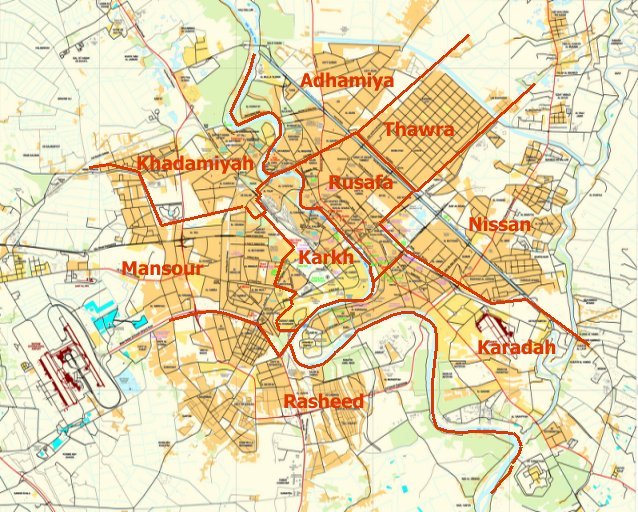
“The tour has exposed a difficult and tragic situation in the whole process, starting with detention and ending with the horrific conditions of the prison,” a statement by Hashemi’s office said. The prison is in the neighborhood of Kadhimiya and is believed to hold mainly Sunni Muslim women. Many of the prisoners, the statement said, were detained because their husbands or sons were suspected of having links to forces resisting U.S. occupation.
“This means if anything that the women are taken hostages to exert pressure on their husbands who are wanted by the authorities,” the statement said. There were teenage women among the prisoners some of whom had spent several years behind bars, the statement added.
One women prisoner, Suaad Aziz, had told Hashemi that she was arrested while looking for her son who had disappeared for more than one year. “I was a principal of a school in the Amiriya district of Baghdad. They have sentenced me to death and no one has ever asked me a single question why I was here,” the statement reported Aziz as saying.
Thousands of Iraqis languish in scores of prisons in Iraq. U.S. troops have their own jails which they have constructed specifically to detain suspects. Iraqi authorities run their own prisons. There are more than 30,000 Iraqis in jails run by the U.S. and Iraqi government and most of them have been incarcerated merely on suspicion and held without trial.
Labels: Kadhimiya, prisons, Tareq al-Hashemi, women
Thursday, September 13, 2007
U.S. military releases detainees in deal with vice-president
On Thursday, Omar al-Jubouri, an adviser on human rights to al-Hashemi, said 43 Iraqis were freed from the Camp Cropper detention facility near Baghdad's international airport. Ramadan in Iraq began on Thursday for the Sunni population while the Shias will commence their daily fasting on Friday. "Task Force 134, the (US-led) organisation responsible for detainee operations, expects to release between 50 and 80 detainees per day during this holy month," a US military statement said.
Major-General Douglas Stone, commander of Task Force 134, said in the statement: "The detainees being released are only those who (US-led forces) have determined no longer need to be detained for imperative reasons of security." Around 20,000 detainees are held in US-run prisons in Iraq, mostly in Camp Bucca near the southern port city of Basra and in Camp Cropper near Baghdad. Al-Hashemi has long complained about the detention of Sunni Arabs.
The issue was a key factor that prompted the main Sunni bloc, the Accordance Front, to quit the government last month. The deal with the US military is separate from an accord that al-Hashemi signed with Iraq's top Shia and Kurdish leaders in August, which also called for the release of many detainees. Al-Jubouri said there had been no movement yet on freeing prisoners under that agreement. Some 32,000 detainees were being held in Iraqi detention facilities and prisons, he said.
Those eligible for release under Operation Lion's Paw, a joint venture between the Iraqi government and US-led forces, will be reviewed by an impartial board, Stone said. His statement said: "The process will be fair, open to all detainees who are qualified and will reflect the detainee population, with Sunni and Shia detainees reviewed equally and impartially. "This will be a completely non-sectarian, non-political process" that will allow prisoners to be home for Ramadan.
Labels: Accord Front, Camp Bucca, Camp Cropper, detainees, Major-General Douglas Stone, Operation Lion's Paw, Ramadan, Tareq al-Hashemi, U.S. military
Monday, August 13, 2007
Mailki calls emergency political summit
Seventeen ministerial posts in Maliki's government are empty or filled by members boycotting cabinet meetings amid protests by many parties at Maliki's faltering programme of national reconciliation. Hopes that his so-called unity coalition can be saved now depend on the senior leadership of the rival parties cutting a new power-sharing deal that can convince the bitter Sunni minority to return to the fold. Maliki, President Jalal Talabani, a Kurd, and Vice President Adel Abdel Mehdi, another Shiite, are expected to attend the crisis summit.
Vice President Tareq al-Hashemi, the senior Sunni Arab in the government and a critic of Maliki's alleged sectarian bias whose presence would be considered crucial, has not yet made it clear whether he will attend. Talabani's office also said Sunday that contacts with political blocs would take place in the next few days, without giving any details, following his talks in Baghdad with Massud Barzani, the president of Iraqi Kurdistan.
Since the US-led invasion of March 2003, Iraq has plunged into an abyss of overlapping civil conflicts that have divided its rival religious and ethnic communities, and left tens of thousands of civilians dead. Washington has warned Iraq's leaders to work harder on unity, concerned that the political stalemate could torpedo efforts to reconcile the warring factions and undermine the work of 155,000 American troops to end the conflict.
Shiite parties are suspicious of Sunni leaders whose minority sect dominated political power under executed former dictator Saddam Hussein and accuse them of supporting violent insurgent groups. Sunni leaders accuse the Shiite parties of ties with powerful neighbour Iran and condemn their alleged complicity with Shiite militias.
Labels: Adel Abdel Mahdi, emergency political summit, Jalal Talabani, Massoud Barzani, Nouri Al-Maliki, Tareq al-Hashemi
Monday, July 23, 2007
Iraq's top five political leaders to hold a summit
The summit will bring together President Jalal Talabani, a Kurd, Shi’ite Prime Minister Nuri al-Maliki and Sunni Vice President Tareq al-Hashemi. It will also involve Masoud Barzani, president of Iraq’s semi-autonomous Kurdistan region and a top aide of powerful Shi’ite leader Abdul Aziz al-Hakim. The government official said the summit may also be extended to include other key figures such as former interim prime minister Iyad Allawi.
The leaders are expected to discuss various issues, including how to agree on amending the constitution. The identity of the disputed oil-rich northern city of Kirkuk could also be on the agenda, officials said. Kurds want Kirkuk included in their autonomous Kurdistan region as its capital and want to press ahead with a referendum by the end of the year, but other ethnic groups object. Iraq’s constitution stipulates a Kirkuk referendum by year’s end.
Maliki’s government is under mounting pressure to meet benchmarks set by Washington to end sectarian violence and push for economic and political reforms. But political wrangling among its factions has left it weak and shaky. Sunni Arab ministers in the government have stopped attending cabinet meetings, while Shi’ite ministers loyal to fiery cleric Moqtada al-Sadr have left the government.
Behind the scenes there has been talk about reshuffling the government, but some people think this would push Iraq to the brink of collapse because various factions would then argue to scratch issues that had already been agreed on. Washington has been pushing Iraq to speed passage of several laws aimed at curbing sectarian violence and healing deep divisions between majority Shi’ites and minority Sunni Arabs.
Only one draft, which concerns Iraq’s huge oil reserves, has been submitted, but the full legislature has yet to debate it. The draft oil law aims to ease tension by ensuring Sunnis share in oil profits. Iraq has the world’s third largest oil reserves, but most is in the Kurdish north or Shi’ite south. Other laws that set provincial elections by the year-end and allow some members of Saddam Hussein’s Baath party to return to government and the military also need to be passed.
But the Iraqi government is running out of time ahead of a report due in Washington by Sept. 15 on Iraq’s security and political progress. The report, by U.S. ambassador Ryan Crocker and military leader General David Petraeus, is being viewed as a political watershed. Lack of action on those benchmark laws is sure to heighten calls from opposition Democrats in Congress and also some Republicans for an American troop pullout from Iraq.
Labels: Abdul Aziz Al Hakim, Iyad Allawi, Jalal Talabani, Kirkuk, Massoud Barzani, meeting, Nouri Al-Maliki, Tareq al-Hashemi
Tuesday, July 03, 2007
Hashemi hints at more drastic steps to be taken by the Accordance Front
"We haven't achieved anything after a year of participating in the government. We are depressed and sidelined, especially in terms of decision-making," said Hashemi, one of two vice presidents in Iraq. The other is Shi'ite. Asked what the Accordance Front would do next, Hashemi said: "I will not talk about this matter because the time for talking has ended. I will let our actions do the talking for us," he said.
"We started by suspending our participation in cabinet and if there is no real response from our partners in this government over our suggestions and reservations, we as the Accordance Front will take (other) measures." His words underscored deep frustration at a political process that has failed to reconcile majority Shi'ites with minority Sunni Arabs. Besides holding six cabinet posts in the 35-member administration, the Accordance Front has 44 seats in the 275-member parliament.
It does not have the numbers to bring down the government, but its absence from cabinet and parliament makes it increasingly hard for Shi'ite Prime Minister Nuri al-Maliki to portray his administration as a unity government. The Front suspended its participation in cabinet last week, mainly over legal steps being taken against the culture minister, one of its six members in the Shi'ite-led government.
That move followed a boycott of parliament a week earlier in response to the ousting of the Sunni speaker. Hashemi insisted that Mahmoud Mashhadani would return as speaker of parliament in the near future, despite a parliament vote last month that removed him following what some officials described as his "rude" behaviour to other legislators.
Hashemi did not elaborate, but added there were more important things for parliament to do than argue over who should be sitting in the speaker's chair. Maliki insists his government is working hard toward national reconciliation. He has also urged the Accordance Front to cancel its decision to boycott cabinet meetings. Hasan al-Senaid, a senior Shi'ite politician close to Maliki, accused the Sunnis over the weekend of politicising the legal steps against Culture Minister Asaad Kamal Hashemi.
The government's spokesman has said an arrest warrant had been issued for the minister over a murder investigation. The minister is in hiding, but Sunni politicians have denied he committed any wrongdoing. Police and court officials have not been able to confirm such a warrant has been issued. Vice President Hashemi also urged the United States not to withdraw American troops prematurely from Iraq.
Labels: Asaad Kamal Hashemi, Iraqi Accordance Front, Mahmoud al-Mashhadani, Tareq al-Hashemi
Monday, June 11, 2007
Al-Maliki urges military to thwart possible coup
Several political parties with representatives in the parliament are openly opposing the way Maliki has been handling issues related to security but particularly their concerns regarding national reconciliation. “Some parties which are part of the political process are involved in staging a coup against the Iraqi government,” said Sami al-Askari, a senior member of Maliki’s coalition government.
A meeting in Cairo which brought together several parties among them small Kurdish factions seems to have unnerved the government. Ayad Allawi, a former prime minister, as well as Hashemi and the leader of a Kurdish Islamic party met in Cairo with the aim of setting up a ‘secular’ government. Maliki is reported to have rushed to Iraqi Kurdistan to secure support from his traditional Kurdish allies, Jalal Talabani, the Iraqi President and Massoud Barzani, head of the Kurdish autonomous region.
These factions hope to form a united front against the current government but they still lack backing from within the mainstream Shiite parties. Invitations to attend the Cairo meeting were sent to the Shiite al-Fadhila party which holds power in the southern city of Basra and the more powerful Shiite movement of cleric Moqtada Sadr’s supporters.
Amar Wajeeh, a senior member of Hashemi’s Islamic Party, confirmed that a joint front has been established to confront Maliki. He said the front was established in Cairo when it became clear that Maliki and his coalition were thwarting attempts to form a moderate coalition. Wajeeh said the front was still waiting a response from Fadhila and has sent a letter inviting Sadr’s group to join. Wajeeh said there was no truth behind reports that the front was staging a ‘coup.’ He said the front would use democratic means and try to gather enough votes in the parliament to bring about change.
Labels: Ayad Allawi, coup, Fadhela party, Nouri Al-Maliki, Sami al-Askari, Tareq al-Hashemi
Monday, May 21, 2007
Al-Hashemi speaks out against U.S.-Iran talks
"It's not good to encourage anybody to talk on my behalf on Iraqi internal and national matters and I would have preferred that this subject be tackled by Iraqis themselves," Al Hashemi told reporters on the sidelines of the third and last day of an international conference held by the Geneva-based World Economic Forum.
"This is really damaging to Iraq's sovereignty," he said. "This is why we insisted that the Iraqis should participate in these meeting, should be aware of the agenda and should be consulted on whatever resolution and agreement to be reached." "So, we're going to keep our eyes open from A to Z on all these meetings," Al Hashemi added.
Labels: Iran, Tareq al-Hashemi, U.S.
Thursday, March 22, 2007
Al-Hashemi says Iraqi troops not ready for U.S. withdrawal
His comments come as U.S. Democratic leaders predicted that the House of Representatives would pass a war-funding bill that sets a strict timetable for withdrawing American combat troops from Iraq. Under the House Democrats' bill, U.S. combat troops would have to be out of Iraq by Sept. 1, 2008. The White House has warned that President George W. Bush would veto any bill with deadlines for withdrawal, but Democrats are anticipating that and are already eyeing other bills to which they could attach similar language, while building pressure for an end to the war. Hashemi, speaking in English, welcomed a timetable for a withdrawal of U.S. forces but said it needed to be coupled with a clear reform plan of Iraqi national forces.
Labels: Iraqi Army, Tareq al-Hashemi, troop withdrawal
Wednesday, March 21, 2007
Al-Hashemi calls for talks with insurgents
Sunni politicians have said Iraq's national security forces are deeply infiltrated by, and provide a cover for, the Shia militias. On Tuesday General Abdul Hussein al-Saffe, head of policing in Dhi Qhar province, told the BBC he could not trust a third of his officers because they were loyal to militias. The vice-president said the armed forces needed to be purged of such influence. Mr Hashemi expressed unease that the sectarian nature of the conflict was reflected in the present government in Iraq. "[It] might be that the Iraqis need to be convinced that to break up this polarisation we have to go for, first of all, election system reform and second, to go for early elections," he said.
Regarding the presence of the US-led coalition, he said many people were "annoyed" because foreign troops were "damaging the dignity of the Iraqis". However he added that the forces should stay in Iraq "until further notice". "We're expecting a timetable, conditional withdrawal," he added.
Labels: Al Qaeda, insurgents, negotiations, Shia militias, Tareq al-Hashemi
Sunday, March 11, 2007
Iraqi Islamic Party headquarters attacked
Police sources did not say whether the blast was caused by a suicide attack. However, Voices of Iraq news agency quoted Mohammad Shaker al-Ghanam, an official from the party, as saying that an unidentified body found near the blast site might 'belong to a suicide bomber who carried out the attack.' Al-Ghanam also said that the blast targeted the information office of the party headquarters. The reason for the attack was not immediately clear. The party is the only Sunni political movement with a national base. Mosul also has witnessed a rise in suspected Sunni insurgent attacks, including a reported raid on a prison last week that allowed nearly 150 prisoners to escape. Most were quickly captured.
Labels: explosion, Iraqi Islamic Party, Mohammad Shaker al-Ghanam, Mosul, Tareq al-Hashemi
Thursday, March 08, 2007
Iraq asks Syria to act as mediator with Baathists
There are about 300 senior former army officers in Syria who used to hold influential positions in the armed forces. Most of these officers were also senior members of the Baath party of former leader Saddam Hussein. They fled Iraq shortly after the fall of Baghdad to U.S. troops in 2003.
Relations between the countries are said to be improving despite U.S. allegations that Damascus was fuelling violence and insurgency in Iraq. Iraqi authorities are apparently keen to revise the debaathification measures under which former members of the Baath party lost their jobs. The sources said the government was willing to accommodate former Baathists as well as senior officers who served in the former army.
Labels: Baathists, Syria, Tareq al-Hashemi, Vice-President