Monday, October 08, 2007
Iraqi govt releases video confessions from Shiite cult after Najaf battle in January
The fierce battle in the area of Zarga, north of Najaf, left 220 militants dead, including spiritual leader Dhia al-Garrawi. Iraq said the heavily-armed group planned to assassinate top Shi'ite scholars to destabilise the country. Riyadh al-Garrawi, who was captured after the fighting, said on the video confession that his brother, Dhia, had met both Allawi and Sunni cleric Harith al-Dari outside Iraq.
Dhia al-Garrawi had proclaimed himself the Mahdi, a messiah-like figure in Islam, and had a cult following. Allawi and Dari, both of whom spend most of their time abroad, are very critical of the Iraqi government and Dari has often accused it of forcing confessions from detainees for political ends. "(Dhia) requested me to arrange an interview with Allawi and (an intermediary) arranged a meeting with Allawi in Jordan," Riyadh al-Garrawi said on the video, shown at an Interior Ministry news conference.
He said Dhia also met Sunni cleric Dari at least twice to discuss political issues, in Syria's capital Damascus and the Gulf emirate of Dubai. "He told me they debated politics and agreed they were against federalism and favoured a secular state," he said.
Usama al-Nujeyfi, a lawmaker from Allawi's bloc, called the investigation results a sham. "It's not a proper investigation, it's all politicised. Dr. Allawi is a national leader who rejects violence in all its forms," he told Reuters. Dari was not immediately available for comment on the video confession.
Labels: Dhia al-Garrawi, Harith al-Dari, Iyad Allawi, Najaf, Riyadh al-Garrawi, Shiite cult, Zarga


Thursday, September 20, 2007
INL members go independent
When asked about the reasons behind his decision, al-Hassani told the independent news agency Voices of Iraq (VOI) that divisions within the secular list over the decision-making process resulted in a complete lack of harmony between some of its members.
Al-Hassani was the former speaker of Iraq's Transitional National Assembly, the first Iraqi parliament formed after the 2005 elections. He was also a leading member in the Iraqi Islamic Party and was appointed as the minister of industry in Allawi's interim government. During the second legislative elections in 2005, al-Hassani joined the secular alliance led by Allawi, which includes many political parties of different ethnic affiliation.
Meanwhile, al-Sehil said that the list's deviation from the moderate and liberal line and its adoption of a "national Baathist line" led some of its senior members to consider reform. "We have tried to bring in reforms and rectify the path of the INL, but we unfortunately failed," al-Sehil said. After the defections of the two parliamentarians the INL now has 22 seats in the 275-member parliament.
Labels: Hachem al-Hassani, Iraqi National List, Iyad Allawi, Safiyah al-Sehil
Monday, September 10, 2007
Kurdish Coalition deny contact with Baathists
Earlier on Sunday a prominent member of former Iraqi prime minister Iyad Allawi's Iraqi National List (INL) said that the KC was making contacts with Baathists, noting Allawi "was not the only one making these contacts. Everyone is denying contacts with Baathists, but there are dialogues grouping together members of the Baath Party and more than one political bloc," Nejefi told VOI by telephone.
Rawndozi indicated that "Jalal Talabani has met armed factions that have links with the dissolved Baath Party but in his capacity as president of Iraq." On Saturday, Iyad Jamal al-Din, an INL member of parliament, said he mediated between U.S. officials and Baathists belonging to former Iraqi vice president Ezzat al-Dori to boost the political process. "They were several meetings that took place inside and outside Iraq," Jamal al-Din told VOI.
He said the meetings "were convened in Arab countries." He declined to name those Arab countries or say when those meetings were held. "The meetings or negotiations were not meant against the government of Iraqi Prime Minister Nouri al-Maliki. On the contrary, they were supporting it and would be of benefit to the country's political process," Jamal al-Din said.
He pointed out that the Baathists, or members of the former ruling Baath (Resurrection) Party, "objected the law on debaathification and the Americans spoke to them about means to push forward the political process."
Allawi had said he met secretly with representatives from the dissolved party's Ezzat al-Dori wing with the aim of arranging their return to Iraq and participation in the political process.
"The dialogue has taken place upon the request of the United States, which was represented by high-ranking officials in those meetings. The discussions focused on how to merge the Baath Party members into the political process," Allawi said in a televised interview by the all-news Dubai-based al-Arabiya satellite channel.
Labels: Baathists, Ezzat al-Dori, Friad Rawndozi, Iraqi National List, Iyad Allawi, Iyad Jamal al-Din, Kurdistan Coalition
Thursday, August 16, 2007
Allawi's party to attend summit if officially invited
“We appreciate the positions of President Talabani and Barazani and their calls for the importance of the INL’s participation in the summit because of its political and ethical weight in the Iraqi political arena,” he added. “There is a need to create an atmosphere of harmony among all politicians to solve political problems,” he also said. “The INL has to be part of these meetings to save the country from repeated crises and its demands must be studied as they are not factional national demands,” the lawmaker explained.
The parliamentary bloc ordered its five ministers last week to boycott cabinet sessions because of the government's failure to implement its program. The ministers of science and technology did not comply with he decision. Former Iraqi Prime Minister Iyad Allawi's INL has 24 seats out of the 275-seat parliament.
Labels: Iraqi National List, Iyad Allawi, Iyad Jamal el-Din
Tuesday, August 14, 2007
Iraqi List Suggests Political Commission To Run The Country
Iraqi List Parliament member, Izzat Al Shabandar, announced yesterday that there is now a project to form a political commission from the main political entities. This commission will look like a front, but this front will not take the place of the leader. It will just say to him, do not be autocratic with political decisions which are connected with the present and the future of the country. Al Shabandar also said that the Al Maliki government can not continue under these circumstances.
He added, “Al Maliki will not continue with this government; it is impossible and we do not care who takes his place as long as the next leader is chosen is a nationalist and is away from sectarianism and religion. The Communist Party, which is part of the Iraqi List, announced that it has created a project to save the country from the recent crisis. The Communist Party Central Committee Secretary and a Parliament member, Hamid Majid Moussa, confirmed that negotiations between his party and other political powers are continuing to solve the crisis.
Iraqi List leader, Ayad Allawi, has told his list’s ministers to continue with their duties, but do not attend the cabinet meetings as a first step before their withdrawal. The Sadr Movement confirmed that their movement is still in the political process. The Movement also confirmed that Ahmed Al Sharifi does not represent the Movement or the political council. Ahmed Al Massoudi (Sadr Movement) has denied what Al Sharifi announced during his press conference Saturday, that there will be changes in the Sadr Movement.
Labels: Ahmed Al Massoudi, Ahmed Al Sharifi, Hamid Majid Moussa, Iraqi Communist Party, Iraqi National List, Iyad Allawi, Izzat Al Shabandar, political commission, Sadr movement
Allawi won't attend political summit
Labels: emergency political summit, Iraqi Accordance Front, Iyad Allawi, Salim al-Juburi
Tuesday, August 07, 2007
Nearly half of maliki's cabinet has quit or is boycotting
The boycotting ministers all belong to the political bloc loyal to Iyad Allawi, the former interim prime minister. The group of mostly secular Sunnis and Shia accused al-Maliki of not responding to their demands for political reform. Wijdan Michael, Iraq's human rights minister and one of those staying away, said: "We are still in the government but we are boycotting cabinet meetings."
The withdrawal comes at a time when the prime minister is under growing pressure from frustrated US officials to make demonstrable progress in reconciling Iraq's warring factions.
Labels: Iraq, Iyad Allawi, Nouri Al-Maliki, Wijdan Michael
Monday, August 06, 2007
Allawi and Barzani to meet for political discussions
Labels: Erbil, Iraqi National List, Iyad Allawi, KRG, Massoud Barzani
Friday, August 03, 2007
Iraqi National List considers withdrawal from government
"We have reservations about the government's performance and we presented a memorandum regarding this three months ago… in which we asked to reform the political process," he said, noting that the withdrawal option is open if demands are not met. The Iraqi National List is a secular bloc and the fourth largest bloc with 25 seats out of the 275-member parliament. The parliamentary bloc has four portfolios within al-Maliki's government.
He stressed that if the bloc withdraws from the government this will be an outcome of their position, not that of the Iraqi Accordance Front. The Sunni Iraqi Accordance Front (IAF) announced on Wednesday its withdrawal from the government and the resignation of five ministers in addition to Deputy Prime Minister Salam al-Zubaie. The IAF had 44 seats in the parliament and it is the third largest bloc after the Unified Iraqi Coalition (UIC) and the Kurdistan Coalition (KC).
"The memorandum presented by the INL has 14 points, and we said that the political process had deviated from its right track and the security file was in the hands of a group belonging to certain parties," al-Negefi said. "The memorandum also included (demands concerning) the participation of some parties not included in the political process, the national reconciliation project and the detainees file," the legislator noted.
MP from the same bloc, Mayson al-Demlougi, said that their demands were ignored by al-Maliki's government, saying "we feel marginalized." She urged the premier to listen carefully to the demands of other blocs, which have reservations about the government's performance, warning of grave consequences if the current government keeps on ignoring blocs' demands.
Head of the INL, Iyad Allawi, described in a televised interview on Wednesday, after the withdrawal of the IAF, the current government as "a sectarian government," considering the withdrawal of the IAF as "a collapse of the political process," highlighting that his front is considering making a similar step.
Labels: Iraqi Accordance Front, Iraqi National List, Iyad Allawi, Osama al-Negefi
Monday, July 23, 2007
Iraq's top five political leaders to hold a summit
The summit will bring together President Jalal Talabani, a Kurd, Shi’ite Prime Minister Nuri al-Maliki and Sunni Vice President Tareq al-Hashemi. It will also involve Masoud Barzani, president of Iraq’s semi-autonomous Kurdistan region and a top aide of powerful Shi’ite leader Abdul Aziz al-Hakim. The government official said the summit may also be extended to include other key figures such as former interim prime minister Iyad Allawi.
The leaders are expected to discuss various issues, including how to agree on amending the constitution. The identity of the disputed oil-rich northern city of Kirkuk could also be on the agenda, officials said. Kurds want Kirkuk included in their autonomous Kurdistan region as its capital and want to press ahead with a referendum by the end of the year, but other ethnic groups object. Iraq’s constitution stipulates a Kirkuk referendum by year’s end.
Maliki’s government is under mounting pressure to meet benchmarks set by Washington to end sectarian violence and push for economic and political reforms. But political wrangling among its factions has left it weak and shaky. Sunni Arab ministers in the government have stopped attending cabinet meetings, while Shi’ite ministers loyal to fiery cleric Moqtada al-Sadr have left the government.
Behind the scenes there has been talk about reshuffling the government, but some people think this would push Iraq to the brink of collapse because various factions would then argue to scratch issues that had already been agreed on. Washington has been pushing Iraq to speed passage of several laws aimed at curbing sectarian violence and healing deep divisions between majority Shi’ites and minority Sunni Arabs.
Only one draft, which concerns Iraq’s huge oil reserves, has been submitted, but the full legislature has yet to debate it. The draft oil law aims to ease tension by ensuring Sunnis share in oil profits. Iraq has the world’s third largest oil reserves, but most is in the Kurdish north or Shi’ite south. Other laws that set provincial elections by the year-end and allow some members of Saddam Hussein’s Baath party to return to government and the military also need to be passed.
But the Iraqi government is running out of time ahead of a report due in Washington by Sept. 15 on Iraq’s security and political progress. The report, by U.S. ambassador Ryan Crocker and military leader General David Petraeus, is being viewed as a political watershed. Lack of action on those benchmark laws is sure to heighten calls from opposition Democrats in Congress and also some Republicans for an American troop pullout from Iraq.
Labels: Abdul Aziz Al Hakim, Iyad Allawi, Jalal Talabani, Kirkuk, Massoud Barzani, meeting, Nouri Al-Maliki, Tareq al-Hashemi
Monday, July 09, 2007
Allawi says National List considering withdawing from Maliki's government
Allawi, leader of one of the biggest groups in the parliament, said that the United Nations and its Security Council should be given a bigger role in Iraq, in coordination with the Arab League and the Organisation of Islamic Conference. Allawi said his parliamentary bloc, the Iraqi National List, was seriously considering "withdrawing from the political process" in Iraq, or at least from the Nouri Al Maliki government. FOLLOW LINK FOR FULL INTERVIEW
Labels: Iraqi National List, Iyad Allawi, U.S. troop withdrawal, UNSC
Monday, July 02, 2007
Adala Party And The Democracy Front Announce They Have Joined The National Accord Movement
Labels: Adala Party, Democracy Front, Iyad Allawi, National Accord Front
Tuesday, June 05, 2007
Kurds stress need for a non-sectarian united government
Labels: Barham Salih, Iyad Allawi, no-confidence vote, politics
Friday, June 01, 2007
Maliki meets with Dhi Qar tribal leaders
Labels: Dhi Qar, Iyad Allawi, Nouri Al-Maliki, security, tribal leaders
Allawi supporters demonstrate across Iraq
Labels: Ayham al-Samarra'i, Baghdad, Basrah, Iraqi List, Iyad Allawi, Karbala, Mahdi al-Hafiz, Mosul
Sunday, May 27, 2007
Al-Hashimi met with Allawi about forming a new party
Labels: Fadhela party, Iraqi Accord Front, Iraqi List, Iyad Allawi, Kurdish Coalition, National Dialogue Front, Salim Al Jabouri, Tariq al-Hashimi
Wednesday, May 23, 2007
Allawi Guarantees Arab And Regional Support For Coup Against Al Maliki
The meeting also discussed the formation of a new political front to face the Iraqi situation and the inclusion of the National Dialogue Front in this new front as well as the inclusion of Khalaf Al Aliyan’s political entity. Information also states that there is an understanding with some members from Fadhila Party, the Sadr Movement, the Islamic Party, as well as some Kurds, “such as Arshad Zebari, who is well known as being one of Saddam’s mules.”
The meeting was also attended by the former Deputy PM, Abid Mutlak Al Jabouri. Leaders from the Iraqi List said that the meeting and side discussions were focused on mobilizing efforts to be utilized to dissolve the current political coalitions. Political sources in Amman expressed Allawi’s lack of confidence in the seriousness of the Islamic Party to take important steps toward this new political front. They also mentioned that Allawi is unsure of the Sadr Movement’s intentions regarding this new front.
Some participants, who have good relations with some Arab countries, believe that for support to continue from the Gulf countries, they must withdraw and announce the new front. The same participants confirmed that there is security and political coordination among these countries to develop assistance for Allawi’s plan.
Some observers say that the Iraqi List’s leadership is searching for any position in the government regardless of the higher national interest for Iraq.
Other observers, who are outside the government, believe that what is developing is intended to destroy the current political infrastructure in Iraq which confirms that if the current government wants to face this coup, it must take certain steps regarding the economic, political and security situations. The current government must also minimize sectarianism. These observers add that the government should also look toward open and secret dialogue with those in and outside of Iraq.
Some Iraq List members said that this political development is related to Cheney’s failure in convincing the Arab countries to support the political process in Iraq. Regarding Fadhila Party, some sources are saying that there has been a dialogue between it and Alllawi’s list. Meanwhile, Al Adib said that Fadhila Party is reconsidering its position regarding the Shiite Alliance and it will likely return to the Alliance in the next few days.
Labels: coup, Fadhela party, Iraqi List, Iyad Allawi
Friday, May 11, 2007
Will Maliki be able to stay the course?
In Baghdad, analysts believe coming July will be crucial and decisive and decide Al Maliki and Iraq's fate. In Shiite circles there are speculations that the Shiite coalition leader Abdul Aziz Al Hakim, if Al Maliki failed in the security and reconciliation, will announce the Shiite autonomy territory in the south and middle of Iraq including nine provinces.
Mudhir Al Husaini, a Political researcher at Baghdad University, told Gulf News: "The new security plan for Baghdad, which started three months ago, is a double-edged sword. If Al Maliki succeeds in halting the decadent security situation then he will remain in his office but if he fails to do so then his position is increasingly shaky".
He added: "The Sharm Al Shaikh international covenant conference and the neighbouring countries meeting was considered as Al Maliki's last opportunity to prove his effectiveness in halting sectarian violence or he would lose the support provided by the conferees and have to leave his office".
One name that surfaces while discussing Al Maliki's successor is Eyad Allawi, Iraq's former interim prime minister who is Shiite and more secular than Al Maliki and not deeply tied to Iran. He seeks to exploit the recent prime minister's security and political failure in the light of Americans desire to form an Iraqi emergency government.
Allawi will most probably be the leading candidate for heading the next alternative government, and accordingly he is seeking to gain trust and support from political blocs like Kurds, the Sadr trend, the Fadhila party and some Sunni parties, beside moving towards obtaining vigorous backing of some regional states. Mohammad Abdul Sahib, a senior official at the Iraqi National Dialogue Ministry, told Gulf News: "We have gone to lengthy rounds in contacting Iraqi opposition armed groups which have their own conditions."
Labels: Abdul Aziz Al Hakim, Iyad Allawi, Nouri Al-Maliki, politics, Sharm el-Sheikh
Monday, April 30, 2007
Allawi to attend Sharm el-Sheikh conference
Allawi arrived in Cairo on Saturday to discuss Iraqi affairs with Egyptian officials, just as the Middle East News Agency reported that he planned to attend the May 3-4 conference. Allawi is believed to have Cairo's support, but it is unclear if the Egyptian government invited him to the conference. MENA also reported that al-Maliki will head the Iraqi delegation to the upcoming meeting, citing Saad Mohammed Ridha, the head of Iraq's diplomatic mission in Cairo.
Allawi, while Shiite through family history, rejects mixing religion and government and says Iraq can only survive through reconciliation with Sunni Muslims. He was installed as Iraq's first post-Saddam prime minister and ran the country from June 2004 until his party was routed by religious Shiite parties in the January 2005 election. Al-Maliki is said to fear rising support among U.S.-allied Egypt, Saudi Arabia and Jordan for an Iraqi national unity government led by Allawi, a favorite of Washington.
At next week's conference, Arab countries will demand that al-Maliki's government do more to reach out to disgruntled Sunni Arabs before they pledge substantial aid to the country, according to a document obtained several days ago by The Associated Press.
On the first day of the conference, officials will unveil the International Compact with Iraq, a five-year plan aimed at strengthening the role of international organizations to stabilize the country's politics and economy.
The second day's meetings will be attended by Iraq's neighbors and the five permanent members of the U.N. Security Council - the United States, Russia, China, France and Britain.
Labels: Egypt, International Compact with Iraq, Iyad Allawi, Nouri Al-Maliki, Saad Mohammed Ridha, Sharm al-Sheikh Conference
Friday, April 27, 2007
Iranian military occupy border post to explore for Iraqi oil
The border post is situated west of the southern city of Kut and Iraqi police in the city declined to comment. Meantime, Iraqi politicians and groups have pressed ahead with their harsh criticism of the current U.S.-Iraqi military operation in Baghdad and U.S. troops’ construction of ‘separation walls’ in the city.
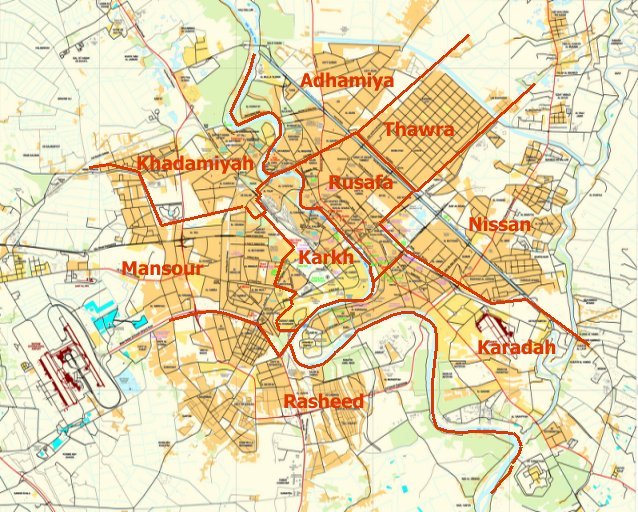
The first portion of the wall is to involve the predominantly Sunni neighborhood of Adhamiya in Baghdad. The high concrete slabs, currently encircling part of the neighborhood, are said to be erected to separate more districts. Former Iraqi Prime Minister Ayad Alawi said the policy of ‘walls and military operations’ was doomed to failure. “Such measures being implemented by U.S. and Iraqi forces are a recipe for a failed strategy. The only alternative is national reconciliation,” he said.
Labels: Adhamiyah, border post, Iran, Iraq Oil, Iyad Allawi, Kut