Friday, October 12, 2007
Major insurgent groups announce formation of political council
He said the program was based on two principles. "First, the occupation is an oppression and aggression, rejected by Islamic Sharia law and tradition. Resistance of occupation is a right guaranteed by all religions and laws," he said. "Second, the armed resistance ... is the legitimate representative of Iraq. It is the one that bears responsibility for the leadership of the people to achieve its legitimate hope."
The groups forming the council include the Islamic Army of Iraq, the Mujahideen Army, Ansar al-Sunna, the Fatiheen Army, the Islamic Front for the Iraqi Resistance (Jami) and the Islamic Movement of Hamas-Iraq. The step could be a bid by the insurgents for a more cohesive political voice at a time of considerable rearrangement among Sunni insurgent groups and Iraq's Sunni Arab minority.
Splinter factions of two insurgent groups, the 1920 Revolution Brigades and the Mujahideen Army, have cooperated with U.S. forces in fighting insurgents allied to al-Qaida in Iraq. Earlier this year, other groups - the Islamic Army of Iraq, the main faction of the Mujahideen Army, a branch of Ansar al-Sunna and the Fatiheen Army - formed a coalition called the Jihad and Reform Front opposed to al-Qaida in Iraq, though they have continued attacks on U.S. and Iraqi forces.
Labels: Ansar al-Sunna, Islamic Army of Iraq, JAMI, Jihad and Reform Front, politics, the Fatiheen Army, the Islamic Front for the Iraqi Resistance, the Islamic Movement of Hamas-Iraq, the Mujahideen Army


Thursday, September 20, 2007
Iraqi parliamentary session cancelled after majority fail to attend
Labels: Council of Representatives, Iraq, politics
Tuesday, September 11, 2007
Maliki calls for majority government instead of unity government
The premier's statements came during his word delivered before the Iraqi parliament. Al-Maliki refused to allow reporters to attend the session and allowed only to the state-run al-Iraqiya satellite television to air the parliament's session. He blamed continued objections made by some participating parties in the government for the failure of the national unity government. "The national unity government's main focus should be the constitution and the signed agreements," he affirmed.
The withdrawal of a number of political blocs: the Sunni Iraqi Accordance Front (IAF), the secular Iraqi National List (INL) and the Shiite Sadrists, from Maliki's cabinet caused a big dilemma to the entire political process. "We should establish a partnership government instead of a national unity government which does not abide by rules of the national unity," the premier also said.
Speaking about the quintuple deal singed a few weeks ago by the parties to the four-way agreement plus the Sunni Iraqi Islamic Party, he described it as a "second step on the road to effectuating the political process and refreshing state institutions' performance in different fields."
He admitted that a stagnant situation faced the political process after the withdrawal of some political blocs.
Maliki attended Monday's session upon an invitation extended by parliament last weekMaliki was supposed to hold his weekly news briefing on Monday but it was cancelled due to his scheduled appearance before parliament today.
Labels: Iraq, Nouri Al-Maliki, politics
Monday, September 10, 2007
Religious clerics become increasingly powerful
Labels: Association of Muslim Scholars of Iraq, Ayatollah Ali al-Sistani, Dr. Abdul-Salam al-Kubayssi, politics, religious clerics
Tuesday, August 28, 2007
Sunni politicians have doubts on political deal
Some key Sunni figures on Monday dismissed the agreement as a stalling tactic by al-Maliki to ease pressure from Washington. "Our position is that this meeting represents a new phase of procrastination and does not honestly aim at solving the problems quickly," Khalaf al-Ilyan, a leader of the Sunni bloc, the Iraqi Accordance Front, said. "I think that no real or practical solution will come out of this."
Another Front leader, Adnan al-Dulaimi, said the accord included "good decisions that would serve the whole Iraqi people". "But we doubt that they will be implemented," he said. "All our experience with al-Maliki indicates that this is another new set of delaying measures. They give you a glimmer of hope, but at the end of the day you get nothing but promises."
Ryan Crocker, the US ambassador to Iraq, has expressed frustration over the lack of movement towards political reconciliation among the Shia, Sunni and Kurdish factions, but called Sunday's accord an "important step forward for political progress, national reconciliation and development". He attended Sunday's meeting with al-Maliki along with Adil Abdul-Mahdi, the Shia vice-president, Tariq al-Hashemi, the Sunni Arab vice-president, Massoud Barzani the head of the northern autonomous Kurdish region and President Jalal Talabani, who is also a Kurd.
But the deal did not convince the main Sunni Arab political bloc to take back the government posts they abandoned this month over differences with al-Maliki, a Shia. The Sunni walkout has paralysed the government ahead of a crucial report to the US congress by Crocker and General David Petraeus, the US commander in Iraq. In a step towards implementing the deal, US and Iraqi officials announced on Monday that US-led forces would increase the number of detainees released during the Islamic fasting month of Ramadan, which begins in September. They did not say how many would be freed.
Labels: Adnan al-Dulaimi, Iraqi Accordance Front, Khalaf al-Ilyan, Nouri Al-Maliki, politics
Wednesday, August 15, 2007
U.S. - "major" political changes to follow political summit
About 50 political leaders had "a friendly meeting" over lunch yesterday at the Baghdad residence of President Jalal Talabani, but the meeting was overshadowed by a suicide attack which killed 10 people in the Iraqi capital. Also, a key player and one of the most senior Sunni Arabs in the government, Vice-President Tariq Al Hashemi, failed to attend Talabani's luncheon. Al Hashemi, a critic of Al Maliki's alleged sectarian bias, said members of his Iraqi Islamic Party, part of the Sunni political bloc that quit the government, would hold meetings with leaders from regional Kurdish parties today before the summit, which will be held later this week.
The summit had been in question until a last-minute push from US Ambassador Ryan Crocker who called on Al Hashemi. Sunni leaders and some Arab countries have reportedly accused Al Maliki of sectarian bias and harbouring close ties with Iran.
Labels: emergency political summit, Iraq, Jalal Talabani, Nouri Al-Maliki, politics, Ryan Crocker, Tariq Al Hashemi
Friday, July 27, 2007
Iraqi leaders meet today in effort to end political crisis
The meeting comes a day after a car bomb attack in central Baghdad killed 25 people and wounded 115. Meanwhile, clashes broke out early today between U.S. forces and militiamen of al-Sadr's Imam Al-Mahdi Army in the city of Karbala, south of Baghdad. At least three militiamen have been killed in the fighting.
Labels: Baghdad, car bomb, Jalal Talabani, Karbala, Mahdi Army, Nouri Al-Maliki, politics, Tariq al-Hashimi
Wednesday, July 25, 2007
Top Leaders Will Meet To Discuss How They Will End Iraq’s Crisis
A government official said: this high-level conference will witness many meetings, this conference may begin on Friday. It is expected that the leaders will discuss many issues, such as how to reach agreements about amending the Constitution and how to resolve the Kirkuk issue.
Kirkuk is located in northern Iraq; and, therefore the Kurds want it to become part of the Kurdistan region. However, since it is also one of Iraq’s most “oil rich” areas this issue is strongly disputed by all the other Iraqi groups.
Labels: Article 140, Iraqi constitution, Jalal Talabani, Kirkuk, Massoud Barzani, Nouri Al-Maliki, politics, Tariq Al Hashemi
Friday, June 29, 2007
U.S. General - political conflict will undermine Iraqi security
Other external political disputes are also affecting the deteriorating situation in Iraq, he indicated. Brooks said that "terrorist operations" targeting the Multi-National Forces (MNF) in Iraq have recently been on the rise compared to attacks against Iraqi security forces, which he said aim to undermine U.S. policy in Iraq and rally international public opinion behind troop withdrawal plans.
"The law-imposing plan is continuing. Iraqi and U.S. forces have managed to purge 35% of Baghdad neighborhoods of terrorist groups," Brig. Gen. Brooks said. U.S. and Iraqi forces have imposed a security crackdown on the Iraqi capital since mid-February 2007 as part of a plan to put an end to violence and curb militia groups.
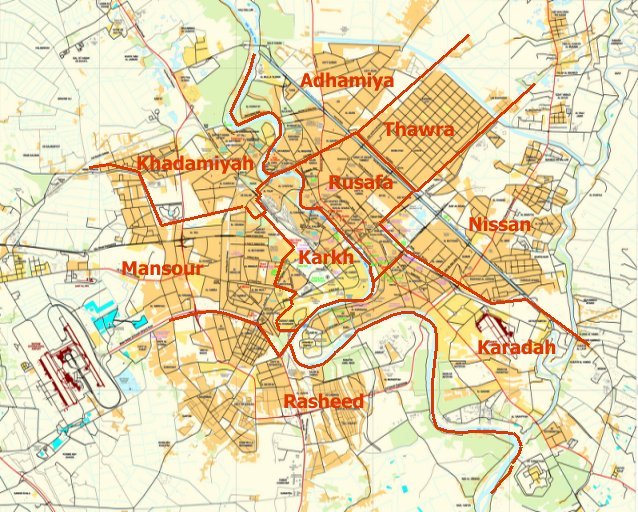
According to Brooks, joint U.S.-Iraqi forces are currently controlling 40% of Baghdad's areas, including al-Ghazaliya neighborhood, al-Khadraa district in Karkh and al-Shab neighborhood in Baghdad's eastern side of Rasafa. Brooks did not provide a timetable for obtaining full control of Baghdad.
"The law-imposing security plan in Baghdad has seen dazzling success that citizens have not noticed because of the violent operations that target them," Brooks explained, adding that U.S. forces will continue erecting concrete barriers around some of Baghdad's neighborhoods and markets to block car bombs from reaching their targets.
Labels: Brigadier General Vincent Brooks, politics, security
Thursday, June 07, 2007
Iraq agrees to majority of militias' demands
The report said that the militias had “expressed their opposition towards Al Qaeda terrorist network’s actions and its ideology, which doesn’t conform with the Iraqis’ culture.” The demands of the militias presented during the talks, the report says, were “positive and attainable” and that “80 per cent of these requests will be met.”
Some militias, according to Al Sabah, needed to feel “a sense of security with regard to their political participation and how their members will be dealt with after they will have been disarmed.”
Labels: Al Qaeda, militias, politics
Tuesday, June 05, 2007
Kurds stress need for a non-sectarian united government
Labels: Barham Salih, Iyad Allawi, no-confidence vote, politics
Friday, June 01, 2007
U.S. Commander believes 80 per cent of enemy combatants are reconcilable
Odierno, the No. 2 U.S. commander in Iraq, told Pentagon reporters by video conference that he is pressing his military officers to reach out to the tribes, to some small insurgent groups and to religious and political leaders to push them to stop the violence.
"We are talking about cease-fires, and maybe signing some things that say they won't conduct operations against the government of Iraq or against coalition forces," Odierno said from Camp Victory in Baghdad. "We believe a large majority of groups within Iraq are reconcilable and are now interested in engaging with us. But more importantly, they want to engage and become a part of the government of Iraq."
Stemming the violence in and around the capital city is key to giving the Iraqi government time to stabilize and move toward reconciliation with the warring sectarian factions. That would then allow the U.S. to begin withdrawing troops.
Odierno said he believes that about 80 percent of the enemy fighters, including key Sunni insurgent groups and Shiite militia, could be brought into the political process. The remainder, he said, are largely al-Qaida operatives who will have to captured or killed.
He cautioned that the process will be slow. And he repeatedly warned that he may need more time to determine if the military buildup ordered by President Bush earlier this year has begun to work.
Labels: cease-fire, Iraqi militants, Lt. Gen. Ray Odierno, politics, security
Tuesday, May 29, 2007
Defected health minister said to have passed information on Sadrists to U.S.
Speaking on condition of anonymity, they said Sadr’s sudden emergence and his meetings have been prompted by the defection of one of his most senior aides, former Health Minister Ali al-Shammari. Shammari, who had resigned his post on Sadr’s orders for his movement to leave the government, has sought asylum in the U.S. which Sadr sees as an enemy.
The sources said Shammari was close to Sadr and had insider information of the movement’s influence, spread and organization. The movement fears that Shammari might have passed to the U.S. confidential information on how the movement procures arms and training and the links it has with Iran.
Since Shammari’s defection, U.S. generals in Iraq have been producing what they described as ‘evidence’ of Iran’s involvement in arming Iraqi insurgent groups and militia factions. Shammari is also reported to have passed lists of the movement’s military leaders, their whereabouts and functions.
Shammari was moved to the U.S. from Baghdad by a special military plane. His defection is seen is a blow to Sadr. But one the movement says Shammari was not that senior and influential. According to Ali Sharifi, one of the movement’s most senior officials, Shammari was not part of the top leadership. “The information regarding the influence of Shammari is exaggerated,” Sharifi said.
Labels: asylum, Health Minister Ali al-Shammari, Iran, Moqtada Al-Sadr, politics, U.S.
Sunday, May 27, 2007
Al-Sadr and aides discuss new direction for their movement
"The Sadr movement is going to appear in a new form and with a new style on the Iraqi scene," said the movement's spokesman Sheikh Salah al-Obeidi. "We intend to establish a mechanism to escape from the routines that we used to work with and that were imposed on us by the circumstances in the country," he said, without elaborating.
The most public face of Sadr's movement in the four years since the US-led invasion has been his Mahdi Army, Iraq's biggest militia, which has been accused of carrying out sectarian attacks against Sunnis. The Mahdi Army continues to clash with British and US forces, and is locked in several local turf wars with rival Shiite factions, but sectarian death squad killings in Baghdad have diminished in recent months.
"Now that he's back from four months in Iran, we hope he'll play a useful and positive role in the development of Iraq," White House national security spokesman Gordon Johndroe said Friday, after Sadr's reappearance. Sadr supporters have recently held out their hands to Sunni tribal leaders in a gesture of reconciliation and have been urging the government to reform Iraq's rickety public services.
But whatever direction his reforms take him in, Sadr remains a staunch opponent of the US presence in Iraq. "There is no other solution for our problems than the withdrawal of the occupier from our country," Obeidi said.
Labels: Gordon Johndroe, Mahdi Army, Moqtada Al-Sadr, politics, Sheikh Salah al-Obeidi
Iraqi politicians, U.S. optimistic on al-Sadr's return
"The return of Moqtada al-Sadr is necessary at this juncture... because his ability to give orders to his followers in person will calm the political and security situation," said Shiite member of parliament Abbas al-Bayati. Sunni politician Ayad al-Sammaraie echoed that view. "His existence inside Iraq will help keep his supporters following this policy," he said. "We welcome his call for national reconciliation. This is what we have been calling for from the beginning."
Sadr created and leads the Mahdi Army, a loosely organised militia of tens of thousands of fighters across central and southern Iraq that has fought US forces twice and constantly spars with rival Shiite militias in the south. It has also been widely implicated in the wave of sectarian killing that has swept the country since the destruction of a revered Shiite shrine in February 2006, but Sadr has blamed the killings on armed groups outside of his control.
In his comeback address on Friday, the cleric appealed to Sunnis and Shiites to unite in the face of the US-led military presence which has become widely unpopolar in both communities. "I say to our Sunni brothers in Iraq that we are brothers and the occupier shall not divide us. They are welcome and we are ready to cooperate with them in all fields. This is my hand I stretch towards them," he said.
His comments drew praise from Miriam al-Rayyis, an advisor to Prime Minister Nuri al-Maliki, who said MPs should follow his example. "He supported unity in his speech on Friday and he didn't defend a certain side. We wish all our political leaders would talk like this," she said.
Sadr once supported the prime minister, but has since pulled out of the government as its reputation has suffered from continual infighting and its inability to address the violence plaguing the country. In December, a US military report identified the Mahdi Army and other Shiite militias it accused of sectarian cleansing as the biggest threat to Iraq's stability.
With the launch of a joint US-Iraqi security crackdown in the capital four months ago, the Mahdi Army decided to lie low. Washington says Sadr went to Iran, although his supporters insist he never left Iraq.
As a result, the US military has now returned to describing Al-Qaeda in Iraq as the number one threat and has been cautiously optimistic about Sadr's own role. "Now that he's back from four months in Iran, we hope he'll play a useful and positive role in the development of Iraq," said White House national security spokesman Gordon Johndroe.
Labels: Abbas al-Bayati, Ayad al-Sammaraie, Gordon Johndroe, Miriam al-Rayyis, Moqtada Al-Sadr, national reconciliation, politics
Friday, May 25, 2007
Al-Sadr re-appears in public
Al-Sadr had gone into hiding in Iran four months ago at the start of the Baghdad security crackdown, but U.S. military officials said early Friday that he had returned to the holy city of Najaf, where he has a house. Residents in Najaf said they saw his motorcade leaving the city and heading toward Kufa on Friday morning. The black-turbaned leader then entered the revered mosque for prayers.
The 33-year-old leader, who has had an antagonistic relationship with the United States, is believed to be honing plans to consolidate political gains and foster ties with Iran. His Mahdi Army fought U.S. troops to a virtual standstill in 2004, but he ordered his militants off the streets when the U.S. began its security crackdown in the Baghdad area to avoid confrontation.
His associates say his strategy is based in part on a belief that Washington will soon start reducing troop strength, leaving behind a huge hole in Iraq's security and political power structure that he can fill. It was not clear why al-Sadr chose to return to Iraq now, although a major rival, Supreme Islamic Council of Iraq leader Abdul-Aziz al-Hakim was recently diagnosed with lung cancer and went to Iran for treatment.
Al-Sadr also believes that Shiite Prime Minister Nouri al-Maliki's government may soon collapse amid its failure to improve security, services and the economy, al-Sadr's aides say. A political reshuffle would give the Sadrist movement, with its 30 seats in the 275-member parliament, a good chance of becoming a major player.
Labels: Abdul Aziz Al Hakim, Iran, Kufa, Mahdi Army, Moqtada Al-Sadr, politics
Thursday, May 17, 2007
UK think tank report - Iraq almost 'failed state'
Labels: Al Qaeda, Chatham House, civil war, Dr Gareth Stansfield, Iraq violence, politics
Tuesday, May 15, 2007
Battle for Basrah
In the latest development of a turf war that has all the ingredients of a gangster movie set in 1920s Chicago, rivals of the provincial governor fell one vote short of voting him out of office last month but have pledged to keep up the standoff. Basra, Iraq's second largest city, is more or less free of the car bombs and the violence between Shi'ites and Sunni Arabs raging in central Iraq, but it has descended into a chaos of its own. Sporadic militia battles, endemic corruption and death threats now scar the once tranquil port.
"Everyone's trying to grab resources and make a quick profit without considering a long-term programme or attempting to establish a power base for the future," said Peter Harling, an analyst for the International Crisis Group who focuses on Iraq. "The interesting thing about violence in Basra is that it's not related to the two big factors of violence elsewhere: fighting the occupation and sectarian violence," he said.
Residents fear that violence could be a sign of things to come, especially as British troops disengage from the south. Britain, which has already turned over three southern provinces to Iraqi control, is poised to reduce its 7,000-strong force in Basra to about 5,500 by the beginning of June.
Basra Governor Mohammed al-Waeli, from Fadhila, wants a Basra region of its own, independent from Najaf to the north, seat of the Shi'ite political establishment but bereft of oil. "Federalism is a large factor behind the dispute," said one Fadhila official who declined to be identified. Waeli could not be reached for an interview despite several requests by Reuters.
One of Waeli's main opponents, former governor Hasan al-Rashid from SIIC's Badr Organization, said his allies had received death threats warning them against deposing Waeli. "There are several points why we are opposed to him, including Basra's worsening security and his constant absence from the provincial council," Rashid told Reuters.
Some in Basra are worried that a British withdrawal would encourage groups to use force to control the oil fields. With sabotage halting exports in northern fields, the Basra terminal is essentially Iraq's only source of income at present. Attacks by suspected militants against British forces are on the rise -- April was the deadliest month for British troops since the first month of the war -- but a spokeswoman for the British consulate in Basra played down fears of political warfare after the planned reduction in British forces.
Labels: Basra, Fadhela party, militias, Mohammed al-Waeli, Moqtada Al-Sadr, politics, SIIC, Supreme Islamic Iraqi Council, violence
Friday, May 11, 2007
Will Maliki be able to stay the course?
In Baghdad, analysts believe coming July will be crucial and decisive and decide Al Maliki and Iraq's fate. In Shiite circles there are speculations that the Shiite coalition leader Abdul Aziz Al Hakim, if Al Maliki failed in the security and reconciliation, will announce the Shiite autonomy territory in the south and middle of Iraq including nine provinces.
Mudhir Al Husaini, a Political researcher at Baghdad University, told Gulf News: "The new security plan for Baghdad, which started three months ago, is a double-edged sword. If Al Maliki succeeds in halting the decadent security situation then he will remain in his office but if he fails to do so then his position is increasingly shaky".
He added: "The Sharm Al Shaikh international covenant conference and the neighbouring countries meeting was considered as Al Maliki's last opportunity to prove his effectiveness in halting sectarian violence or he would lose the support provided by the conferees and have to leave his office".
One name that surfaces while discussing Al Maliki's successor is Eyad Allawi, Iraq's former interim prime minister who is Shiite and more secular than Al Maliki and not deeply tied to Iran. He seeks to exploit the recent prime minister's security and political failure in the light of Americans desire to form an Iraqi emergency government.
Allawi will most probably be the leading candidate for heading the next alternative government, and accordingly he is seeking to gain trust and support from political blocs like Kurds, the Sadr trend, the Fadhila party and some Sunni parties, beside moving towards obtaining vigorous backing of some regional states. Mohammad Abdul Sahib, a senior official at the Iraqi National Dialogue Ministry, told Gulf News: "We have gone to lengthy rounds in contacting Iraqi opposition armed groups which have their own conditions."
Labels: Abdul Aziz Al Hakim, Iyad Allawi, Nouri Al-Maliki, politics, Sharm el-Sheikh
Speaker adjourns session after heated argument over deteriorating security situation
According to a parliamentary committee assigned to write a report on the situation following a field visit to Karbala, residents of Diala held a sit-in in the street linking the shrines of the third Shiite Imam Hussein and his brother Abbas, calling on the government to improve the security situation in Diala.
The report submitted to the parliament revealed that during one year 11,200 people were killed, 9,500 families displaced, 8,250 women widowed, 16,500 children orphaned, 66 Shiite tombs destroyed, 350 groves set on fire and an equal number looted. The report blamed the U.S. forces for the deteriorating situation in Diala.
Legislator Shatha al-Mousawi, from the Shiite Unified Iraqi Coalition, asked the House Speaker to summon Iraqi Prime Minister Nouri al-Maliki along with interior and defense ministers to attend a special parliamentary session on the deteriorating security situation in Diala province and elsewhere in Iraq. She said the government is "weak." Diala is located in central Iraq, 57 km northeast of Baghdad, whereas Karbala, the second Shiite city after Najaf, is 110 km southwest of Baghdad.
Labels: Diala, Karbala, Mahmoud al-Mashhadani, politics, security, Shatha al-Mousawi, UIA