Tuesday, October 16, 2007
U.S., Iraqi officials debate Blackwater's expulsion from Iraq
The Iraqi investigators issued five recommendations to the government of Prime Minister Nouri Al Maliki, which has since sent them to the US Embassy as demands for action. Point No. 2 in the report says: "The Iraqi government should demand that the United States stops using the services of Blackwater in Iraq within six months and replace it with a new, more disciplined organization that would be answerable to Iraqi laws." Sami Al Askari, a top aide to Al Maliki, said that point in the Iraqi list of demands was nonnegotiable.
"I believe the government has been clear. There have been attacks on the lives of Iraqi citizens on the part of that company (Blackwater). It must be expelled. The governmenthas given six months for its expulsion and it's left to the US Embassy to determine with Blackwater when to terminate the contract. The American administration must find another company," he told AP.
In talks between American diplomats and the Al Maliki government, Al Askari said, the US side was not "insisting on Blackwater staying." He was the only Iraqi or American official who would allow use of his name, others said information they gave was too sensitive. In an interview to be broadcast Monday on PBS, television presenter Charlie Rose asked Blackwater chief Erik Prince about the issue."We'll do what we're told and, you know, make the transition as smooth as possible," Prince said.
Labels: Blackwater, Iraq, Nisoor Square, private security contractors, Sami Al Askari, security


Tuesday, September 18, 2007
Risk Advisory Group opens office in Dubai
The office will be supported by Martin Stone, head of TRAG's Middle East & North Africa practice, and Dr David Claridge, Managing Director of Janusian Security Risk Management. Gary Wood said: "Our new office has a strong, experienced team who are well-placed in an area with high business potential." "Dubai is among the fastest-growing cities in the world, with huge development in finance, construction, telecoms and tourism. Excellent communications, transportation and business infrastructure have attracted thousands of companies to a growing number of well-run free zones, with the Dubai International Financial Centre (DIFC) being the latest example.
"However, these are potentially intricate markets and Western business practices can conflict with local law, local custom and, in some instances, religion, which add new layers of complexity to the business planning process. The new office allows TRAG to offer on-the-ground service levels to existing and new clients who are increasingly basing their regional operations in Dubai," he said.
"This development continues TRAG's international expansion and we are pleased to add such a valuable region to our portfolio, at a point where businesses increasingly need our services as they are entering new, higher-risk markets."
Labels: Dr David Claridge, Dubai, Gary Wood, Janusian, Martin Stone, Risk Advisory Group, security, TRAG
Iraq incapable of protecting Shatt al-Arab
“The smugglers’ boats have more advanced weapons than we have,” he added. Jasem’s statement came in response to comments made by some Iraqi parliamentarians who warned against the increase in the smuggling of crude oil through the Shatt al-Arab. “Iraqi naval forces had dominated the Arab Gulf, but now they are incapable of protecting our coast,” he also said, highlighting the need for more advanced and faster boats to face the smugglers.
“It is about 180 km in length, and needs more soldiers and equipment to protect it,” he explained. The brigadier blamed the shortage in oil which, according to him, “hampers our moves.” The Shatt al-Arab is a river in southwest Iraq, formed by the convergence of the Euphrates and the Tigris rivers at the town of al-Qurnah in Basra, southern Iraq.
Labels: Brigadier Abdul Hakim Jasem, oil, security, Shatt al-Arab, smugglers
Iraqi government to review status of all private security firms in Iraq
Blackwater has said its guards acted in self-defence in Sunday's incident. But the Iraqi interior ministry has claimed the men fired "randomly at citizens" in a crowded square in the capital, killing innocent bystanders and a policeman. The Blackwater guards were protecting a convoy carrying officials from the US State Department at the time.
Earlier, the US Secretary of State, Condoleezza Rice, telephoned Prime Minister Nouri Maliki to express her regret over the deaths and pledge to help carry out a "fair and transparent" investigation into the incident.
BLACKWATER USA FACTS
Founded in 1997 by three former US Navy SEALs
Headquarters in North Carolina
One of at least 28 Private Security Companies in Iraq
Employs 744 US citizens, 231 third-country nationals, and 12 Iraqis to protect US state department in Iraq (May 2007)
Provided protection for former CPA head Paul Bremer
Four employees killed by mob in Falluja in March 2004
Personnel have no combat immunity under international law if they engage in hostilities
A spokesman for the US State Department told the AFP news agency that during her phone call to Mr Maliki, Ms Rice had "reiterated that the United States does everything it can to avoid such loss of life in contrast to the enemies of the Iraqi people who deliberately target civilians". The two agreed to hold any wrongdoers accountable, according to Mr Maliki's spokesman.
Thousands of often heavily armed private security guards are employed in Iraq. Although they have no combat immunity under international law if they engage in hostilities, many critics say they are accountable only to their employers. Blackwater is one of the biggest private security contractors in Iraq and is reported to have a contract worth $300m (£150m) with the State Department to protect its diplomatic staff and equipment there. The BBC's Justin Webb in Washington says Blackwater's suspension could be a potentially serious blow to the department's work in Iraq.
Labels: Blackwater, Iraq, Iraqi government, PMCs, private security firms, PSCs, security, U.S. State Department
Thursday, September 13, 2007
U.N. concerned about shelling of Kurdistan
According to the statement, Qazi called on those concerned to spare no effort to halt the shelling and to refrain from taking any action that would undermine Iraq's political and humanitarian stability. Concerned U.N. agencies contacted local authorities and sent teams to assess the situation and immediate humanitarian needs. The teams supplied hundreds of immigrant families with humanitarian assistance such as clothing, hygiene packages, medical kits and blankets, and work is still underway to provide sufficient amounts of water to the victims, Qazi added.
The Kurdistan Regional Government's (KRG) UN Coordinator, Dindar Zebari, described on Sunday the Iraqi government's stance on Iranian and Turkish shelling of cross-border regions as "weak," noting that a UN delegation will visit the region to examine the situation.
Labels: Ashraf Qazi, Dindar Zebari, Kurdistan, security, U.N.
Wednesday, September 12, 2007
Petraeus decides not to send U.S. troops to Basra
"So I think we're in a wait-and-see approach with Basra. But we have every expectation that Basra will be resolved by Iraqis," he said at a press conference here. Petraeus, who was grilled by Congress for two days about the situation in Iraq, is scheduled to depart next week for London for talks on Britain's plans in Iraq.
The 5,500-British force has been pulled into an air base outside Basra since last week's handover of its last base inside the city, and plans call for reducing that force by 500 troops in the coming weeks. The British pull-back from bases in the south has been accompanied by a rise of factional violence among Shiite militias competing for control of the oil rich region, which has Iraq's only major port on the Gulf. Petraeus said the violence has subsided over the past month because of accommodations worked out by the Iraqis.
There are "lots of challenges, don't get me wrong," he said. "There's militia infiltration... All these different parties have elements and different structures in Iraq. "But they have come to accommodations that are allowing the functioning of activities down there. And, certainly, the oil has been flowing and the ports have been moving, and all the rest of that.
Petraeus said a four star Iraqi general has been assigned to the south and the Iraqi are moving in a special operations forces battalion and elements of a mechanized battalion while swapping out some army brigades. "In many cases, in that area, the presence of those forces, again, when it comes to intra-Shia rivalries, can sometimes be enough to keep the situation one in which they're shouting rather than shooting," he said.
Labels: Basra, General David Petraeus, security, Shiite militias, U.S. troops
The security situation in Iraq through Iraqi eyes
Hassan Nassir in Al-Khadimiyah, Baghdad
The security situation in my neighborhood in northwest Baghdad is more or less stable, but there are situations when we have gunfire, mortar fire, and confrontations. It is a working-class neighborhood; the standard of living here is average. There used to be a mixture in this neighborhood of Shi'a, Sunnis, Kurds, and even Christians, but many people have left. Now it is basically Shi'ite.
About four months ago, U.S. forces began to build a small, simple base in the area. They are active during the night. After midnight, they begin patrols, or walk along the street, or they may target particular houses or individuals. The militias are also present; they call themselves "popular committees" but we can call them militias. They don't appear constantly; they are in contact with each another and withdraw when the Americans move in, but they are here.
My neighborhood, Al-Jamil, close to Al-Sadr City, is primarily Shi'ite, but there are a number of Sunni and Christian homes, because the neighborhood residents have prevented their expulsion. It's a neighborhood with an above-average standard of living. U.S. forces have taken over a site to use as a camp or a base about 200-300 meters from where I live. The truth is that since the Americans have been stationed here, we have been aware of a number of operations, but I don't think that there is any link between the Americans and this neighborhood. We see them three or four times a day in their vehicles and Hummers, but they have never stopped to talk with the neighbors or other people.
here are no militia checkpoints in my neighborhood, and frankly I don't see the presence of such forces. Our neighborhood is maybe quieter than other neighborhoods. We can move freely around our neighborhood. I see girls and women who go out shopping normally. As for going to other neighborhoods, I only go to particular neighborhoods. For example, there are areas I cannot reach; I used to buy my clothes in Al-Adhamiyah or in the "Camp" neighborhood, but I am now forced to keep out of these areas. However, I can do my shopping on Palestine Street, which is crowded with shoppers, both male and female, even girls wearing trousers and without hijabs.
The neighborhood where I live is not really mixed in terms of Shi'a and Sunnis. There are very few Sunnis. We find that some of those with a limited education are anxious to carry guns at night, and sometimes hand grenades. We sometimes hear gunfire for a particular reason or for no reason at all. At the same time, we see that culture survives -- artists and writers are also living here.
We have not seen any U.S. forces. I haven't seen any Americans in the neighborhood, but some time ago there was an attack on the house of someone who was working as a contractor for the Americans. His house was attacked, and we then saw an American presence, but only for a very brief period.
There are no militia checkpoints in this area, because our neighborhood is within the city, and because the security agencies are somewhat alert and they spread out after 11 at night. But how do we know if there are any armed elements around? Any minor incident is accompanied by concentrated gunfire; this shows that people have weapons.
With regard to the security situation, we cannot call it good or bad. There is a police presence, and there is control over security, and there have not been any incidents in our actual neighborhood. But we hear that incidents do occur in the market and in the crowded areas, incidents involving explosions, assassinations at night.
My neighborhood's standard of living is low to medium. Most people are government employees. It does include the various sects: there are Shi'a, Sunnis, etc., but there is no differentiation here. The U.S. forces are not present in our neighborhood, but they do pass by on the main street. They have fixed bases where they are centered. Nobody is involved with them, nor does anybody go near them, except for those who work at their bases -- they are distant from us and people do not mix with them.
There are no checkpoints here manned by militias, and the control of the streets is in the hands of the police and army. We sometimes hear about armed elements, but not in our neighborhood. The armed elements are at the governorate level, and on the main roads and highways.
In general, the situation where I live is quiet up to a point, but we often hear about "the calm" before the storm. My neighborhood has as an above-average or good standard of living. The people there are mostly educated employees with government offices. There is no presence at all of U.S. forces, but there are two checkpoints manned by the local police in our area.
Sometimes when there are political activities, the militias appear and take control of the street, exhibiting all of their capabilities, to an amazing level. They have wireless communications devices, and they keep in contact. But they do not have a daily presence.
In our area, freedom of movement is practically total; there are no inconveniences or security pestering, except occasionally. But there are rumors that there are in fact assassinations, and they are aimed at political people, or those who had relations with the previous regime. In reality, there is fear, because the assassinations that are taking place are random. This may be on purpose, in order to "mix the cards." Actually this is the only issue people talk about in our neighborhood.
Labels: Al-Jamil, Al-Khadimiyah, Babylon, Baghdad, Iraq, Najaf, security, Tikrit
Monday, September 10, 2007
SOC-SMG wins $14 mn. Iraq security contract
Labels: contract, FOBs, Iraq, security, SOC-SMG
Thursday, September 06, 2007
The armies of Iraq
Now the fighters have turned against each other. This year has seen Shia infighting on the streets of Iraqi cities such as Karbala and Sunni armed groups fighting to keep al-Qaeda out of their regions. In a series of reports, Al Jazeera's Hoda Abdel Hamid looks at the new reality of Iraq's many armies.
Part One - Sunni armed groups
Sunni armed groups are a complicated web of alliances of Iraqi nationalists, Islamists, former Iraqi army officers and a few Baathists. For the past four years, the groups have become better organised and more popular among disaffected Sunnis. They see them as a legitimate resistance which also protects civilians from foreign troops and Shia militia death squads. These days most of the Sunni fighters are Iraqis, and that means the US and Iraqi governments have no choice but to talk to them. Sources say negotiations are under way, but until Sunni fighters feel their role in the future is recognised they are unlikely to give up their arms.
Click here to watch Part One
Part Two - Shia militias
The Mahdi Army is said to have morethan 60,000 militiamen [AFP]The conflict between Iraq's Shia rivals has been ongoing since 2003. The Jaish al-Mahdi, or Mahdi Army, is loyal to Shia leader Muqtada al Sadr. Said to have 60,000 men in its ranks, it is by far the biggest militia in Iraq. Its rival, the Badr organisation, is the military wing of the Supreme Islamic Iraqi Council, previously known as the Supreme Council for the Islamic Revolution in Iraq. This influential Shia party was formed in Iran during the presidency of Saddam Hussein and its leaders were exultant after the US invasion.
Click here to watch Part Two
Part Three - Iraq's security forces
In the remote desert areas of Iraq, US soldiers are training Iraqi recruits to form the nation's new army and police force. But outside the cocoon of a training camp, the newly graduated security forces must tackle one of the most challenging environments in the world. The US is currently allied with some tribes in its fight against al-Qaeda. Incorporating Sunnis would ease some of the sectarian tensions. But the main question remains: When will the security forces be really able to deal with the challenges of Iraq?
Click here to watch Part Three
Part Four - The US army
They were supposedly welcomed as liberators who would bring freedom and democracy to Iraq. But the most powerful army in the world was not ready for handmade road-side bombs that have killed hundreds of soldiers so far and maimed thousands more. It blamed all the attacks in these early stages on al-Qaeda and disgruntled members of Saddam's former government. But now, on the eve of the report by General David Petraeus, head of US forces in Iraq, into the success of the recent troop "surge", the US presence in Iraq is already at the heart of the presidential debate in the US and withdrawing or staying has become a national debate.
Click here to watch Part Four
Part Five - Al-Qaeda
The Bush administration is building its new case to stay in Iraq as a war against al-Qaeda. However, it is not the largest group fighting today, nor is it the one that carries out most attacks - only 15 per cent in the first half of 2007 according to the US military. However, it is behind the vast majority of devastating car bombs and suicide attacks which fuel the sectarian war.
Labels: Al Qaeda, Iraq, Iraqi security forces, militants, security, Shia militias, Sunni armed groups, U.S. military
Tuesday, August 21, 2007
CRS report - Private Security Contractors in Iraq: Background, Legal Status, and Other Issues
Labels: 10th Iraqi Army division, accountability, Congressional Research Service, contractors, federal law, international law, Iraqi war, Military law, private security companies, PSCs, security
Wednesday, August 08, 2007
U.N. expects to raise number of international staff in Iraq
U.N. Secretary-General Ban Ki-moon has been under pressure from the United States to expand the U.N.'s role in Iraq and said in June he would consider it. But he cited deteriorating security in Iraq as an obstacle. The new text puts more focus on human rights, humanitarian issues, protecting civilians, and promoting the safety of humanitarian personnel than the initial document.
Amnesty International's Secretary General Irene Khan had complained that the original draft was completely "silent on the gross human rights abuses taking place on a daily basis in Iraq, and on the deepening humanitarian crisis in the country." Calling the revised draft "balanced," U.S. Ambassador Zalmay Khalilzad said, "I believe that we are well on our way to the adoption of the resolution this Thursday."
Undersecretary-General for Political Affairs B. Lynne Pascoe told reporters after briefing the council Tuesday that the new mandate would enable the U.N. to work on issues "that clearly need to be done out there," especially national reconciliation, humanitarian assistance and dealing with the millions of Iraqis who have fled their homes.
"We are on a very strong effort to increase the numbers" of international staff in Iraq, he said. "The current ceiling is 65. I think by the fall, by October, we'll be up to about 95." But Pascoe stressed that there are two constraints to an expanded U.N. role: Iraqi political leaders must decide what they want the U.N. to do and security conditions must be sufficient for U.N. staffers to work. "We will be looking at the security situation everywhere to decide what level is appropriate," he said.
Soon after Pascoe spoke, the U.N. Staff Council, the executive body of the U.N. Staff Union which represents over 5,000 staff at U.N. headquarters, unanimously adopted a resolution calling on the secretary-general "not to deploy any additional staff members to Iraq and to remove those currently serving ... in Baghdad until such time as the security situation and environment improves." The Staff Council's resolution noted "the unacceptably high level of risk to the safety and security" of U.N. personnel.
Labels: Iraq, Lynne Pascoe, Secretary-General Ban Ki-moon, security, U.N., UNSC, Zalmay Khalilzad
Friday, July 27, 2007
Statistics on the surge and quality of life in Iraq
Labels: electricity, hospitals, Iraq, security, statistics
Thursday, July 19, 2007
Karbala, Anbar provinces form security committee
"We agreed on securing the international highway to ensure safety of the passengers including pilgrims and visitors of holy shrines in the province, determining boundaries of security responsibility and areas of joint patrols, and securing the area of Kilometer 160 which lies on the highway between Iraq and Jordan ", continued the governor.
"We also agreed on the necessity of securing the area near Razazah Lake (150 km west of Karbala), exchange intelligence tips, establishing a hotline between the two sides in both operation rooms, reporting any operations within the borders between the two provinces to take the necessary measures, and assist in evacuating bodies of the killed within the geographical boundaries of Anbar province" he added.
"The meeting resulted in a form of cooperation between the two provinces to find joint investment projects that meet the needs of the population in the two provinces" said al-Khazaali. "The two provinces share administrational boundaries, tribal relations, and Islamic and national brotherhood that are considered the cornerstone of preserving the unity of Iraq ", explained al-Khazaali.
He pointed out that the two provinces demanded the central government to support this approach between them and to provide the necessary requirements to render the work of the joint committee a success. Karbala, which is 108 km south of Baghdad, shares administrational boundaries with Anbar, 45 km west of Baghdad.
Labels: Al Anbar, Aqeel al-Khazaali, Hilla, Karbala, Kilometer 160, Razazah Lake, security
Wednesday, July 04, 2007
Sunni, Shia families swap houses to stay safe
As a result, a new phenomenon has emerged: Sunni and Shia families are swapping houses. Estate agents are providing lists of available properties, facilitating swap arrangements. "It is hard to leave the house you built and in which you spent your life raising your children, and which contains memories in every corner, but death is dreadful," said bearded Najim, a 52-year-old Shia pensioner and father of six boys.
"When I heard about house exchanges, I immediately started looking for a displaced Sunni family from Baghdad to take my house in Dora. After weeks of inquiries, I found an estate agent with a list of uprooted Sunni families looking to swap properties," he said.
"After a search of nearly a month, I was introduced to Najim at an estate agent's office and we each agreed to take the other's house for six months, but we left our furniture in our houses because many people have been attacked by militants while moving household belongings," said Khayon, a 49-year-old father of three girls.
According to their renewable deal, which was drafted at the estate agent's office, the two families agreed to exchange their houses until the security situation improves.
"House swaps are booming," said an estate agent in Dora who arranged the Najim-Khayon deal but who did not want to be named for security reasons. "Since houses prices are declining due to the deteriorated security situation, families can't sell their houses and prefer to swap," he added. He went on to say that since the beginning of the year he had housed 211 uprooted Sunni families in Dora and its suburbs "without any problems and all sides are satisfied".
According to the UN Refugee Agency (UNHCR), since February 2006 about 822,810 Iraqis have been prompted to leave their homes and move to new areas in search of basic security. The figure is higher than the estimated figure of 600,000 issued by the Iraqi Ministry of Migration and Displacement. Of these, about 40,000 families - or about 200,000 people - have fled their homes in Baghdad, a senior official at the ministry told IRIN - on condition of anonymity as he was not authorised to disclose numbers.
Other families, doubtful of such swap-deals or suspicious of the estate agents, try to find people with whom they can exchange their houses by putting out the word to relatives and family friends. Some do not swap their homes but find families to stay in them before they flee. But there have also been problems.
Nadhim Mahmoud Ali, a 59-year-old Shia doctor, fled his house in Baghdad's western Sunni suburb of Amiriyah in January and moved to the country's northern autonomous region of Kurdistan after finding a Sunni family to stay in his house.
"But a month later, he [the head of the Sunni family] started calling us asking permission to open all the rooms in the house, claiming that they don't have enough rooms. And then he started asking permission to sell our furniture to feed his family," Ali said. "The latest shock was last month when he gave me a call to say that the Iraqi Islamic Party [an influential Sunni political group] had given him the house as it belonged to a Shia family and he was an uprooted Sunni," he added.
Similarly, houses of uprooted Sunni families have been turned over to displaced Shia families by the Mahdi army, a Shia militia loyal to radical religious leader Muqtada al-Sadr that has been blamed for sectarian killings. On 24 February the Iraqi government, which says it is seeking to end sectarian violence and the illegal seizure of homes in the capital, launched a new security crackdown called "Operation Imposing Law", in conjunction with US forces, to try to achieve its aims.
In a bid to stop the sectarian bloodletting, the government said those who had occupied the homes of displaced families would be given 15 days to return the properties to their original owners or prove they had permission to be there. However, as the security operation enters its seventh month, there is little evidence so far of many people returning to their rightful homes.
Labels: estate agents, house swap, Iraq, security
Friday, June 29, 2007
U.S. General - political conflict will undermine Iraqi security
Other external political disputes are also affecting the deteriorating situation in Iraq, he indicated. Brooks said that "terrorist operations" targeting the Multi-National Forces (MNF) in Iraq have recently been on the rise compared to attacks against Iraqi security forces, which he said aim to undermine U.S. policy in Iraq and rally international public opinion behind troop withdrawal plans.
"The law-imposing plan is continuing. Iraqi and U.S. forces have managed to purge 35% of Baghdad neighborhoods of terrorist groups," Brig. Gen. Brooks said. U.S. and Iraqi forces have imposed a security crackdown on the Iraqi capital since mid-February 2007 as part of a plan to put an end to violence and curb militia groups.
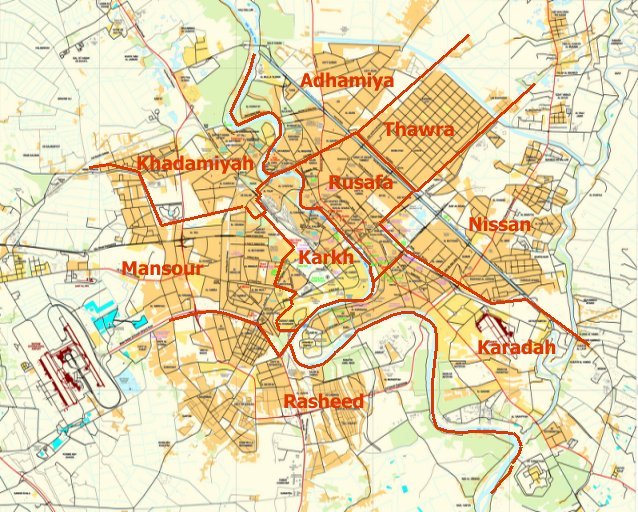
According to Brooks, joint U.S.-Iraqi forces are currently controlling 40% of Baghdad's areas, including al-Ghazaliya neighborhood, al-Khadraa district in Karkh and al-Shab neighborhood in Baghdad's eastern side of Rasafa. Brooks did not provide a timetable for obtaining full control of Baghdad.
"The law-imposing security plan in Baghdad has seen dazzling success that citizens have not noticed because of the violent operations that target them," Brooks explained, adding that U.S. forces will continue erecting concrete barriers around some of Baghdad's neighborhoods and markets to block car bombs from reaching their targets.
Labels: Brigadier General Vincent Brooks, politics, security
Wednesday, June 27, 2007
Towers and ditches to protect Karbala
Aqeel al-Qhazaali, Karbala’s governor, said two police battalions will be stationed at the ditch to protect the city from violent attacks. The towers will be built several kilometers away from the ditch and close to the desert separating Karbala from the rebellious Province of Anbar. “These guard towers will extend across the whole of the desert area bordering the Province of Anbar,” said Rahman Mashawi, Karbala’s police force spokesman. He said the towers, once in place, will make it easier “to detect infiltrators and capture them.”
Mashawi did not say how many towers the province will eventually build but added all of them will be manned by police forces 24 hours a day. He said there will be foot patrols across the desert as well as an efficient communication system linking the various security personnel in the area. The security measures, he said, will be further intensified during Shiite religious occasions in which hundreds of thousands of pilgrims flock to the city.
Labels: Aqeel al-Qhazaali, Karbala, Rahman Mashawi, security
Wednesday, June 06, 2007
$14 mn. security contract for Diyala awarded
Labels: contract, Diyala, security, SOC-SMG
Friday, June 01, 2007
U.S. Commander believes 80 per cent of enemy combatants are reconcilable
Odierno, the No. 2 U.S. commander in Iraq, told Pentagon reporters by video conference that he is pressing his military officers to reach out to the tribes, to some small insurgent groups and to religious and political leaders to push them to stop the violence.
"We are talking about cease-fires, and maybe signing some things that say they won't conduct operations against the government of Iraq or against coalition forces," Odierno said from Camp Victory in Baghdad. "We believe a large majority of groups within Iraq are reconcilable and are now interested in engaging with us. But more importantly, they want to engage and become a part of the government of Iraq."
Stemming the violence in and around the capital city is key to giving the Iraqi government time to stabilize and move toward reconciliation with the warring sectarian factions. That would then allow the U.S. to begin withdrawing troops.
Odierno said he believes that about 80 percent of the enemy fighters, including key Sunni insurgent groups and Shiite militia, could be brought into the political process. The remainder, he said, are largely al-Qaida operatives who will have to captured or killed.
He cautioned that the process will be slow. And he repeatedly warned that he may need more time to determine if the military buildup ordered by President Bush earlier this year has begun to work.
Labels: cease-fire, Iraqi militants, Lt. Gen. Ray Odierno, politics, security
Maliki meets with Dhi Qar tribal leaders
Labels: Dhi Qar, Iyad Allawi, Nouri Al-Maliki, security, tribal leaders
Tuesday, May 29, 2007
U.S. military looking for convoy escort security services
Labels: contracts, convoy escort, security