Wednesday, October 10, 2007
Polish embassy in Baghdad to relocate
Labels: Baghdad, Green Zone, Polish embassy


Monday, October 08, 2007
Bombs explode near Polish embassy in Baghdad
Labels: Baghdad, bombs, Polish embassy, Waldemar Figaj
Thursday, September 13, 2007
U.S. general - Iranian supplied rocket used in attack on military base
The military said one person was killed and 12 injured in an "indirect fire" attack on Tuesday on Camp Victory, a sprawling military base near Baghdad international airport. Bergner, spokesman for US forces in Iraq, told a press conference the rocket was similar to those supplied in the past by "Iranian sources" to Mahdi Army fighters.
He acknowledged however that there was no direct evidence to prove that Mahdi Army fighters were behind Tuesday's attack nor that the weapon had definitely been supplied by Iranian forces. "It was consistent with rockets supplied in the past by Iranian sources to Jaysh al-Mahdi," he said, using the US military's term for the Mahdi Army.
Sadr has called on his militia to halt armed activities for six months, but attacks are continuing. "We do see some elements obeying Sadr's pledge," said Bergner. "But we also see some members who are disobeying his pledge."
Labels: Baghdad, Camp Victory, Iran, Mahdi Army, Major General Kevin Bergner
Wednesday, September 12, 2007
Demonstrations in Baghdad over U.S. building dividing wall
The demonstrators -- tribal leaders, clerics and local residents -- marched from one neighbourhood to the other carrying banners reading "No to the dividing wall" and "The wall is US terrorism." The protesters demanded in a statement that the government intervene to halt the wall and ensure that the section already completed is demolished. "The wall is in accordance with Al-Qaeda's plans," the statement said, adding that the barrier was being built to "separate family from family."
"The wall is dividing small neighbourhoods and will lead to the partitioning of Iraq," said Hassan al-Taii, a leader of the large Taii Sunni tribe. He demanded that the Baghdad government destroy the wall and act against those "planting division and sectarianism among Iraqis." Since early this year, US and Iraqi forces have been erecting walls around or between some Baghdad neighbourhoods in what their commanders call a "concrete caterpillar" designed to protect residents from sectarian violence.
In April the military came under flak when it began constructing a ring of six-tonne (14,000 pounds) concrete blocks around the Sunni Adhamiyah neighbourhood to prevent it from being mortared from the nearby Shiite areas. Many Iraqis argue that the barricades will only heighten tensions between Sunnis and Shiites by segregating the once mixed city.
During Wednesday's protest, demonstrators carried Iarqi flags and chanted, "No, no to terrorism", and "Yes, yes to unity." "This wall does not provide security and stability," said Shiite cleric Abdul Baqir al-Subaihawi.
"The government must maintain security in Baghdad rather than separate its neighbourhoods," he added. Shiite radical leader Moqtada al-Sadr has urged artists to paint the concrete barriers springing up around Baghdad with murals showing what he dubbed the "ugly face" of the US military in Iraq.
The Baghdad council has employed professional artists to paint the walls with calming landscapes and scenes depicting Iraq's natural beauty, but Sadr -- a firebrand preacher and militia leader -- had something more dramatic in mind. "I call on you to draw magnificent tableaux that depict the ugliness and terrorist nature of the occupier, and the sedition, car bombings, blood and the like he has brought upon Iraqis," he said.
Labels: Abdul Baqir al-Subaihawi, al-Ghazaliyah, al-Shuala, Baghdad, wall
Gunmen steal $550,000 in Iraq
One officer quoted the accountant as saying the cash was being carried from a factory in Baghdad's Zafaraniyah neighborhood to a private bank. The victims drew attention from passing motorists, who alerted police. Authorities responded about an hour later, when they found the seven victims sitting unharmed in the empty armored truck by the side of the road, the officers said.
The assailants' identities were unknown, and it was unclear how they obtained what appeared to be two Iraqi police vehicles, in which they fled. One of the police officers who spoke to The Associated Press was on patrol at the time of the robbery and responded to the scene. The other was on duty in a local station and received multiple reports of the incident.
Labels: Baghdad, robbery, Sinak, theft
The security situation in Iraq through Iraqi eyes
Hassan Nassir in Al-Khadimiyah, Baghdad
The security situation in my neighborhood in northwest Baghdad is more or less stable, but there are situations when we have gunfire, mortar fire, and confrontations. It is a working-class neighborhood; the standard of living here is average. There used to be a mixture in this neighborhood of Shi'a, Sunnis, Kurds, and even Christians, but many people have left. Now it is basically Shi'ite.
About four months ago, U.S. forces began to build a small, simple base in the area. They are active during the night. After midnight, they begin patrols, or walk along the street, or they may target particular houses or individuals. The militias are also present; they call themselves "popular committees" but we can call them militias. They don't appear constantly; they are in contact with each another and withdraw when the Americans move in, but they are here.
My neighborhood, Al-Jamil, close to Al-Sadr City, is primarily Shi'ite, but there are a number of Sunni and Christian homes, because the neighborhood residents have prevented their expulsion. It's a neighborhood with an above-average standard of living. U.S. forces have taken over a site to use as a camp or a base about 200-300 meters from where I live. The truth is that since the Americans have been stationed here, we have been aware of a number of operations, but I don't think that there is any link between the Americans and this neighborhood. We see them three or four times a day in their vehicles and Hummers, but they have never stopped to talk with the neighbors or other people.
here are no militia checkpoints in my neighborhood, and frankly I don't see the presence of such forces. Our neighborhood is maybe quieter than other neighborhoods. We can move freely around our neighborhood. I see girls and women who go out shopping normally. As for going to other neighborhoods, I only go to particular neighborhoods. For example, there are areas I cannot reach; I used to buy my clothes in Al-Adhamiyah or in the "Camp" neighborhood, but I am now forced to keep out of these areas. However, I can do my shopping on Palestine Street, which is crowded with shoppers, both male and female, even girls wearing trousers and without hijabs.
The neighborhood where I live is not really mixed in terms of Shi'a and Sunnis. There are very few Sunnis. We find that some of those with a limited education are anxious to carry guns at night, and sometimes hand grenades. We sometimes hear gunfire for a particular reason or for no reason at all. At the same time, we see that culture survives -- artists and writers are also living here.
We have not seen any U.S. forces. I haven't seen any Americans in the neighborhood, but some time ago there was an attack on the house of someone who was working as a contractor for the Americans. His house was attacked, and we then saw an American presence, but only for a very brief period.
There are no militia checkpoints in this area, because our neighborhood is within the city, and because the security agencies are somewhat alert and they spread out after 11 at night. But how do we know if there are any armed elements around? Any minor incident is accompanied by concentrated gunfire; this shows that people have weapons.
With regard to the security situation, we cannot call it good or bad. There is a police presence, and there is control over security, and there have not been any incidents in our actual neighborhood. But we hear that incidents do occur in the market and in the crowded areas, incidents involving explosions, assassinations at night.
My neighborhood's standard of living is low to medium. Most people are government employees. It does include the various sects: there are Shi'a, Sunnis, etc., but there is no differentiation here. The U.S. forces are not present in our neighborhood, but they do pass by on the main street. They have fixed bases where they are centered. Nobody is involved with them, nor does anybody go near them, except for those who work at their bases -- they are distant from us and people do not mix with them.
There are no checkpoints here manned by militias, and the control of the streets is in the hands of the police and army. We sometimes hear about armed elements, but not in our neighborhood. The armed elements are at the governorate level, and on the main roads and highways.
In general, the situation where I live is quiet up to a point, but we often hear about "the calm" before the storm. My neighborhood has as an above-average or good standard of living. The people there are mostly educated employees with government offices. There is no presence at all of U.S. forces, but there are two checkpoints manned by the local police in our area.
Sometimes when there are political activities, the militias appear and take control of the street, exhibiting all of their capabilities, to an amazing level. They have wireless communications devices, and they keep in contact. But they do not have a daily presence.
In our area, freedom of movement is practically total; there are no inconveniences or security pestering, except occasionally. But there are rumors that there are in fact assassinations, and they are aimed at political people, or those who had relations with the previous regime. In reality, there is fear, because the assassinations that are taking place are random. This may be on purpose, in order to "mix the cards." Actually this is the only issue people talk about in our neighborhood.
Labels: Al-Jamil, Al-Khadimiyah, Babylon, Baghdad, Iraq, Najaf, security, Tikrit
Monday, September 10, 2007
Night curfew to be eased in Baghdad during Ramadan
However, vehicles will not be allowed over the many bridges that span the Tigris River and link east and west Baghdad on the Muslim day of rest. The vehicle curfew was introduced to thwart insurgent attacks on worshippers observing the main weekly prayers. The announcement of the changes to the curfew came hours after Prime Minister Nuri al-Maliki said that violence in Baghdad had fallen by 75 percent since the US military "surge" was launched in the capital on February 14.
Labels: Baghdad, Brigadier General Qassim Atta, curfew, Ramadan
Tuesday, August 21, 2007
Deputy sciences and technology minister kidnapped
"The kidnappers phoned his family later and told them about the incident without demanding any ransom," he added. Al-Attar has a Ph.D. in Physics from the Baghdad University and he has been in his current post for more than two years. The man is married and has two children. No word was available from security authorities or the Iraqi government on the incident.
Labels: 10th Iraqi Army division, abduction, Arasat al-Hindiya, Baghdad, gunmen, r. Sameer Saleem al-Attar, sciences and technology ministry
Thursday, August 09, 2007
Tight security in Baghdad as Shia pilgrims flock to Kadhimiya mosque
Almost 1,000 pilgrims died in 2005 when rumours of an attack caused a stampede. Many victims, mostly women, children or elderly, were crushed or drowned as panic spread that there were suicide bombers among the pilgrims. More than 1,800 Iraqi police, including hundreds of security agents, have been deployed in and around the mosque, which is one of Shia Islam's holiest sites.
The mosque has long been a target of insurgents, the BBC's Andy Gallacher in Baghdad says. Many Shias flog themselves during the pilgrimage. The pilgrimage marks the death in 799 of Musa al-Kadhim, the seventh of 12 imams revered by Shias. On Thursday, more than a million pilgrims are expected to march to the mosque, many flogging themselves with iron chains or cutting their foreheads with swords. These grieving rituals were banned under former Iraqi President Saddam Hussein. But now they are something of a show of power for Shias in Iraq, our correspondent says.
Labels: Baghdad, Imam Musa al-Kadhim, Kadhimiya mosque, Shiite pilgrims
Tuesday, August 07, 2007
Baghdad lockdown for religious festival
In the Kadhimiyah district of the city, home to Kadhim's tomb and the centre of the celebrations, the curfew will begin on Tuesday night, he added. "The aim of the curfew is to deny terrorists and takfiri (sectarian extremists) any opportunity to strike," Atta, the chief spokesman of the Baghdad security plan, told state television. Atta said civilians would not be allowed to carry weapons and that the route that pilgrims will follow on foot to the shrine would be tightly controlled by Iraqi security forces.
Imam Kadhim was the seventh of the 12 Shiite imams and died in Baghdad in 799 after he was poisoned in prison. Every year tens of thousands of Shiite pilgrims mark his passing by visiting his tomb in Kadhimiyah.
Iraq is in the grip of sectarian war and previous pilgrimages have been marred by violence and accidents. In August 2005, at least 965 people were killed when fears of attack triggered a stampede on a Tigris river bridge.
Labels: Baghdad, Brigadier General Qassim Atta, curfew, Imam Musa Kadhim, Kadhimiyah, lockdown, religious festival, Shiite pilgrims
Monday, August 06, 2007
General Motor Corp. security guards arrested in Baghad
Labels: Baghdad, General Motors Corporation, Oqba Ibn Nafi square
Thursday, August 02, 2007
Saudi considers re-opening embassy in Baghdad
Saudi Arabia, a Sunni Muslim country, has had frosty relations with the Iraqi government of Prime Minister Nouri al-Maliki and has not hidden its suspicions that al-Maliki does not have the interests of Iraq's Sunni minority at heart. Secretary of State Condoleezza Rice thanked her Saudi host for considering diplomatic ties, calling it "an important step."
The Arab world has lagged far behind Europe in placing embassies in Baghdad. Responding to criticism from the U.S. ambassador to the United Nations, al-Faisal said Saudi Arabia is already doing all it can to address concerns about the flow of terrorists over its border into Iraq. "All that we can do in order to protect the border in Iraq we have been doing," he said.
The foreign minister insisted his country was supportive of the Iraqi government. "As an indication of our good intentions, we let their (soccer) team win," al-Faisal joked, referring to Iraq's soccer victory over Saudi Arabia in the final of the Asia Cup.
Labels: Baghdad, embassy, Prince Saud al-Faisal, Saudi Arabia
Friday, July 27, 2007
Mahdi Army clashes with U.S. troops in Karbala
The fighting in Karbala, 50 miles south of Baghdad, broke out as the joint U.S.-Iraqi force conducted a pre-dawn raid on the house of a leader of the Mahdi Army militia, which is loyal to radical Shiite cleric Muqtada al-Sadr, prompting the militia fighters to open fire, according to a police officer and a local council member.
The militia leader Razzaq al-Ardhi and his brother were arrested in the clashes, which lasted nearly two hours, the officials said, speaking on condition of anonymity because they weren't authorized to release the information. The U.S. military did not immediately respond to a request for comment. The officials said four militiamen and five civilians were killed and 23 people were wounded in the fighting, which also damaged four or five houses.
Another clash erupted about three hours later as residents were removing the dead bodies from the hospital. Militiamen with the mourners briefly fought with a joint Iraqi army and police patrol, but no casualties were reported, the officials said.
In Baghdad, cleanup crews used tractors and cranes to clear out the debris after a highly sophisticated simultaneous truck bombing and rocket attack devastated a Shiite market district in one of the capital's safest central neighborhoods Thursday. Rescue workers pulled three more bodies from the rubble, and police raised the casualty toll to at least 31 people killed and 104 wounded.
Mourners streamed into mosques and funeral tents were set up in the neighborhood's main street, where black banners were hung on the walls with names of the dead. Although suicide bombings are common in Iraq, it is rare for militants to stage such a double attack with such effectiveness. The attackers struck about 6:40 p.m. as the Karradah district's market area was packed with shoppers on the eve of the Islamic day of rest.
Labels: Baghdad, Karbala, Karrada, Mahdi Army, Razzaq al-Ardhi, suicide truck bomber, U.S.-Iraqi force
Iraqi leaders meet today in effort to end political crisis
The meeting comes a day after a car bomb attack in central Baghdad killed 25 people and wounded 115. Meanwhile, clashes broke out early today between U.S. forces and militiamen of al-Sadr's Imam Al-Mahdi Army in the city of Karbala, south of Baghdad. At least three militiamen have been killed in the fighting.
Labels: Baghdad, car bomb, Jalal Talabani, Karbala, Mahdi Army, Nouri Al-Maliki, politics, Tariq al-Hashimi
Friday, July 20, 2007
U.S. military bombs entry bridge to Baghdad
The strike was part of Operation Marne Avalanche launched recently to target insurgent strongholds in Baghdad’s southern belts and in central provinces such as Babil, Karbala and Najaf. The operation aims to cut off weapons smuggling into Baghdad from the central and southern regions of Iraq. The military said the operation has so far resulted in the killing of five insurgents, the detention of 42 others and the discovery of a large weapons cache.
Labels: Baghdad, bridge, Operation Marne Avalanche
Friday, June 29, 2007
Iranian bank opens first branch in Baghdad
Labels: Baghdad, Bank Melli Iran
Thursday, June 28, 2007
25 killed in car bomb attack in Bayaa
In the southern city of Basra, a roadside bomb killed three British soldiers and seriously wounded another in the early hours of Thursday, the British military said. The latest attacks underscore the strength of militants in Iraq despite the arrival of 28,000 additional U.S. troops. The unrelenting violence is pushing Iraq to the brink of all-out civil war between majority Shi'ites and minority Sunni Arabs.
The deadliest car bomb in Baghdad exploded in the Shi'ite district of Bayaa. The blast, which went off during the morning rush hour, wounded 40 people and destroyed dozens of vehicles. The Bayaa area in southwest Baghdad has been a frequent target of car bombs blamed on Sunni Islamist al Qaeda.
Labels: Baghdad, Basra, Bayaa, beheadings, car bomb, Salman Pak
Wednesday, June 20, 2007
Abuse of Iraqi orphans
"I saw children that you could see literally every bone in their body that were so skinny, they had no energy to move, no expression," Sergeant Michael Beale told CBS News. "The kids were tied up, naked, covered in their own waste, and there were three people cooking themselves food but nothing for the kids," said Lieutenant Stephen Duperre.
Captain Benjamin Morales described his fury when he discovered the caretaker of the orphanage occupying a well-kept office and a stockroom filled with food and clothing. Instead of being given to the children, Capt Morales said the soldiers believed the supplies were being kept for sale on the black market. "I got extremely angry with the caretaker when I got there. It took every muscle in my body to restrain myself from not going after that guy," he said.
A total of 24 boys were found in the orphanage and taken to a local hospital. The prime minister, Nouri al-Maliki, ordered the arrest of those responsible but the three staff, including the caretaker, disappeared before they could be apprehended, according to CBS. Coverage of the orphanage's discovery was broadcast by CBS News last night and posted on cbsnews.com.
Labels: Baghdad, children, Iraqi orphans, Nouri Al-Maliki, orphanage, special needs
Monday, June 04, 2007
Security plan only able to protect 146 of the 457 Baghdad neighbourhoods despite troop surge
Iraqi police also said at least six people were killed and 14 were wounded in three separate bombings Monday in Baghdad. The New York Times said an American assessment of the security plan through late May found that American and Iraqi forces were able to "protect the population" and "maintain physical influence over" only 146 of the 457 Baghdad neighborhoods.
Troops have either not begun operations aimed at rooting out insurgents or still face "resistance" in the remaining 311 neighborhoods, according to the report, which cited a one-page assessment along with summaries from brigade and battalion commanders in Baghdad. U.S. and Iraqi military officials played down the report.
"We have stated all along that this was going to be harder before it gets easier," military spokesman Lt. Col. Christopher Garver said. "It's going to be a tough fight over the summer and the plan is just in its beginning stages."
It appeared to be the first comprehensive analysis of the progress of the operation that began Feb. 14. Gen. David Petraeus, the top U.S. commander in Iraq, is due to report in September on whether the current troop increase is working amid a fierce debate in Washington over whether President Bush should begin withdrawing American forces.
The U.S. military announced Sunday that 14 American soldiers had been killed over a three-day period in a deadly start for June and raising to at least 3,493 members of the U.S. military who have died since the Iraq war started in March 2003, according to an Associated Press count. May was the third bloodiest month since the war began, with 127 troop deaths reported.
Following initial optimism over the operation to quell sectarian violence, unrelenting bombings staged by suspected Sunni insurgents have killed hundreds of Iraqis. U.S. commanders have cited a drop in the numbers of execution-style killings usually blamed on Shiite militias but those numbers also have seen a recent spike.
U.S. military leaders in charge of the Baghdad drive, now nearing the end of its fourth month, have repeatedly complained that both the Iraqi army and police units that were sent to Baghdad for the operation are often at only 60 percent full strength, if that.
He acknowledged some challenges with the Iraqi troops, including concerns that some were biased in their loyalties to one side or another, apparently referring to the sectarian bent of predominantly Shiite forces. Iraqi military spokesman Brig. Gen. Qassim al-Moussawi said Baghdad has 184 neighborhoods and "we are controlling more than 50 percent of them." The U.S. and Iraqi military frequently differ over details and designations of neighborhoods.
The police are deeply infiltrated by Shiite militiamen who use their membership in the force more for sectarian purposes against Sunni Muslims than in conducting police operations on behalf of the government of Prime Minister Nouri al-Maliki.
Labels: Baghdad, troop surge, U.S. forces
Saturday, June 02, 2007
Despite Baghdad security operation, violence soars
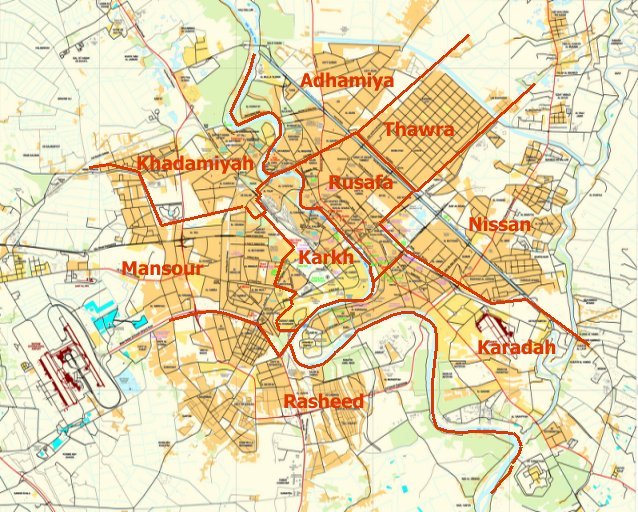
Worst hit is the Karkh side of Baghdad where pitched battles occasionally take place amid densely populated quarters. U.S. and Iraqi troops have failed to put an end to kidnapping and the dumping of unidentified bodies on the streets of Baghdad. Baghdad is divided into two quarters – Karkh and Rasafah – bisected by the Tigris River.
Assad Ali from Karkh says residents sometimes have to stay indoors for several days fearing to leave their homes due to escalating violence. “Violent acts are setting our areas on fire. It is illogical for the government to leave us to our fate,” he said. Ali said he thought the authorities were more concerned about the Rasafah side of Baghdad which he said was relatively quieter.
The ongoing violence has brought business to a halt in many areas. Workers and civil servants cannot join work, aggravating living conditions for the majority of the population. According to Muhsen Hamed property prices have dropped by almost 50 percent particularly in Karkh. “There is a continuous movement of families in the city for the most violent areas to the less violent,” he said.
Hamed said certain quarters of Baghdad with their own vigilante groups are seeing a rise in property and rent as more and more families flock there. Estate agents in Karkh say they have lost their business due to ongoing violence. “For more than a year I have not sold a single house,” said Abdullatif Raheem, an estate agent.
Raheem said even in smart areas with heavy military presence, prices property prices have dropped substantially. He said monthly rents in the smart district of Mansour have plummeted to about 250,000 (USD$200) dinars from one million.
Labels: Baghdad, Karkh, Operation Fardh al-Qanoon, violence