Friday, July 27, 2007
Mahdi Army clashes with U.S. troops in Karbala
Security
(AP) - Shiite militiamen battled with U.S. and Iraqi troops Friday in the holy city of Karbala, and the fighting left nine people dead and nearly two dozen wounded, local officials said. Separately, the U.S. military said another American soldier was killed in fighting, raising to eight the number of troop deaths reported during the past two days.
The fighting in Karbala, 50 miles south of Baghdad, broke out as the joint U.S.-Iraqi force conducted a pre-dawn raid on the house of a leader of the Mahdi Army militia, which is loyal to radical Shiite cleric Muqtada al-Sadr, prompting the militia fighters to open fire, according to a police officer and a local council member.
The militia leader Razzaq al-Ardhi and his brother were arrested in the clashes, which lasted nearly two hours, the officials said, speaking on condition of anonymity because they weren't authorized to release the information. The U.S. military did not immediately respond to a request for comment. The officials said four militiamen and five civilians were killed and 23 people were wounded in the fighting, which also damaged four or five houses.
Another clash erupted about three hours later as residents were removing the dead bodies from the hospital. Militiamen with the mourners briefly fought with a joint Iraqi army and police patrol, but no casualties were reported, the officials said.
In Baghdad, cleanup crews used tractors and cranes to clear out the debris after a highly sophisticated simultaneous truck bombing and rocket attack devastated a Shiite market district in one of the capital's safest central neighborhoods Thursday. Rescue workers pulled three more bodies from the rubble, and police raised the casualty toll to at least 31 people killed and 104 wounded.
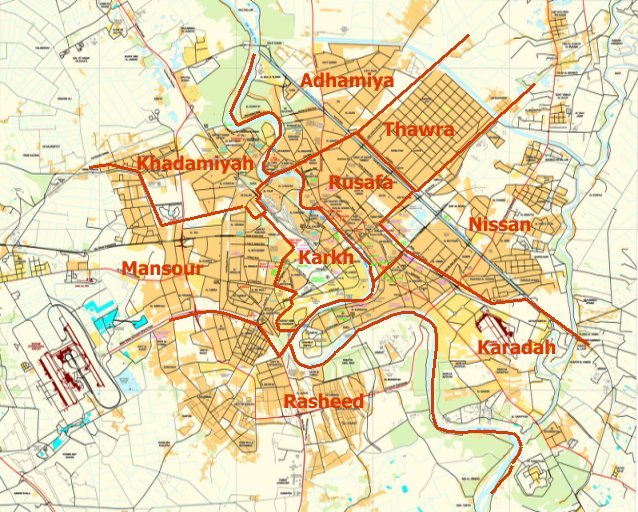
Mourners streamed into mosques and funeral tents were set up in the neighborhood's main street, where black banners were hung on the walls with names of the dead. Although suicide bombings are common in Iraq, it is rare for militants to stage such a double attack with such effectiveness. The attackers struck about 6:40 p.m. as the Karradah district's market area was packed with shoppers on the eve of the Islamic day of rest.
Labels: Baghdad, Karbala, Karrada, Mahdi Army, Razzaq al-Ardhi, suicide truck bomber, U.S.-Iraqi force


Monday, July 23, 2007
Triple car bomb attack in Baghdad kills 12
Security
(AP) - Three parked cars exploded within 30 minutes in a predominantly Shiite area in Baghdad on Monday, killing at least 12 people, police said, the deadliest in a series of bombings and shooting attacks nationwide. Two of the blasts in the Baghdad neighborhood of Karradah struck nearly simultaneously. One targeted a passing police patrol, killing three officers and three pedestrians and wounding nine other people, a police officer said, adding that at least seven cars also were damaged in the blast, which struck near to the Interior Ministry's nationality and social affairs directorate and the 14th of July bridge, he added.
Another parked car bomb about 500 yards away struck at about the same time, ripping through a bustling market of vegetables and household goods, killing three civilians and wounding five others, the policeman added. Another car packed with explosives struck a police patrol in Elwiyah square at about 11:30 a.m. in another part of Karradah, killing two policemen and a civilian and wounding five people, police said.
Karradah, a popular shopping area, has been hit by several high-profile bombings, and Monday's attack occurred despite a 5-month-old U.S.-Iraqi security operation aimed at stopping such violence in the capital.
Another car packed with explosives blew up on the main road about 200 yards from an entry point to the U.S.-controlled Green Zone, killing at least four Iraqis and wounding seven, a police officer said, speaking on condition of anonymity because of security concerns. The heavily fortified Green Zone is home to the U.S. and British embassies as well as Iraqi government offices and thousands of American troops and contractors.
Labels: car bombs, Elwiyah square, Green Zone, Karrada, police officers
Friday, July 13, 2007
$300 mn. stolen from Iraqi bank
Crime
(Reuters) - Thieves have stolen nearly $300 million from a bank in Baghdad, police and a bank official said Thursday, in what is probably one of the biggest thefts in Iraq since the 2003 war to topple Saddam Hussein. Police said the thieves were three guards who worked at the private Dar Es Salaam bank in Baghdad's Karrada district.
They said that when bank employees arrived for work on Wednesday they found the front door open and the money gone. The guards, who normally slept at the bank, had also disappeared, they said. An official at the bank said about $300 million in U.S. dollars had been stolen, as well as 220 million Iraqi dinars ($176,000). He declined to give further details.
Police said the Interior Ministry and the Finance Ministry had set up a committee to investigate the theft. It was not immediately clear why the bank had so much cash on hand, but Karrada is a key commercial district in Baghdad. Ever since the U.S.-led invasion of Iraq, most transactions have been conducted in cash because of limited facilities to transfer money through banks or other financial institutions. Huge amounts of money were looted from Iraq's banks during the invasion.
Labels: bank raid, Dar Es Salaam bank, Karrada
Monday, May 14, 2007
Round-up of violence across Iraq
Security
Roundup of violence in Iraq - 13 May 2007
(McClatchy Newspapers) - The daily Iraq violence report is compiled by McClatchy Newspapers in Baghdad from police, military and medical reports. This is not a comprehensive list of all violence in Iraq, much of which goes unreported. It’s posted without editing as transmitted to McClatchy’s Washington Bureau.
(McClatchy Newspapers) - The daily Iraq violence report is compiled by McClatchy Newspapers in Baghdad from police, military and medical reports. This is not a comprehensive list of all violence in Iraq, much of which goes unreported. It’s posted without editing as transmitted to McClatchy’s Washington Bureau.
(Reuters) - Following are security developments in Iraq at 1400 GMT on Monday:
* Denotes new or updated item.
BAGHDAD - A roadside bomb targeting a police patrol killed one person and wounded 13, including four policemen, in Zaafaraniya district of southern Baghdad, police said.
BAGHDAD - A car bomb in a parking lot killed one person and wounded four others in the central Karrada district of Baghdad, police said.
BAGHDAD - A car bomb killed one person and wounded three others in Palestine Street in northeastern Baghdad, police said.
BAGHDAD - The bodies of 22 people were found in different districts of Baghdad on Sunday, police said.
* BAGHDAD - A suicide car bomber killed two Iraqi soldiers and wounded four others at a major intersection in western Baghdad, police said.
* NEAR BASRA - A roadside bomb wounded six Danish soldiers just north of Basra, British military spokesman Major David Gell said.
MOSUL - The bodies of six people, including a policeman, were found shot in different districts of the northern city of Mosul on Sunday, police said.
MOSUL - Gunmen killed two former members of Saddam Hussein's Baath Party in Mosul on Sunday, police said.
Labels: Baath Party, Basra, car bomb, Danes, IED, Karrada, Mosul, police, Zaafaraniya
Thursday, April 19, 2007
Over 200 killed in bloodiest day since start of security operation
Security
(AP) - Grieving relatives retrieved bodies from hospital morgues Thursday, and passers-by gawked at the giant crater left by a market bomb in one of four attacks that killed 183 people on the bloodiest day since the U.S. troop increase began nine weeks ago. But violence did not abate Thursday, as a suicide bomber exploded in another mostly Shiite district, killing at least 11 people and wounding 28, police said. The car bomb exploded next to a fuel tanker in Karradah, setting fire to the truck. The death toll was expected to rise.
Many of the more than 230 Iraqis killed or found dead nationwide a day earlier were buried in quiet ceremonies before Thursday's noon prayer, according to Muslim tradition. Other bodies lay in refrigeration containers, still unidentified, at morgues across Baghdad. The most devastating blast struck the Sadriyah market as workers were leaving for the day, charring a lineup of minibuses that came to pick them up. At least 127 people were killed and 148 wounded, including men who were rebuilding the market after a Feb. 3 bombing left 137 dead.
On Thursday, collective wakes were being held for multiple victims in huge tents erected in narrow alleys and at nearby mosques within view of the blast site. Onlookers gathered around a crater about three yards wide and one yard deep, left by the force of the explosion. The car bombing appeared meticulously planned. It took place at a pedestrian entrance where tall concrete barriers had been erected after the earlier attack. It was the only way out of the compound, and the construction workers were widely known to leave at about 4 p.m., the time of the bombing.
U.S. military spokesman Maj. Gen. William Caldwell told The Associated Press that al-Qaida in Iraq was suspected in the bombing. "Initial indications based on intelligence sources show that it was linked to al-Qaida," Caldwell said in a late-night telephone interview. The attacks appeared to be yet another attempt by Sunni insurgents and al-Qaida to force Shiite militiamen back onto the streets. Radical Shiite cleric Muqtada al-Sadr had ordered his Mahdi Army fighters to put away their weapons and go underground before the security crackdown began, leaving regions like those bombed on Wednesday highly vulnerable.
An outburst of violence from the Shiite militia would also ease pressure on the Sunni insurgents, creating a second front for U.S. and Iraqi soldiers struggling to diminish violence in the capital and provide time for the Iraqi government to gather momentum for sectarian reconciliation.
Brig. Gen. Qassim al-Moussawi, the Iraqi military spokesman, said, "We have not seen such a wave of attacks since the security plan began. These are terrorist challenges. Ninety-five percent of those killed today were civilians." Late Wednesday, Prime Minister Nouri al-Maliki ordered the arrest of the Iraqi army colonel who was in charge of security in the region around the Sadriyah market. The colonel's name was not given.
The 127 deaths in Wednesday's market bombing were recorded by Raad Muhsin, an official at the al-Kindi Hospital morgue where the victims were taken. A police official confirmed the toll, speaking on condition of anonymity because he was not authorized to release the information.
Besides the market attack, bombs struck Shiite targets in the capital at a police checkpoint, near a hospital and in a small bus. Nationwide the number of people killed Wednesday or found dead was 233, which was second only to a total of 281 killed or found dead on Nov. 23, 2006. Those figures are according to AP record-keeping, which began in May 2005.
Labels: Al Qaeda in Iraq, Baghdad, Brig. Gen. Qassim al-Moussawi, Karrada, Sadriyah market, suicide bomber, violence
Wednesday, April 18, 2007
Dozens killed as several bombs explode in Baghdad
Security
(CNN) - Attackers set off deadly bombs in neighborhoods across Baghdad on Wednesday, killing at least 45 people and wounding others, an Interior Ministry official said. The latest strike occurred in Baghdad's Sadr City, where at least 28 people were killed and 44 others were wounded. The official said most of the casualties are civilians. Five of those dead and seven of those wounded were Iraqi security forces.
The car bomb detonated near an Iraqi Army checkpoint at one of the entrances to Sadr City, the official said.
Iraqi and U.S. troops in Baghdad have intensified their efforts to establish the peace in war-torn Baghdad with a two-month-old crackdown called Operation Enforcing the Law.
At least 11 civilians were killed and 13 others wounded when a parked car bomb detonated in central Baghdad's Karrada district. The car was parked near a hospital and a market. Four police officers were killed and six civilians wounded shortly when a suicide car bomber exploded at an Iraqi police checkpoint in southern Baghdad. Two civilians were killed and nine others wounded when a roadside bomb detonated at a busy intersection in central Baghdad.
Labels: Baghdad, bombs, Karrada, Sadr City
Saturday, March 24, 2007
Karrada sealed off in security crackdown
Security
(Reuters) - U.S. and Iraqi troops sealed off the Karrada district in the heart of Baghdad on Saturday, stopping all vehicles and pedestrians from entering the area, which has suffered a spate of deadly car bombs in recent weeks. The Karrada operation appeared to be part of a major U.S.- backed security crackdown aimed at quelling the daily bombings and shootings that have killed thousands and sparked fears Iraq is sliding into full-scale civil war.
While the crackdown has succeeded in reducing the number of sectarian shootings car bombs remain a major problem and U.S. officials say they are devoting more resources to curbing them. In the volatile southern Baghdad district of Dora, a suicide bomber driving a truck packed with explosives attacked a police station. Gunmen also attacked army checkpoints in Hay al-Jamiya, a Sunni area, in western Baghdad, on Saturday morning. Residents said they could hear the sound of intense gunfire. At least one woman was arrested in Saturday's operation in Karrada after about 20 weapons, including AK-47 rifles and belt -fed machineguns were found in her house, an Iraqi army officer said, showing Reuters plastic bags filled with the weapons.
The streets of Karrada, whose residents are mainly Shi'ite Muslims and Christians and include several top politicians, were largely empty. Convoys of Humvee armoured vehicles roamed the area, which is close to the international Green Zone. "There is an ongoing operation in the area," U.S. military spokesman Major Steven Lamb said, without elaborating. One American soldier manning a checkpoint told Reuters the operation could last several hours or several days.
Labels: car bombs, Karrada, security crackdown
Tuesday, March 20, 2007
Car bombs continue across Baghdad
Security
(DPA) At least 11 Iraqis were killed and 45 others injured Tuesday in a series of attacks across war-torn Iraq, Iraqi police sources and witnesses said. A suicide bomber blew himself up in a car bomb in the Karada district near the Green Zone, killing three Iraqis and wounding 17 others, an Iraqi police source said. Elsewhere in Baghdad, another suicide bomber detonated a car bomb inside an Iraqi military checkpoint in the Jamaa district in western Baghdad, killing a soldier and wounding another, an Iraqi police source said.
In central Baghdad, a remote-controlled car bomb went off near a police station in the crowded Sheik Omar district, killing at least five Iraqis and wounding 17 others. Also Tuesday, two Iraqis were killed and six others were wounded in a roadside car bomb in a commercial complex in the Karada district. In southern Baghdad, at least four Iraqis were wounded Tuesday when a mortar shell struck the Walid residential district, witnesses said.
In central Baghdad, a remote-controlled car bomb went off near a police station in the crowded Sheik Omar district, killing at least five Iraqis and wounding 17 others. Also Tuesday, two Iraqis were killed and six others were wounded in a roadside car bomb in a commercial complex in the Karada district. In southern Baghdad, at least four Iraqis were wounded Tuesday when a mortar shell struck the Walid residential district, witnesses said.
Labels: Jamaa, Karrada, Sheik Omar, suicide bomber, Walid
Thursday, March 15, 2007
Blasts in Karradah and Iskandariyah kill more people
Security
(AP) A suicide car bomber apparently targeting a senior city official struck an Iraqi military checkpoint Thursday in a Shiite neighborhood in Baghdad, killing at least eight people, officials said. The blast came a day after the U.S. military said stopping car bombings had become the main focus of a major security sweep to halt the sectarian violence in the capital. Karradah, a major commercial district, has been hit by bombings several times in recent months, including a suicide car bombing on Jan. 25 that killed 30 people.
In the city of Iskandariyah, 30 miles south of Baghdad, a bomb in a parked car exploded as a bus packed with workers passed by, killing at least four and wounding 24, police said. The Baghdad blast, which occurred just after 3 p.m., tore through a popular square in the predominantly Shiite area of Karradah, sending a huge plume of black smoke rising above the flags atop the nearby French Embassy. Officials said eight people were killed and 25 were wounded.
The driver detonated the explosives as a convoy carrying the head of the city council, Sabir al-Issawi, was passing the checkpoint on Kahramanah Square, the council chief's deputy told the AP. The mayor was unhurt, but three of his bodyguards were wounded, Naeem al-Qabi said. The bombing in Iskandariyah occurred about 7:30 a.m. as the bus was carrying employees of a state-owned car company to work. It shattered the facades of nearby houses, leaving piles of concrete rubble along the street. A ball of crumpled metal over a tire was all that was left of the car that exploded.
The government, meanwhile, announced that it had decided to hold a minute of silence in all Iraqi cities on Friday morning to commemorate the anniversary of the 1988 chemical weapons attack on the Kurdish town of Halabja in northern Iraq, according to state TV. Saddam had ordered the attack as part of a scorched-earth campaign to crush a Kurdish rebellion in the north, seen as aiding the Iranian enemy.
Labels: blast, Halabja, Iskandariyah, Karrada, Sabir al-Issawi
Sunday, March 11, 2007
More pilgrims killed
Security
(BBC) Two bomb attacks in the Iraqi capital, Baghdad, have left at least 29 people dead, police said. Nineteen people died in the Karrada district when a car bomb exploded near a truck carrying Shia pilgrims. In a separate incident, a suicide bomber blew himself up on a minibus in eastern Baghdad, killing 10 people. The latest violence comes a day after Baghdad hosted a conference on security, attended by world powers including the US, Syria and Iran.
In Karrada, a car bomber drove into a truck that was bringing about 70 men and boys home from the holy city of Karbala, south of Baghdad. Hundreds of thousands of pilgrims had gone to Karbala to mark the Arbaeen ceremony, one of the holiest events in the Shia calendar. "I blame the government," the Associated Press news agency quoted one man injured in the blast as saying. "They didn't provide a safe route for us even though they knew we were targets for attack."
Last week, in the run-up to the ceremony, scores of pilgrims were killed in bomb and gun attacks across Iraq.
Sunday's separate suicide attack happened in Baghdad's Shia stronghold of Sadr City, injuring at least eight people.
Labels: bombings, Karrada, Sadr City, Shiite pilgrims