Wednesday, October 10, 2007
Polish embassy in Baghdad to relocate
Labels: Baghdad, Green Zone, Polish embassy


Wednesday, September 19, 2007
U.S. embassy in Iraq suspends diplomatic convoys across Iraq
The government announced the investigation on Tuesday, after the interior ministry decided to "halt the licence" of Blackwater, which provides security to US diplomats in Iraq. Ali al-Dabbagh, a government spokesman, announced the decision "to review the operations of foreign and local security companies in Iraq". He said: "This came after the flagrant assault conducted by members of the American security company Blackwater against Iraqi citizens."
In a notice sent to Americans in Iraq, the US embassy said it had acted to review the security of its personnel and possible increased threats to those leaving the Green Zone while accompanied by security details after the weekend killing of Iraqi civilians involving Blackwater guards.
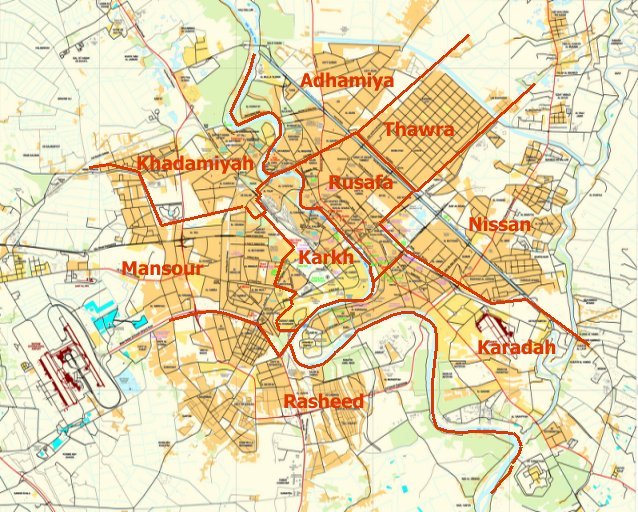
"In light of a serious security incident involving a US embassy protective detail in the Mansour District of Baghdad, the embassy has suspended official US government civilian ground movements outside the International Zone [Green Zone] and throughout Iraq," the notice said.
"This suspension is in effect in order to assess mission security and procedures, as well as a possible increased threat to personnel travelling with security details outside the International Zone," said the notice. Blackwater said on Monday that it had received no official notice from Iraq's interior ministry.
The toll from the shooting rose to nine - 10 civilians and one policeman - on Tuesday, according to a local hospital medic. US officials in Baghdad have yet to clarify the legal status of foreign security contractors in Iraq, including whether they could be liable for prosecution by Iraqi authorities. Riad Kahwaji, director of the Institute for Near East and Gulf Military analysis, told Al Jazeera: "Only the party that brought them [the private security firms] into Iraq can take them out of Iraq - and that is the US."
He said that under their contracts "neither Blackwater nor the other [private security] companies are obliged to obtain a licence from Iraq". Kahwaji said: "The chances are they are going to stay. Because a lot of the foreign companies and contractors that are rebuilding Iraq rely totally on these Western, or US-based, security companies. "They don't have any confidence in the Iraqi police and the Iraqi security services."
Condoleezza Rice, the US secretary of state, telephoned Nuri al-Maliki, Iraq's prime minister, on Monday to express regret over the death of innocent civilians. US and Iraqi sources said the shooting erupted after a bomb exploded near a US diplomatic convoy, but a US government incident report said armed men fired on the convoy and Blackwater guards responded. "Blackwater's independent contractors acted lawfully and appropriately in response to a hostile attack in Baghdad on Sunday," said a statement from the North Carolina company, reported by CNN on its website.
"Blackwater regrets any loss of life, but this convoy was violently attacked by armed insurgents, not civilians, and our people did their job to defend human life." Nevertheless, Abdul Sattar Ghafour Bairaqdar, a judge from Iraq's highest court, the Supreme Judiciary Council, said Blackwater could face trial. "This company is subject to Iraqi law and the crime committed was on Iraqi territory and the Iraqi judiciary is responsible for tackling the case," he said.
Muqtada al-Sadr, the Shia leader of the al-Mahdi Army militia, added his voice to anger over the incident, urged the government to "cancel this company's work, and the rest of the criminal and intelligence companies".
Labels: Abdul Sattar Ghafour Bairaqdar, Ali al-Dabbagh, Blackwater, Condoleezza Rice, diplomatic convoys, Green Zone, Moqtada Al-Sadr, private security companies, U.S. embassy Iraq
Thursday, August 09, 2007
U.S. commander - Iranian explosives undermining security in Iraq
There were 99 EFP attacks in Iraq in July -- the most since counting began in December, Odierno said. That type of explosive accounted for one-third of the 79 U.S. troop deaths last month, he said. The military says both parts for the weapons and the weapons themselves are being brought across the border. The United States can't prove that Iran's central government is responsible for providing the weaponry, but officials have been saying for months that such activity is being conducted by Iran's Revolutionary Guards-Quds Force.
Iran officially has denied being involved in promoting insurgent activity, but some U.S. officials think the country's senior leaders must be aware of the activity if the Quds Force is involved. Asked about the EFP numbers, State Department spokesman Sean McCormack told reporters Wednesday that "we have not yet seen any positive results from the Iranians" and that at future meetings, "we will convey that we have not seen any positive developments."
Odierno said the United States is taking defensive action against the attacks, specifically by targeting Shiite extremist cells in Baghdad. "We continue to go after these EFP networks in Baghdad and all over the country," he said. Additionally, new armored vehicles are being shipped to Iraq. More than 17,000 are needed in Iraq, but right now there are only about 200, the Pentagon says.
Iran -- which says the huge border with Iraq is porous and has acknowledged that smugglers and black marketers do traverse it -- frequently likens the dilemma with problems the United States faces along its vast border with Mexico.
Military officials have said for weeks that they expect as many weapons as possible to be shipped from Iran to Iraq before September, when Gen. David Petraeus, the top U.S. commander in Iraq, and U.S. Ambassador to Iraq Ryan Crocker issue a report about progress there. The thinking is that Iran intends to make it look like the United States is not making any progress.
In addition to the Iranian-based explosives, military elements in Iran are also hurting Iraq's security, Odierno said. Insurgents trained in Iran have been firing rockets and mortars at Baghdad's Green Zone with greater precision, and money from Iran is ending up in the hands of Iraqi insurgents, he said.
All of this comes as a thaw has unfolded between the United States and Iran, which have been meeting in Iraq to discuss security. The ambassadors have met and a subcommittee has been formed to deal with security matters that have popped up. Iraq has spearheaded the effort. Officials have said the United States has made its position about Iranian involvement clear in the meetings, the last of which was Monday. Additionally, Iraqi Prime Minister Nuri al-Maliki was visiting Iran, where he was discussing security and other matters with officials there.
Labels: EFPs, explosively formed projectiles, Green Zone, Iran, Lt. Gen. Ray Odierno, MRAPS, Quds Force, Revolutionary Guards
Friday, August 03, 2007
Asian Cup Iraqi football champions fear for their lives
But three players - team captain Younis Mahmoud, Nashat Akram and Hawar Mulla Mohammed - would not be with them. Mahmoud, who scored the winning goal in Iraq's 1-0 Asian Cup final win over Saudi Arabia, had said he feared for his life if he returned to Iraq to celebrate the stunning victory. Qassim said a welcome-home celebration would be held in a Baghdad hotel in the Green Zone, home to the U.S. Embassy and the Iraqi government headquarters.
"I wish the celebration would take place in al-Shaab stadium, but that is impossible for security reasons," said Mohammed Kadhom, 35, who works at the country's oil ministry. Al-Shaab is a huge, Saddam Hussein-era facility on the capital's east side. "It is sad that we can't receive our national team in a public celebration as others do, I myself fear for their safety," Kadhom said.
Vehicles were banned from Baghdad's streets for four hours coinciding with prayer services on Friday, for a regular weekly curfew on the Muslim holy day. Several rings of security around the Green Zone would prevent ordinary Iraqis from welcoming the team, which has already had celebrations in Dubai and Amman en route back from Indonesia, where the winning match was played.
Labels: Asian Cup final, football, Green Zone, Hawar Mulla Mohammed, Nashat Akram, soccer, vehicle ban, Younis Mahmoud
Monday, July 30, 2007
Security Minister says Iranians involved in violence in Iraq
Waili was referring to recent attacks on the so-called Green Zone which houses government offices, U.S. administrative quarters as well as embassy. “Militia elements and Iranian experts are pounding the Green Zone on almost daily basis,” he said. Waili is part of the Shiite coalition ruling the country which is alleged to have strong ties with Iran.
Asked about accusations that he himself was closely related to Iraq, Waili said: “I only belong to Iraq.” He said his ministry was praised by U.S. troops recently. However, he expressed disquiet at the newly formed Iraqi Intelligence Organization, saying there were many in the government who were not totally happy with its chief Mohammed al-Shahwani.
He did not elaborate but said the government was not involved in Iraqi intelligence activities as the organization is being financed and administered by the United States. On whether he had received any Iranian demands, Waili said Tehran’s only request has been the closure of camps run by Iranian exiles, Mujahideen Khalq in Iraq.
Labels: Green Zone, Iran, Iraqi Intelligence Organization, Mohammed al-Shahwani, Mujahideen Khalq, Shirwan al-Waili
Monday, July 23, 2007
Triple car bomb attack in Baghdad kills 12
Another parked car bomb about 500 yards away struck at about the same time, ripping through a bustling market of vegetables and household goods, killing three civilians and wounding five others, the policeman added. Another car packed with explosives struck a police patrol in Elwiyah square at about 11:30 a.m. in another part of Karradah, killing two policemen and a civilian and wounding five people, police said.
Karradah, a popular shopping area, has been hit by several high-profile bombings, and Monday's attack occurred despite a 5-month-old U.S.-Iraqi security operation aimed at stopping such violence in the capital.
Another car packed with explosives blew up on the main road about 200 yards from an entry point to the U.S.-controlled Green Zone, killing at least four Iraqis and wounding seven, a police officer said, speaking on condition of anonymity because of security concerns. The heavily fortified Green Zone is home to the U.S. and British embassies as well as Iraqi government offices and thousands of American troops and contractors.
Labels: car bombs, Elwiyah square, Green Zone, Karrada, police officers
Friday, July 13, 2007
Largest known attack on Green Zone kills three
Labels: Green Zone, IDF, International Zone, mortar rounds, U.S. embassy
Monday, July 02, 2007
Sunni govt officials leave Baghdad for Kurdistan
Information indicates that the families of Vice-President Tariq Al Hashemi, Deputy Prime Minister Salam Al Zubai, and the suspended head of the Iraqi Parliament Mahmoud Al Mashadani, will move to the Kurdish regions, especially to Arbil, where leaders promised special protection and support. The escalation of sectarian violence in Baghdad led Sunni leaders to transfer their families to Kurdish region, a step that might indicate a worsening of security situation in future, said Sunni sources.
Faris, an official bodyguard for Sunni Accord Front members, told Gulf News: "There were written threats sent to Sunni officials, claiming to kill their family members if they do not withdraw from the whole political process .... Besides the possibility of securing their families' safety in Baghdad became almost impossible. ... their sons ... go to schools and universities while their wives visit relatives, that is the reason we need a large number of bodyguards."
According to Iraqi sources, who asked not to be named, some Arab countries have offered to host families of the Sunni officials, but they preferred the Kurd region mainly because most Sunni leaders admire the Kurdish position characterised by moderation concerning de-Baathification and dissolution of the Iraqi army.
Zuhair Al Dulaimi, a history professor, told Gulf News: "An important reason forcing Sunnis to flee Baghdad is that assassination campaigns have turned into massacres, claiming the lives of 20 to 50 citizens per day." Sunni political groups estimated that 200,000 Iraqis have left for Jordan, Syria and Egypt among other countries, and approximately out of 190,000 Sunnis who left, 150,000 are from Baghdad alone.
Labels: Al Qaeda, Green Zone, International Zone, Iraqi Accord Front, Kurdistan, Mahmoud Al Mashahdani, relocation, Salam Al Zubai, Sunni officials, Tariq Al Hashemi
Wednesday, June 20, 2007
Increasing attacks on Green Zone
Rear Adm. Mark Fox, a U.S. military spokesman in Baghdad, declined to provide details on the number of attacks against the Green Zone, which is also known as the International Zone, but said they were increasing. Iraqi military spokesman Qassim al-Moussawi said the attacks were coming from inside residential areas, causing difficulties in responding to them because of concern about civilian casualties. He said security forces were receiving daily information about the location of the launching pads.
A security official working in Prime Minister Nouri al-Maliki's office also said a shell landed in the garden of the home of Human Rights Minister Wijdan Mikaeil. Two shells fell short of their Green Zone target, with one hitting Abu Nwas Street near the Jumhuriya Bridge, and a second fell into the Tigris. One shell landed near the home of Deputy Prime Minister Barham Saleh. A June 5 U.N. report said insurgents had bombarded the Green Zone with rockets and mortar fire more than 80 times since March, reportedly killing at least 26 people.
Labels: Brig. Gen. Qassim al-Moussawi, Green Zone, International Zone, mortar rounds, Rear Adm. Mark Fox
Monday, May 21, 2007
Round-up of violence across Iraq
* denotes new or updated item.
* BAQUBA - Two people were killed and 15 wounded when three mortar rounds landed in the religiously mixed city of Baquba, police said.
* BAGHDAD - Two mortar rounds landed in the heavily fortified Green Zone, which houses the Iraqi parliament and U.S. embassy, in central Baghdad, police said. They did not know if there were any casualties.
* BAGHDAD - The Iraqi army killed two insurgents and detained 69 others in Baghdad during the past 24 hours, the Defence Ministry said. Another 26 insurgents were detained in other parts of Iraq.
* BAGHDAD - Militants kidnapped and killed a journalist from one of Iraq's most popular national newspapers, Azzaman, in southern Baghdad on Sunday, his employers said on Monday.
HIBHIB - Police said three Iraqi soldiers were killed and four wounded in clashes with gunmen who attacked a minibus carrying off-duty soldiers near the town of Hibhib, near Baquba, 65 km (40 miles) north of Baghdad. A hospital source and Iraqiya state television put the death toll at seven.
KHALIS - Four people were wounded by a car bomb in the town of Khalis, 80 km (50 miles) north of Baghdad, police said.
FALLUJA - A suicide car bomber rammed his vehicle into an Iraqi army checkpoint in the Sunni stronghold of Falluja, 50 km (35 miles) west of Baghdad, causing an unknown number of casualties, police said.
BAGHDAD - The office of Adnan al-Dulaimi, the head of the biggest Sunni group in parliament, said that the Iraqi army had opened fire on his motorcade in Adil district in western Baghdad. There were no casualties.
BAGHDAD - Four Iraqi policemen were wounded when a roadside bomb exploded near their patrol in Wazirya district in central Baghdad, police said.
ISKANDARIYA - Four people from al-Ubaidat tribe were killed and five wounded in clashes between them and gunmen in Iskandariya, 40 km (25 miles) south of Baghdad, police said.
BAGHDAD - A roadside bomb exploded near an Iraqi army patrol, killing three soldiers and wounding two in Adil district of western Baghdad, police said.
ISKANDARIYA - A roadside bomb exploded near a police patrol, wounding three policemen in Iskandariya, police said.
SAFRA - Saboteurs set an oil by-products pipeline on fire when they planted bombs beneath it in the village of Safra, 65 km (40 miles) southwest of Kirkuk, police and Oil North Company said.
NEAR TAL AFAR - A roadside bomb exploded near a police patrol, wounding three policemen in the main road between the town of Sinjar and Tal Afar, 420 km (260 miles) northwest of Baghdad, police said.
TIKRIT - Police said that they arrested Salah Khalil, the head of the Independent Electoral Commission of Iraq office in Salaheddine Province on Sunday in the city of Tikrit, police said. He was accused of supporting insurgents, a source said.
Labels: abduction, Adnan Dulaimi, al-Ubaidat tribe, Baqouba, Fallujah, Green Zone, Hibhib, Iskandariyah, Khalis, mortar rounds, Safra, suicide bomber
Thursday, May 17, 2007
Two Iraqis killed in mortar attack on Green Zone
No American casualties were reported, and the two dead as well as most of the wounded were Iraqis, U.S. Embassy spokesman Lou Fintor said. An Iraqi security officer said one of the dead was a driver for the staff of Prime Minister Nouri al-Maliki, whose office is in the Green Zone. The officer spoke on condition of anonymity because he was not supposed to release the information.
On Tuesday, five contractors working for the US embassy were wounded by "indirect fire", an embassy spokesman said. On May 2, two Indians, a Filipino and a Nepalese working for the embassy were killed in a rocket attack.
Both the intensity and skill of the attack were noteworthy. The shells, believed to be 122mm, exploded in rapid succession over about a three-minute period. The blasts were relatively close to one another, suggesting an experienced mortar crew using more than one launcher. It was unclear whether the rounds were fired by Sunni or Shiite extremists. Both groups operate in areas of the city within rocket and mortar range of the secured complex despite the ongoing Baghdad security crackdown.
U.S. officials would not comment on damage in Wednesday's attack, citing security. However, the U.S. Institute of Peace said its office suffered "significant" shrapnel damage though there were no casualties among its staff. The institute sponsored the bipartisan Iraq Study Group, which outlined a plan last December for the withdrawal of most U.S. combat troops by early 2008.
Nine people were wounded in a rocket attack Tuesday, and four Asian contractors were killed in a barrage May 3. State Department spokesman Tom Casey downplayed the latest attack, saying "it's been part of the operating environment for our officials there, as well as for other people working there."
Nevertheless, the recent increase in attacks has raised alarm among American staffers living and working in what had been considered an oasis of safety in the turbulent Iraqi capital. This month, the U.S. Embassy ordered diplomats to wear flak jackets and helmets while outdoors or in unprotected buildings. Later this year, the United States plans to open a massive new embassy inside the Green Zone despite the ongoing security threat. Embassy staffers have expressed concern that the new facility lacks enough space to house the estimated 1,000 employees in safety.
Those concerns have risen because of a number of high-profile security breaches in the American-controlled zone, located on the west bank of the Tigris River, which flows through the center of the city.
Labels: Green Zone, mortar rounds
Thursday, May 10, 2007
Green Zone under attack again
The situation marks a sharp turnaround for the heavily guarded Green Zone - long viewed as the safest corner of Baghdad with its shops, restaurants, American fast-food outlets and key Iraqi and American government offices. The security deterioration also holds dire implications for the Iraqi government, which uses the Green Zone as a haven for key meetings crucial to its ability to govern. On Wednesday, for example, Vice President Dick Cheney held meetings in the Green Zone with Iraq's prime minister.
The increase in mortar attacks comes despite the presence of tens of thousands more American and Iraqi soldiers in the streets of Baghdad as part of the security crackdown ordered by President Bush in January.The vest and helmet security order was issued May 3, one day after four Asian contract workers working for the U.S. government were killed when rockets or mortars slammed into the Green Zone. It was at least the third straight day of barrages against the 3.5-square-mile area along the west bank of the Tigris River in the center of Baghdad.
Because of the "recent increase of indirect fire attacks" - the military term for mortar and artillery barrages - the order told embassy employees that until further notice, "outdoor movement" must be "restricted to a minimum." Government employees who work outside of a "hardened structure" such as the current embassy building or travel "a substantial distance outdoors" must wear "personal protective equipment," meaning flak jackets and helmets, the order said.
A U.S. Embassy spokesman confirmed the order was in effect until further notice. But he refused to say more, citing security, and would not allow his name to be published, citing embassy regulations. Attacks on the Green Zone are nothing new: They have occurred from time to time since the first months of the U.S. presence in Iraq. Often, the rounds landed in open fields - part of a system of parks that Saddam Hussein built when the area served as the headquarters of his regime.
But the latest attacks have been unnerving because of their frequency, the size of the ordnance and the accuracy of some hits. Some rounds appear to have been fired from Sunni insurgent strongholds to the south of the Green Zone. Others have come from areas where Shiite militiamen operate.
At last week's regional summit in the Egyptian resort of Sharm el-Sheik, U.S. Ambassador Ryan Crocker said it was unclear if the attackers were becoming more skilled, had better weapons or tools or were just getting lucky. He noted that it was difficult to stop mortar attacks. Extremists can carry the weapons in vehicles, set up quickly, fire them and drive away. It is also likely that rounds fired from Shiite areas are intended as a warning to Iraq's Shiite-led government not to bow to American pressure and disband the militias.
Labels: Green Zone, IDF, mortar attacks
Thursday, May 03, 2007
Rocket attack on Green Zone kills four
It was the third straight day that the U.S.-controlled area in central Baghdad was hit by rockets or mortars, heightening concerns about security in the area that is home to the U.S. and British embassies and thousands of American troops. Insurgents and militia fighters routinely fire rockets and mortars into the sprawling complex on the west bank of the Tigris River, but the attacks seldom cause casualties or damage because they are poorly aimed and the zone contains much open space.
But two Americans - a contractor and a soldier - were killed in late March in a rocket attack on the area and two suicide vests were found unexploded less than a week after that. The adequacy of security in the vast area in central Baghdad more recently came into question in the aftermath of the April 12 suicide bombing in the Iraqi parliament building's dining hall. One lawmaker was killed in the blast, which was claimed by an al-Qaida-led amalgam of Sunni insurgents.
The Philippines banned deployment of workers to Iraq after insurgents abducted Filipino truck driver Angelo de la Cruz in July 2004. About 5,000 to 6,000 Filipinos are employed in U.S. military camps across Iraq, mostly as cooks and maintenance personnel. A smaller number work as bodyguards for businessmen. Most already were in Iraq when the Philippine government imposed the deployment ban. Despite the ban, many Filipino workers are believed to have slipped into Iraq through neighboring countries such as Jordan, prompting the government to appeal to those countries to help block such passage.
Labels: contractors, Filipino, Green Zone, rocket attack
Tuesday, May 01, 2007
14 killed in ambush, IZ badges found in terrorist stronghold
About 45 minutes later, a group of gunmen standing on the highway opened fire at civilian cars, killing three people and wounding five near Latifiyah and about 6 miles north of the site of the initial attack. The attacks occurred on the main highway linking the capital to predominantly Shiite southern provinces. Farmers often use the road to transport goods and Shiite pilgrims use it for treks to the holy cities of Najaf and Karbala, but they have to go through the dangerous areas closer to Baghdad.
No casualties were reported in the mortar attack — the second strike against the sprawling complex in about 12 hours — but it underscored heightened concerns about security in an area that is home to the U.S. and British embassies and thousands of American troops, as well as the Iraqi government headquarters. The Pentagon also said Monday that documents captured in recent fighting in Baghdad included two identity cards for access to the Green Zone and an ID card for access to the U.S. Embassy.
Labels: Green Zone, gunmen, Iskandariyah, Latifiyah, MNFI badges, mortar rounds
Tuesday, April 24, 2007
Car bombs explode near Iranian Embassy
On Monday, two parked car bombs exploded outside the embassy in Karradah Mariam, an area of Baghdad that is about 200 yards from the heavily guarded Green Zone, where the Iraqi government and the U.S. and British embassies operate. One bomb exploded near the same public parking lot at about noon, killing one civilian and wounding another. At 4:30 p.m., the other parked car bomb exploded close to a police patrol near the Iranian Embassy, killing one civilian and wounding two officers, police said.
On Tuesday, the prominent Iraqi Sunni insurgent group Islamic Ansar al-Sunnah issued a statement on its Web site claiming responsibility for Monday's bombing near the parking lot. "Despite the failed and filthy security plan which is being carried by crusaders and renegades against Muslims in this country, your brother mujahedeen are determined to continue this long road," the group said. It said the attack targeted a parking lot used by Iraqi "renegades who work at the Green Zone."
U.S. officials have accused Iran, a mostly Shiite country, of training and arming Shiite militiamen in Iraq, fueling the country's sectarian war. Iraqi Prime Minister Nouri al-Maliki, leader of Iraq's Shiite-majority government, recently said efforts are under way to try to release five Iranians who were captured by U.S. forces on Jan. 11 in the city of Irbil in Kurdish-controlled northern Iraq. U.S. authorities have said the five detained Iranians included the operations chief and other members of Iran's elite Quds Force, which is accused of arming and training Iraqi militants.
Labels: Ansar al-Sunnah, car bombs, Green Zone, Iranian embassy, Karradah Mariam
Iraqi campaign launches campaign to expel U.S. embassy from presidential palace
Labels: Green Zone, Iraqi Umma party, Methal al-Alousi, U.S. embassy
Thursday, April 12, 2007
Bomb rocks Iraq's parliament in the Green Zone
"Several people were wounded, including members of parliament and some employees," Abu Bakr said. Initial media reports said at least four people were wounded. Al-Arabiyah television said a member of parliament was killed. A spokesman for the U.S. Embassy in Baghdad, which is also in the Green Zone, said no Americans were injured in the blast. A security official at the parliament building said a second lawmaker, a Shiite member, also was killed. He spoke on condition of anonymity because he was not authorized to speak to the media.
"We are aware of reports of an explosion in the Green Zone. We are investigating the nature and source of the explosion," spokesman Lou Fintor said. "No Embassy employees or U.S. citizens were affected." Mobile telephones and landlines in central Baghdad around the Green Zone, which is home to the parliament complex, did not appear to be in service after the blast.
The US military said it was tracking media reports of a blast inside the sprawling Green Zone compound, also home to the Iraqi government and foreign embassies. Militants have rarely managed to penetrate the various checkpoints and carry out attacks. Recently, the U.S. military said two suicide vests had been found inside the zone, a sprawling area that comprises many government buildings and the U.S. embassy. Attempts to reach dozens of lawmakers by telephone were unsuccessful.
Labels: explosion, Green Zone, Iraq's parliament, Iraqi Accord Front, Muhammad Awadh, National Dialogue Block
Sunday, April 01, 2007
Suicide vests found in International Zone
U.S. military spokesman Rear Adm. Mark Fox said the vests were found Saturday and the matter was under investigation. "It reflects the nature of the security challenge that we're facing," he told reporters, without giving more details.
Two Americans — a contractor and a soldier — were killed in a rocket attack on the Green Zone on Tuesday.
Insurgents and militia fighters routinely fire rockets and mortars into the Green Zone, the nominally secure area in central Baghdad that is site of the U.S. Embassy and the Iraqi government and parliament. The attacks seldom cause casualties or damage because they are poorly aimed and the zone contains much open space.
Labels: Green Zone, International Zone, suicide vests
Friday, March 30, 2007
Green Zone increasingly targeted by rockets and mortars
The attack stunned a workforce normally blase about Baghdad's habitual wartime booms and blasts. A State Department official, speaking on condition of anonymity, also said, "There are increasing attacks on the embassy. These are people who are trying to kill Americans," the official added. "They have someone who is a straight shooter."
A spokesman for the U.S. Embassy did not answer calls or return e-mails seeking comment early Thursday. The Tuesday attack was the gravest in a series that have hit the walled zone of about four square miles in recent days, U.S. officials said. Three rockets crashed down Wednesday, Fintor said. Two attacks, coming two hours apart, hit Monday. The zone was also hit Saturday and Sunday, officials said. At least 10 people were wounded in those attacks.
A week ago, a rocket attack landed about 100 yards from the Green Zone residence of Prime Minister Nouri al-Maliki, jolting the room where he was holding a news conference with U.N. Secretary General Ban Ki Moon. Ten rocket and mortar attacks have struck inside the heavily protected sector this month, according to the U.S. military. Most have hit in the past week.
"It's clear that there have been increasing targeting attacks against the international zone," Rear Adm. Mark I. Fox, a U.S. military spokesman in Baghdad, said at a news conference. The increased use of mortars and rockets is a "change in tactics," he said, and part of an overall strategy to disrupt the government and incite sectarian violence.
Wednesday morning, embassy personnel received a bulletin citing the "recent increase of indirect fire attacks on the embassy compound." It included strict instructions: Body armor and helmets would now be required for all "outdoor activities" within the sprawling embassy complex, even short walks to the cafeteria. There would be no group gatherings outside, including at the famed Palace Pool. No "nonessential" visitors would be allowed in the compound.
A U.S. official in Baghdad characterized embassy personnel as "anxious and alert." Fadhil Shuweili, an adviser to Iraq's minister of state for national security, said most rockets and mortars targeting the Green Zone are believed to come from Sunni areas on the outskirts of Baghdad.
Labels: Green Zone, International Zone, mortar rounds, rocket attack
Wednesday, March 28, 2007
Contractor, soldier killed in International Zone
Insurgents and militia fighters routinely fire rockets and mortars into the Green Zone, the nominally secure area in central Baghdad that is site of the U.S. Embassy and the Iraqi government and parliament. The attacks seldom cause casualties or damage because they are poorly aimed and the zone contains much open space.
Minutes later the U.S. command issued a terse statement that the soldier was killed and a second wounded. A U.S. official, speaking on condition of anonymity because he was not authorized to release the information, said all the dead and wounded were victims of the same rocket assault.
The last known U.S. death in the Green Zone was in February when an American contractor was killed in a checkpoint shooting in the Green Zone.
On Oct. 14, 2004, twin bombings struck a cafe and an open market inside the Green Zone, killing six people, including four Americans, and wounding nearly 30.
On Nov. 25, 2004, a mortar attack killed four employees of a British security firm and wounded at least 12 in the Green Zone. Britain's Foreign Office said the four security workers for London-based Global Risk Strategies were former Gurkhas, renowned Nepalese soldiers.
On Jan. 29, 2005, insurgents hit the U.S. Embassy in Baghdad with a rocket, killing two Americans, a civilian and a Navy sailor, on the eve of landmark elections. The rocket hit the embassy compound after nightfall, near the building itself. Four other Americans were wounded.
On Oct. 14, 2004, twin bombings struck a cafe and an open market inside the Green Zone, killing six people and injuring nearly 30.
Labels: Green Zone, International Zone, rocket attack