Friday, April 06, 2007
20 Iraqi, British and U.S. soldiers killed in 24 hours
Security
(RFE/RL) - Nearly 20 Iraqi, British, and U.S. soldiers were killed in attacks across Iraq in the past 24 hours. Four British soldiers and a civilian interpreter were killed in a roadside bombing near the southern city of Al-Basrah. Ten Iraqi soldiers were killed in an attack near the northern city of Mosul. In Baghdad, four U.S. soldiers were killed by two roadside bombs. In addition, the U.S. military said four people were injured when an army helicopter with nine people aboard went down south of Baghdad.
Also in Baghdad, a senior Iraqi journalist was killed today when a suicide car bomb exploded outside the Baghdad headquarters of a television channel run by a leading Sunni political party. In a statement, the Iraqi Islamic Party said deputy bureau chief Thaer Ahmed Jabr died in the attack. At least 10 other employees were wounded. More than 180 media workers, most of them Iraqi, have been killed in Iraq since the U.S.-led invasion in 2003.
Also in Baghdad, a senior Iraqi journalist was killed today when a suicide car bomb exploded outside the Baghdad headquarters of a television channel run by a leading Sunni political party. In a statement, the Iraqi Islamic Party said deputy bureau chief Thaer Ahmed Jabr died in the attack. At least 10 other employees were wounded. More than 180 media workers, most of them Iraqi, have been killed in Iraq since the U.S.-led invasion in 2003.
Labels: Baghdad, Basrah, helicopter, Iraqi Islamic Party, Mosul, roadside bombs, security forces, Thaer Ahmed Jabr


Wednesday, March 28, 2007
Chlorine truck bomb attacks in Falluja
Security
(Reuters) - Insurgents with two chlorine truck bombs attacked a local government building in Falluja, western
Iraq, on Wednesday and 15 Iraqi and U.S. security forces were injured, the U.S. military said. "Numerous Iraqi soldiers and policemen are being treated for symptoms such as labored breathing, nausea, skin irritation and vomiting that are synonymous with chlorine inhalation," a U.S. statement said.
It said no Iraqi or U.S. forces were killed in what it called a "complex attack" using mortars and small arms as well as the truck bombs. Earlier Iraqi police said two car bombs exploded near an Iraqi checkpoint outside a U.S. military base in Falluja, killing eight Iraqi soldiers. It was not immediately clear if they were referring to the same incident but the U.S. statement was sent to Reuters in response to a query about the earlier report.
"Iraqi police identified the first suicide attacker and fired on the truck, causing it to detonate before reaching the compound," the U.S. statement said. "Iraqi Army soldiers spotted the second suicide truck approaching the gate and engaged it with small arms fire, causing it to also detonate near the entrance of the compound." U.S. commanders and the Iraqi government have blamed al Qaeda militants for several recent attacks using chlorine gas that poisoned hundreds of people in Anbar, a restive mainly Sunni Arab province in western Iraq.
Iraq, on Wednesday and 15 Iraqi and U.S. security forces were injured, the U.S. military said. "Numerous Iraqi soldiers and policemen are being treated for symptoms such as labored breathing, nausea, skin irritation and vomiting that are synonymous with chlorine inhalation," a U.S. statement said.
It said no Iraqi or U.S. forces were killed in what it called a "complex attack" using mortars and small arms as well as the truck bombs. Earlier Iraqi police said two car bombs exploded near an Iraqi checkpoint outside a U.S. military base in Falluja, killing eight Iraqi soldiers. It was not immediately clear if they were referring to the same incident but the U.S. statement was sent to Reuters in response to a query about the earlier report.
"Iraqi police identified the first suicide attacker and fired on the truck, causing it to detonate before reaching the compound," the U.S. statement said. "Iraqi Army soldiers spotted the second suicide truck approaching the gate and engaged it with small arms fire, causing it to also detonate near the entrance of the compound." U.S. commanders and the Iraqi government have blamed al Qaeda militants for several recent attacks using chlorine gas that poisoned hundreds of people in Anbar, a restive mainly Sunni Arab province in western Iraq.
Labels: Al Qaeda, chlorine bombs, complex attack, Fallujah, security forces
Tuesday, March 06, 2007
Sunnis targeted by Iraqi security forces
Security
(Daily Telegraph) Iraq's security forces are receiving orders to conduct raids in which minority Sunni Muslims are intimidated and harassed as part of ethnic cleansing in Baghdad, American military commanders have said. High-level politicians issuing orders for Iraqi units to move against sectarian targets amounts to a violation of a key White House condition for sending additional forces to Baghdad.
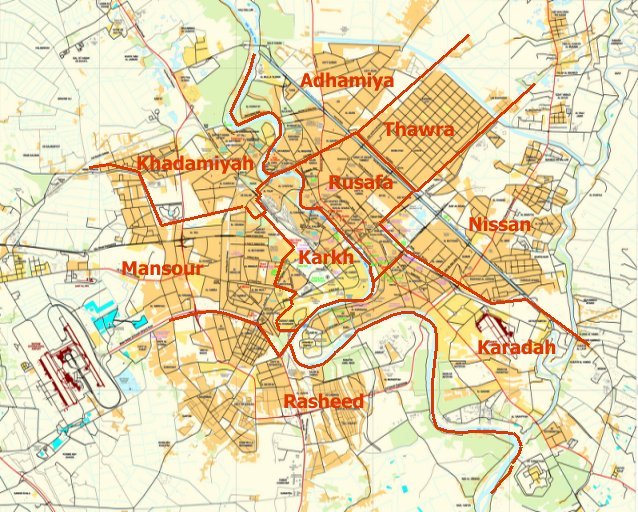
Military officials expressed concerns that the raids targeted leading Sunni community leaders in the capital's richest suburb Mansour, as well as nearby Amariyah. Mansour is Baghdad's Mayfair. Until recently it was a cosmopolitan mix of the elite and embassies.
President George W Bush set a series of benchmarks for the Iraqi government to meet when he committed 17,500 extra troops to quell violence in Baghdad. One was that the Shia-led administration had to demonstrate it had purged sectarian activities from within the government and security forces. Nouri al-Maliki, the prime minister, agreed that a Joint Command Centre with American and Iraqi would have the sole power to direct operations in Baghdad.
A classified map of the capital seen by The Daily Telegraph shows dramatic gains by Shias in all but a handful of areas. In only a few districts have Sunnis been able to consolidate their dominant position.
Military officials expressed concerns that the raids targeted leading Sunni community leaders in the capital's richest suburb Mansour, as well as nearby Amariyah. Mansour is Baghdad's Mayfair. Until recently it was a cosmopolitan mix of the elite and embassies.
President George W Bush set a series of benchmarks for the Iraqi government to meet when he committed 17,500 extra troops to quell violence in Baghdad. One was that the Shia-led administration had to demonstrate it had purged sectarian activities from within the government and security forces. Nouri al-Maliki, the prime minister, agreed that a Joint Command Centre with American and Iraqi would have the sole power to direct operations in Baghdad.
A classified map of the capital seen by The Daily Telegraph shows dramatic gains by Shias in all but a handful of areas. In only a few districts have Sunnis been able to consolidate their dominant position.
COMMENT: The ethnic mapping of Baghdad has changed radically in the last year. In the past there were many mixed ethnic areas. As sectarian killing and threats increased, many people left mixed areas to move into parts of Baghdad where their ethnic group was the majority. In other cases, they packed their bags and left. The majority of Baghdad is now divided in two, with Shias occupying the majority of Risafa - the side on the east of the Tigris and Sunnis in Karkh on the west of the river. However it is worth bearing in mind that Iraq's population is made up of 63% Shias and 34% Sunnis, resulting in Shias taking the most space. COMMENT ENDS.
Labels: ethnic cleansing, security forces
Tuesday, February 27, 2007
U.S., Iraqi forces raid Sadr City
Security
(AP) US and Iraqi forces staged raids in Baghdad’s main Shia militant stronghold Tuesday as part of politically sensitive forays into areas loyal to radical cleric Muqtada Al Sadr. Troops have held back on broad sweeps through the teeming Sadr City slums since a major security operation began earlier this month targeting militant factions and sectarian death squads that have ruled Baghdad’s streets.
Al Sadr withdrew his powerful Mahdi Army militia from checkpoints and bases under intense government pressure to let the neighbor-by-neighbor security sweeps move ahead. But Prime Minister Nouri Al Maliki and others have opposed extensive U.S.-led patrols through Sadr City, fearing a violent backlash could derail the security effort. The pre-dawn raids appeared to highlight a strategy of pinpoint strikes in Sadr City rather than the flood of soldiers sent into some Sunni districts.
At least 16 people were arrested after U.S.-Iraqi commandos, using concussion grenades, stormed six homes, police said. The US military had no immediate details of the operation. At a news conference, the Pentagon’s No. 2 commander in Iraq, Lt. Gen. Ray Odierno, declined to comment on whether there were special tactics for Sadr City. "We will go after anyone who we feel is working against the government of Iraq," he said. US military spokesman Maj. Gen. William Caldwell told Al Arabiya television that forces will increase our operations in the coming days,’ but noted that the security crackdown in the capital should continue until at least October.
Al Sadr withdrew his powerful Mahdi Army militia from checkpoints and bases under intense government pressure to let the neighbor-by-neighbor security sweeps move ahead. But Prime Minister Nouri Al Maliki and others have opposed extensive U.S.-led patrols through Sadr City, fearing a violent backlash could derail the security effort. The pre-dawn raids appeared to highlight a strategy of pinpoint strikes in Sadr City rather than the flood of soldiers sent into some Sunni districts.
At least 16 people were arrested after U.S.-Iraqi commandos, using concussion grenades, stormed six homes, police said. The US military had no immediate details of the operation. At a news conference, the Pentagon’s No. 2 commander in Iraq, Lt. Gen. Ray Odierno, declined to comment on whether there were special tactics for Sadr City. "We will go after anyone who we feel is working against the government of Iraq," he said. US military spokesman Maj. Gen. William Caldwell told Al Arabiya television that forces will increase our operations in the coming days,’ but noted that the security crackdown in the capital should continue until at least October.
Labels: Lt. Gen. Ray Odierno, raid, Sadr City, security forces