Wednesday, June 27, 2007
U.S. siege on al-Azamiyah lifted
Security
(Voices of Iraq) - U.S. forces lifted a five-day siege from al-Aazamiya, northern Baghdad, local residents said on Tuesday. "U.S. forces removed barricades from the outlets to the neighborhood and allowed residents to go to work after a siege that lasted for five days following Thursday's bombing of a U.S. vehicle and an attack on an Iraqi army checkpoint," an eyewitness told the independent news agency Voices of Iraq (VOI).
Another eyewitness told VOI, "technicians and workers started fixing water pipes damaged in the bombings and clashes last week and now the electricity is back." U.S. forces had asked residents of al-Aazamiya via microphone to report any armed groups in the area and were allowing only pedestrians in or out.
Another eyewitness told VOI, "technicians and workers started fixing water pipes damaged in the bombings and clashes last week and now the electricity is back." U.S. forces had asked residents of al-Aazamiya via microphone to report any armed groups in the area and were allowing only pedestrians in or out.
Labels: Azamiyah, siege, U.S. forces


Saturday, April 21, 2007
Azamiyah residents complain about barrier
Security
(AP) - A wall U.S. troops are building around a Sunni enclave in Baghdad came under increasing criticism on Saturday, with residents calling it "collective punishment" and a local leader saying construction began without the neighborhood council's approval.
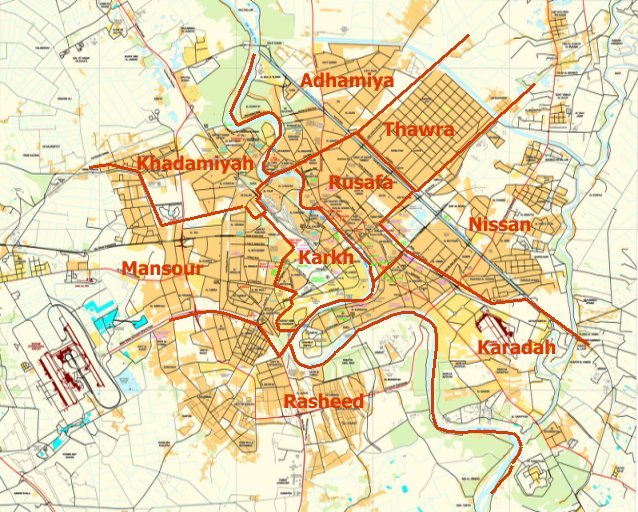
The U.S. military says the wall in Baghdad is meant to secure the minority Sunni community of Azamiyah, which "has been trapped in a spiral of sectarian violence and retaliation." The area, located on the eastern side of the Tigris River, would be completely gated, with entrances and exits manned by Iraqi soldiers, the U.S. military said earlier this week.
But some residents of the neighborhood, which is surrounded by Shiite areas, complained that they had not been consulted in advance about the barrier. U.S. and Iraqi forces have long erected cement barriers around marketplaces and coalition bases and outposts in Baghdad and other Iraqi cities such as Ramadi in an effort to prevent attacks, including suicide car bombs. But the Azamiyah project appears to be the biggest effort ever to use a lengthy wall in Baghdad to break contact, and violence, between Sunnis and Shiites.
The U.S. strategy for stabilizing Iraq now involves persuading Iraqis to live in peace and support their democratically elected government and launching a security plan in the capital that calls for 28,000 additional American troops and thousands of Iraqi soldiers.
The U.S. military says it began building the barrier April 10. AP Television News footage from the site on Saturday showed small concrete blocks, piles of dirt and coils of barbed wire on a main street. Eventually, the military said, the wall will be three miles long and include sections as tall as 12 feet. Community leaders said Saturday that construction began before they had approved an American proposal for the wall.
"A few days ago, we met with the U.S. army unit in charge of Azamiyah and it asked us, as a local council, to sign a document to build a wall to reduce killing and attacks against Iraqi and U.S. forces," said Dawood al-Azami, the acting head of the Azamiyah council. "I told the soldiers that I would not sign it unless I could talk to residents first. We told residents at Friday prayers, but our local council hasn't signed onto the project yet, and construction is already under way."
Labels: Azamiyah, barrier, Dawood al-Azami, U.S. military
Friday, April 20, 2007
Three-mile wall to protect Sunni part of Baghdad
Security
(AP) - U.S. soldiers are building a three-mile wall to protect a Sunni Arab enclave surrounded by Shiite neighborhoods in a Baghdad area "trapped in a spiral of sectarian violence and retaliation," the military said.
When the wall is finished, the minority Sunni community of Azamiyah, located on the eastern side of the Tigris River, will be completely gated, and traffic control points manned by Iraqi soldiers will provide the only means to enter it, the military said.
"Shiites are coming in and hitting Sunnis, and Sunnis are retaliating across the street," said Capt. Scott McLearn, of the U.S. 407th Brigade Support Battalion, which began the project April 10 and is working "almost nightly until the wall is complete," the statement said. It said the concrete wall, including barriers as tall as 12 feet, "is one of the centerpieces of a new strategy by coalition and Iraqi forces to break the cycle of sectarian violence" in Baghdad.
U.S. and Iraqi forces have long erected cement barriers around marketplaces and coalition bases and outposts in Baghdad and other Iraqi cities such as Ramadi in an effort to prevent attacks, including suicide car bombs. American forces also have constructed huge sand barriers around towns such as Tal Afar, an insurgent stronghold near the Syrian border, to limit access to them.
The Wall Street Journal reported on April 5 that U.S. forces in the mostly Sunni area of Dora in southern Baghdad had erected massive concrete barriers to separate Sunni and Shiite neighborhoods in an effort to stop widespread sectarian violence there. And Britain's Independent newspaper reported April 11 that U.S. forces are planning a counterinsurgency operation that would seal off large areas of Baghdad, using barricades to create "gated communities" that could only be entered with newly issued ID cards.
Currently, the U.S. strategy for stabilizing Iraq involves getting Iraqis to reconcile and support the democratically elected Shiite-dominated government in Baghdad, and a security plan in the capital that calls for 28,000 additional American troops and thousands of Iraqi soldiers. U.S. Maj. Gen. William B. Caldwell IV, the top spokesman for coalition forces in Iraq, was quoted as saying Wednesday that he was unaware of any effort to build a wall dividing Shiite and Sunni enclaves in Baghdad and that such a tactic was not a policy of the Baghdad security plan.
Labels: Azamiyah, Capt. Scott McLearn, Maj. Gen. William Caldwell
Tuesday, March 27, 2007
Leaders of car-bombing ring captured
Security
(AP) - Leaders of a car-bombing ring believed responsible for the deaths of hundreds of Iraqis in the Shiite Sadr City enclave and elsewhere in Baghdad have been captured, the U.S. military said on Monday. The suspected bombers were rounded up last week by American forces during continuing security sweeps in Azamiyah, the Sunni stronghold in northern Baghdad, the military statement said.
The U.S. command said one of the detained men, Haitham al-Shimari, was suspected in the "planning and execution of the majority of car bombs which have killed hundreds of Iraqi citizens in Sadr City." The reported "second-in-command" of the Azamiyah-based cell, Haidar al-Jafar, was arrested the same day. The military said that group had "killed approximately 900 innocent Iraqi citizens" and wounded 1,950. Three other men believed connected to the bombing cell also were in custody, the military said.
The U.S. command said one of the detained men, Haitham al-Shimari, was suspected in the "planning and execution of the majority of car bombs which have killed hundreds of Iraqi citizens in Sadr City." The reported "second-in-command" of the Azamiyah-based cell, Haidar al-Jafar, was arrested the same day. The military said that group had "killed approximately 900 innocent Iraqi citizens" and wounded 1,950. Three other men believed connected to the bombing cell also were in custody, the military said.
Labels: Azamiyah, car bombs, Haidar al-Jafar, Haitham al-Shimari, Sadr City