Tuesday, August 28, 2007
Islamic Army in Iraq signs ceasefire with Al Qaeda in Iraq
Insurgency
(The Times) - The Islamic Army is one of Iraq’s best known resistance groups, made up largely of former members of Saddam Hussein’s army and security forces. In a turnaround that heartened proponents of the US troop surge, it has lately been firing its weapons at Al-Qaeda in Iraq instead of American soldiers. The US military has been discreetly putting out feelers to the Islamic Army in the hope of winning it over permanently.
But Ibrahim al-Shammari, a representative of the Islamic Army, had an uncompromising message for the Americans. The Islamic Army and other armed factions would agree to talks only if they accepted that the “Islamic resistance” was the legitimate representative of the Iraqi people and agreed to set a clear timetable for withdrawal from Iraq. The government of Nouri al-Maliki, the prime minister, was finished, he boasted. “The final countdown has started. It has lost the support of Iraqis and the American people.”
It was hard to disagree when Senator Hillary Clinton, the front-runner for the Democratic presidential nomination, had just joined a chorus of US politicians demanding Maliki’s removal. She said she hoped the Iraqi parliament would replace him with a “less divisive and more unifying figure”. Ryan Crocker, the US ambassador in Baghdad, told Time magazine, “the fall of the Maliki government, when it happens, might be a good thing”.
Yet many opponents of the US troop build-up, including Clinton, are coming round to the view that the surge is partially working – at least to the west of Baghdad in Anbar province, where Sunni tribesmen have been aiding Iraqi security forces and the Americans.
According to Shammari, however, the gains in Anbar will be shortlived. He said the Islamic Army had signed a ceasefire with Al-Qaeda in Iraq. The country was to be carved into spheres of influence where the Islamic Army and Al-Qaeda in Iraq could operate independently of each other. It would represent an enormous setback for the surge. Shammari admitted Al-Qaeda in Iraq was unpopular. “Local people consider them enemy number one. They tyrannised people and killed and assaulted tribal leaders. They lost their bases and supporters and provoked the clans into rising up against them,” he said.
But the Islamic Army resents the way the Americans have tried to turn the infighting in Anbar to their advantage. “We’ve had big problems with Al-Qaeda ever since they began targeting and killing our men,” he said. “Eventually we had to fight back, but we found American troops were exploiting the situation by spreading rumours that exacerbated the conflict.”
The Islamic Army has also noted President George Bush’s comments about the success of the surge. “Bush foolishly announced to the world that all the Sunnis in Iraq were fighting Al-Qaeda so he could claim to have achieved a great victory,” Shammari said. “It’s nonsense.”
The Islamic Army is considering resuming the kidnapping of foreigners as a sign of renewed militancy, Shammari said. In the past, it was responsible for murdering Enzo Baldoni, an Italian journalist, and a number of foreign workers. It also kidnapped two French journalists who were later released. “Every foreigner in Iraq is a potential target for us no matter what his nationality or religion,” Shammari said. “If he is proven to be a spy, he will be punished and an Islamic court will determine his fate.” The purpose of taking hostages would not be to kill them, he added. “We want western governments to listen to the Iraqi people and stop supporting the occupation by sending their citizens to Iraq.”
The Islamic Army’s defiance sharpens the dilemma for American forces. Could progress in Anbar quickly unravel? If the US draws down its forces, will the Sunnis take the fight, not to Al-Qaeda, but to the Shi’ite government in Baghdad? And if so, will the US military have helped to build up a brutal sectarian force?
In Baghdad, Colonel Rick Welch, head of reconciliation for the US military command, told The Washington Post earlier this month that Sunni groups had recently provided 5,000 fighters for policing efforts in the capital. But he admitted that Maliki’s government was “worried that the Sunni tribes may be using mechanisms to build their strength and power and eventually to challenge this government. This is a risk for us all”.
The National Intelligence Estimate, drawn up by US intelligence agencies and published last week, spelt out similar dangers. “Sunni Arab resistance to Al-Qaeda in Iraq has expanded in the last six to nine months but has not yet translated into broad Sunni Arab support for the Iraqi government or widespread willingness to work with the Shia,” it noted.
Back in the villa, Shammari said Maliki’s government would soon be gone. “The daily contradictions in the statements by American leaders about Iraq prove that the Iraqi resistance is going in the right direction.”
He added: “The next president should take prompt action to withdraw all US troops from Iraq.” And Gordon Brown should follow suit, he said, though he could hardly fail to be aware that plans for British withdrawal in the coming months are already advanced. “The new prime minister should save Britain from the humiliating stupidity of Tony Blair and Bush and start withdrawing troops from Iraq now,” he said.
But Ibrahim al-Shammari, a representative of the Islamic Army, had an uncompromising message for the Americans. The Islamic Army and other armed factions would agree to talks only if they accepted that the “Islamic resistance” was the legitimate representative of the Iraqi people and agreed to set a clear timetable for withdrawal from Iraq. The government of Nouri al-Maliki, the prime minister, was finished, he boasted. “The final countdown has started. It has lost the support of Iraqis and the American people.”
It was hard to disagree when Senator Hillary Clinton, the front-runner for the Democratic presidential nomination, had just joined a chorus of US politicians demanding Maliki’s removal. She said she hoped the Iraqi parliament would replace him with a “less divisive and more unifying figure”. Ryan Crocker, the US ambassador in Baghdad, told Time magazine, “the fall of the Maliki government, when it happens, might be a good thing”.
Yet many opponents of the US troop build-up, including Clinton, are coming round to the view that the surge is partially working – at least to the west of Baghdad in Anbar province, where Sunni tribesmen have been aiding Iraqi security forces and the Americans.
According to Shammari, however, the gains in Anbar will be shortlived. He said the Islamic Army had signed a ceasefire with Al-Qaeda in Iraq. The country was to be carved into spheres of influence where the Islamic Army and Al-Qaeda in Iraq could operate independently of each other. It would represent an enormous setback for the surge. Shammari admitted Al-Qaeda in Iraq was unpopular. “Local people consider them enemy number one. They tyrannised people and killed and assaulted tribal leaders. They lost their bases and supporters and provoked the clans into rising up against them,” he said.
But the Islamic Army resents the way the Americans have tried to turn the infighting in Anbar to their advantage. “We’ve had big problems with Al-Qaeda ever since they began targeting and killing our men,” he said. “Eventually we had to fight back, but we found American troops were exploiting the situation by spreading rumours that exacerbated the conflict.”
The Islamic Army has also noted President George Bush’s comments about the success of the surge. “Bush foolishly announced to the world that all the Sunnis in Iraq were fighting Al-Qaeda so he could claim to have achieved a great victory,” Shammari said. “It’s nonsense.”
The Islamic Army is considering resuming the kidnapping of foreigners as a sign of renewed militancy, Shammari said. In the past, it was responsible for murdering Enzo Baldoni, an Italian journalist, and a number of foreign workers. It also kidnapped two French journalists who were later released. “Every foreigner in Iraq is a potential target for us no matter what his nationality or religion,” Shammari said. “If he is proven to be a spy, he will be punished and an Islamic court will determine his fate.” The purpose of taking hostages would not be to kill them, he added. “We want western governments to listen to the Iraqi people and stop supporting the occupation by sending their citizens to Iraq.”
The Islamic Army’s defiance sharpens the dilemma for American forces. Could progress in Anbar quickly unravel? If the US draws down its forces, will the Sunnis take the fight, not to Al-Qaeda, but to the Shi’ite government in Baghdad? And if so, will the US military have helped to build up a brutal sectarian force?
In Baghdad, Colonel Rick Welch, head of reconciliation for the US military command, told The Washington Post earlier this month that Sunni groups had recently provided 5,000 fighters for policing efforts in the capital. But he admitted that Maliki’s government was “worried that the Sunni tribes may be using mechanisms to build their strength and power and eventually to challenge this government. This is a risk for us all”.
The National Intelligence Estimate, drawn up by US intelligence agencies and published last week, spelt out similar dangers. “Sunni Arab resistance to Al-Qaeda in Iraq has expanded in the last six to nine months but has not yet translated into broad Sunni Arab support for the Iraqi government or widespread willingness to work with the Shia,” it noted.
Back in the villa, Shammari said Maliki’s government would soon be gone. “The daily contradictions in the statements by American leaders about Iraq prove that the Iraqi resistance is going in the right direction.”
He added: “The next president should take prompt action to withdraw all US troops from Iraq.” And Gordon Brown should follow suit, he said, though he could hardly fail to be aware that plans for British withdrawal in the coming months are already advanced. “The new prime minister should save Britain from the humiliating stupidity of Tony Blair and Bush and start withdrawing troops from Iraq now,” he said.
Labels: Al Qaeda in Iraq, Hillary Clinton, Ibrahim al-Shammari, Islamic Army in Iraq, kidnapping, Ryan Crocker


Monday, April 02, 2007
Truck bomb kills 13 in Kirkuk as 19 men kidnapped from Shia village
Security
(Reuters) - A suicide truck bomb killed 12 people and wounded 137 others in the northern Iraqi city of Kirkuk on Monday in the latest attack by insurgents using explosives-laden trucks. Many of the victims were women and children at a nearby school, police said. Insurgents have hit a string of northern Iraqi towns in the past 10 days in bombings that have killed hundreds of people. Officials have blamed the attacks on Sunni Islamist al Qaeda.
In other violence, the bodies of 19 men from a Shi'ite village kidnapped by gunmen at a fake checkpoint north of Baghdad were found on Monday, police said. All had been shot in the head in one of the biggest kidnappings in months. U.S. commanders say insurgents are shifting the focus of their attacks outside Baghdad because of a nearly seven-week-old crackdown in the capital. The U.S.-Iraqi offensive is seen as a final attempt to halt Iraq's plunge into sectarian civil war.
Police said the attacker in Kirkuk rammed his vehicle into the main gate of the police criminal investigation department and detonated the bomb, triggering a blast that echoed across the ethnically mixed city. The building was partially destroyed. In the mass kidnapping, gunmen seized the 19 men from a Shi'ite village near the city of Baquba after stopping cars at a fake checkpoint on Sunday. The bodies were found not far from Baquba, which lies 65 km (40 miles) north of Baghdad. A car bomb also killed two people and wounded nine others in the southern Bayaa district of Baghdad, police said.
In other violence, the bodies of 19 men from a Shi'ite village kidnapped by gunmen at a fake checkpoint north of Baghdad were found on Monday, police said. All had been shot in the head in one of the biggest kidnappings in months. U.S. commanders say insurgents are shifting the focus of their attacks outside Baghdad because of a nearly seven-week-old crackdown in the capital. The U.S.-Iraqi offensive is seen as a final attempt to halt Iraq's plunge into sectarian civil war.
Police said the attacker in Kirkuk rammed his vehicle into the main gate of the police criminal investigation department and detonated the bomb, triggering a blast that echoed across the ethnically mixed city. The building was partially destroyed. In the mass kidnapping, gunmen seized the 19 men from a Shi'ite village near the city of Baquba after stopping cars at a fake checkpoint on Sunday. The bodies were found not far from Baquba, which lies 65 km (40 miles) north of Baghdad. A car bomb also killed two people and wounded nine others in the southern Bayaa district of Baghdad, police said.
Labels: Baghdad, Baqouba, car bombs, kidnapping, Kirkuk, suicide truck bomber
Sunday, March 18, 2007
Islamic group calls for release of German hostages
Security
(AFP) - An Islamic group in Germany called for the immediate release of two German citizens abducted in Iraq, in an interview published on Sunday. "The kidnapping has nothing to do with the nature of our religion and also finds no justification in the Koran," the chairman of the Islamic Council for Germany, Ali Kizilkaya, told Bild am Sonntag. "I call on the kidnappers in the name of humanity: Let the innocent hostages go immediately."
Hannelore Krause, who is 61 and married to an Iraqi doctor, and their 20-year-old son Sinan, who works at the Iraqi foreign ministry, were seized on February 6. Sunday's appeal came after Krause's husband and Sinan's wife made an emotional plea for their release in a video message broadcast on channels in Germany and the Arab world Friday. And German President Horst Koehler last week also called for their release in a video broadcast. Earlier this month, a militant Islamist group in Iraq called the Kataeb Siham al-Haq (Righteous Arrows Battalions) threatened to execute the hostages unless Germany pulls its troops out of
Afghanistan.
Afghanistan.
Labels: Germany, Hannelore Krause, Islamic Council for Germany, Kataeb Siham al-Haq, kidnapping, Righteous Arrows Battalions
Friday, March 02, 2007
Islamic State of Iraq kidnaps Interior Ministry employees
Security
(SITE) According to a communique published on jihadist forums on Thursday, March 1, 2007, the Islamic State of Iraq has announced the capture of eighteen employees of the Ministry of the Interior in Diyala, Iraq. The communique states that "This blessed operation is in response to the crimes carried out by those apostates in their fight against the Sunnis…including raping our sister in Allah, 'Sabrina al-Janabi.'" Sabrin al-Janabi, a Sunni Iraqi woman, recently claimed she was raped by several Shi'a officers.
The Islamic State of Iraq has given the Iraqi government 24 hours to respond to two demands:
1. "Handing over the officers involved in the heinous act against our pious sister."
2. "The release of all Sunni Muslim sisters from the prisons of the apostate [Ministry of] Interior."
To back up their claim, the Islamic State of Iraq posted ten pictures depicting masked gunman holding 18 blindfolded men, some in army uniforms, hostage.
The Islamic State of Iraq has given the Iraqi government 24 hours to respond to two demands:
1. "Handing over the officers involved in the heinous act against our pious sister."
2. "The release of all Sunni Muslim sisters from the prisons of the apostate [Ministry of] Interior."
To back up their claim, the Islamic State of Iraq posted ten pictures depicting masked gunman holding 18 blindfolded men, some in army uniforms, hostage.
Labels: Diyala, Islamic State of Iraq, kidnapping, Ministry of Interior
Thursday, March 01, 2007
Abductions curbed by military operations
Security
(Gulf News) The wave of kidnappings that had swept the Iraqi capital till a few days ago has been restricted after the implementation of the 'Imposing Law' security plan, according to citizens. The captors are facing difficulties in carrying out their missions in Baghdad's suburbs, crowded with military and security barricades, they added. The motives behind abductions ranged from the common demand for heavy ransom to assassination of the detainees, according to Iraqi residents.
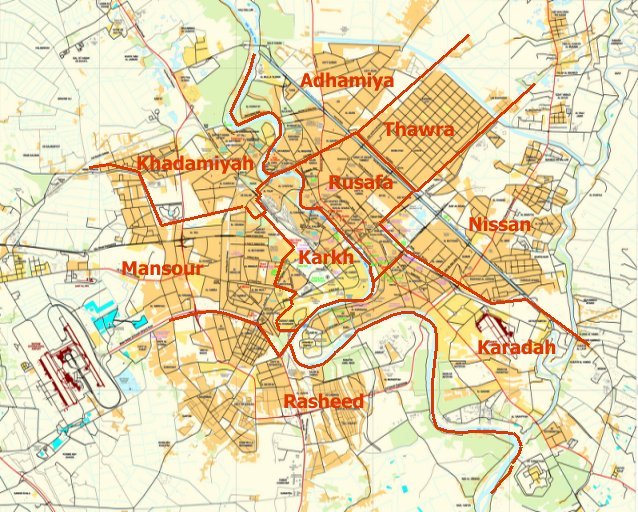
Some of the abductions aim to sponsor armed groups. In the Sunni-majority city of Al Adhamiya, kidnapping has another aspect. Captors tell the potential victim that if he doesn't pay the jihad payment, he will be abducted and then the bargains will start between them and his family.
Except Al Qaida in Iraq, which is led by Abu Hamza Al Muhajir, and the Shiite militias, the sole purpose of the kidnappings is to turn the hostage before a court that issues the death sentence to him. Money, therefore, has no place in these groups' minds. As in the case of Al Muhajir organisation, Shiite armed militias and specifically the Mehdi Army, have specific goals unless the kidnapped has Shiite roots.
Some of the abductions aim to sponsor armed groups. In the Sunni-majority city of Al Adhamiya, kidnapping has another aspect. Captors tell the potential victim that if he doesn't pay the jihad payment, he will be abducted and then the bargains will start between them and his family.
Except Al Qaida in Iraq, which is led by Abu Hamza Al Muhajir, and the Shiite militias, the sole purpose of the kidnappings is to turn the hostage before a court that issues the death sentence to him. Money, therefore, has no place in these groups' minds. As in the case of Al Muhajir organisation, Shiite armed militias and specifically the Mehdi Army, have specific goals unless the kidnapped has Shiite roots.
Labels: Abu Hamza Al Muhajir, Al Qaeda in Iraq, hostages, kidnapping, operation Imposing Law, Shiite militias