Sunday, November 11, 2007
Iraqi Minister Council removes legal immunity from foreign private security firms
Republic of Iraq, Ministry of Interior, Ministry Agency of information and National Investigations
General Dept of the Technical Affairs, Headquarters of Registration and Assessment of Private Security Companies
Letter No: 937, Date: Nov 1, 2007
To: All PSC
Sub: Removing the legal immunity
According to the directions of the Minister Council regarding moving the legal immunity
from all the foreign private security companies and deal with it according to Iraqi law.
Please notify that in all your future missions and give the direction to all your staff. For
your information all the Iraqi security departments were informed about it .The MNF
confirming taking the legal actions against any violator in the future. Including signing
your passports from the traveling and Jinsseya directorate to make your residence in Iraq
legal .And the violator will face legal punishment from the Iraqi law.
Col
The Director of Registration and Assessment of PSC office
Copy to: To be informed and to take the appropriate actions …..With
respect PSCAI, PSC.
General Dept of the Technical Affairs, Headquarters of Registration and Assessment of Private Security Companies
Letter No: 937, Date: Nov 1, 2007
To: All PSC
Sub: Removing the legal immunity
According to the directions of the Minister Council regarding moving the legal immunity
from all the foreign private security companies and deal with it according to Iraqi law.
Please notify that in all your future missions and give the direction to all your staff. For
your information all the Iraqi security departments were informed about it .The MNF
confirming taking the legal actions against any violator in the future. Including signing
your passports from the traveling and Jinsseya directorate to make your residence in Iraq
legal .And the violator will face legal punishment from the Iraqi law.
Col
The Director of Registration and Assessment of PSC office
Copy to: To be informed and to take the appropriate actions …..With
respect PSCAI, PSC.
In the Name of the People - The Presidency Council
Based on what was submitted by the Council of Ministers and ratified by the Council of
Representatives and in accordance with the provisions of Article 138 (Fifth) of the
Constitution, the Presidency Council has decided in its session held on / / / to promulgate
the following law.
No. ( ) of 2007
The Law of subjecting Non-Iraqi Security Companies and its Contractors to the
Provisions of the Iraqi law
Article 1:
Non-Iraqi security companies and its non-Iraqi employees and contractors shall be
subject to the Iraqi legislations and the jurisdiction of the Iraqi judiciary in all civil and
criminal cases. All immunities granted to them in accordance with any valid legislation
shall be canceled.
Article 2:
The categories mentioned in Article 1 of this law shall be subject to the Iraqi legislations
including those related to the residency, granting visas, possessing and carrying weapons,
paying taxes, fees and customs, registering companies and granting them license to work
in the Iraqi territories.
Article 3:
The vehicles, ships, airplanes belonging to the categories mentioned in Article 1 of this
law shall be subject to the procedures of registration, licensing, checking and inspection
stipulated in the Iraqi legislations.
Article 4:
This law shall be deemed as an amendment for the Dissolved CPA Order No17 of 2004.
Article 5:
This Law shall enter into force on the date of its publishing in the Official Gazette.
Provisions of the Iraqi law
Article 1:
Non-Iraqi security companies and its non-Iraqi employees and contractors shall be
subject to the Iraqi legislations and the jurisdiction of the Iraqi judiciary in all civil and
criminal cases. All immunities granted to them in accordance with any valid legislation
shall be canceled.
Article 2:
The categories mentioned in Article 1 of this law shall be subject to the Iraqi legislations
including those related to the residency, granting visas, possessing and carrying weapons,
paying taxes, fees and customs, registering companies and granting them license to work
in the Iraqi territories.
Article 3:
The vehicles, ships, airplanes belonging to the categories mentioned in Article 1 of this
law shall be subject to the procedures of registration, licensing, checking and inspection
stipulated in the Iraqi legislations.
Article 4:
This law shall be deemed as an amendment for the Dissolved CPA Order No17 of 2004.
Article 5:
This Law shall enter into force on the date of its publishing in the Official Gazette.
Labels: Interior Ministry, Iraq, legal immunity, private security firms, PSCs


Monday, September 17, 2007
Iraqi government pulls Blackwater's security license
Security
(AP) - The Iraqi government said Monday that it was pulling the license of an American security firm allegedly involved in the fatal shooting of civilians during an attack on a U.S. State Department motorcade in Baghdad. The Interior Ministry said it would prosecute any foreign contractors found to have used excessive force in the Sunday shooting. It was latest accusation against the U.S.-contracted firms that operate with little or no supervision and are widely disliked by Iraqis who resent their speeding motorcades and forceful behavior.
Interior Ministry spokesman Abdul-Karim Khalaf said eight civilians were killed and 13 were wounded when security contractors believed to be working for Blackwater USA opened fire in a predominantly Sunni neighborhood of western Baghdad. "We have canceled the license of Blackwater and prevented them from working all over Iraqi territory. We will also refer those involved to Iraqi judicial authorities," Khalaf said.
The spokesman said witness reports pointed to Blackwater involvement but said the shooting was still under investigation. It was not immediately clear if the measure against Blackwater was intended to be temporary or permanent. Blackwater, based in Moyock, N.C., provides security for many U.S. civilian operations in the country. Phone messages left early Monday at the company's office in North Carolina and with a spokeswoman were not immediately returned.
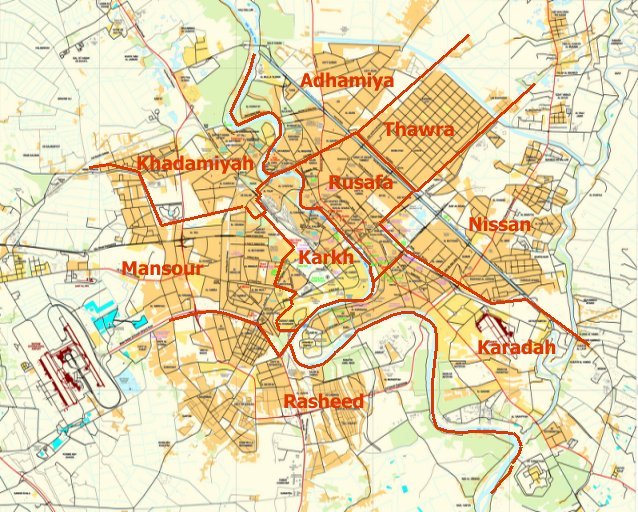
The U.S. Embassy said a State Department motorcade came under small-arms fire that disabled one of the vehicles, which had to be towed from the scene near Nisoor Square in the Mansour district. An embassy official provided no information about Iraqi casualties but said no State Department personnel were wounded or killed. He spoke on condition of anonymity because he was not authorized to speak to media.
He said the shooting was being investigated by the State Department's diplomatic security service and law enforcement officials working with the Iraqi government and the U.S. military. Prime Minister Nouri al-Maliki late Sunday condemned the shooting by a "foreign security company" and called it a "crime." The decision to pull the license was likely to face a challenge as it would be a major blow to a company that was at the forefront of one of the main turning points in the war.
The 2004 battle of Fallujah — an unsuccessful military assault in which an estimated 27 U.S. Marines were killed, along with an unknown number of civilians — was retaliation for the killing, maiming and burning of four Blackwater guards in that city by a mob of insurgents. Tens of thousands of foreign private security contractors work in Iraq — some with automatic weapons, body armor, helicopters and bulletproof vehicles — to provide protection for Westerners and dignitaries in Iraq as the country has plummeted toward anarchy and civil war.
Monday's action against Blackwater was likely to give the unpopular government a boost, given the contractors' widespread unpopularity. Many of the contractors have been accused of indiscriminately firing at American and Iraqi troops, and of shooting to death an unknown number of Iraqi citizens who got too close to their heavily armed convoys, but none has faced charges or prosecution.
The question of whether they could face prosecution is a gray legal area. Unlike soldiers, they are not bound by the Uniform Code of Military Justice. Under a special provision secured by American-occupying forces, they are exempt from prosecution by Iraqis for crimes committed there. Khalaf, however, denied that the exemption applied to private security companies.
Interior Ministry spokesman Abdul-Karim Khalaf said eight civilians were killed and 13 were wounded when security contractors believed to be working for Blackwater USA opened fire in a predominantly Sunni neighborhood of western Baghdad. "We have canceled the license of Blackwater and prevented them from working all over Iraqi territory. We will also refer those involved to Iraqi judicial authorities," Khalaf said.
The spokesman said witness reports pointed to Blackwater involvement but said the shooting was still under investigation. It was not immediately clear if the measure against Blackwater was intended to be temporary or permanent. Blackwater, based in Moyock, N.C., provides security for many U.S. civilian operations in the country. Phone messages left early Monday at the company's office in North Carolina and with a spokeswoman were not immediately returned.
The U.S. Embassy said a State Department motorcade came under small-arms fire that disabled one of the vehicles, which had to be towed from the scene near Nisoor Square in the Mansour district. An embassy official provided no information about Iraqi casualties but said no State Department personnel were wounded or killed. He spoke on condition of anonymity because he was not authorized to speak to media.
He said the shooting was being investigated by the State Department's diplomatic security service and law enforcement officials working with the Iraqi government and the U.S. military. Prime Minister Nouri al-Maliki late Sunday condemned the shooting by a "foreign security company" and called it a "crime." The decision to pull the license was likely to face a challenge as it would be a major blow to a company that was at the forefront of one of the main turning points in the war.
The 2004 battle of Fallujah — an unsuccessful military assault in which an estimated 27 U.S. Marines were killed, along with an unknown number of civilians — was retaliation for the killing, maiming and burning of four Blackwater guards in that city by a mob of insurgents. Tens of thousands of foreign private security contractors work in Iraq — some with automatic weapons, body armor, helicopters and bulletproof vehicles — to provide protection for Westerners and dignitaries in Iraq as the country has plummeted toward anarchy and civil war.
Monday's action against Blackwater was likely to give the unpopular government a boost, given the contractors' widespread unpopularity. Many of the contractors have been accused of indiscriminately firing at American and Iraqi troops, and of shooting to death an unknown number of Iraqi citizens who got too close to their heavily armed convoys, but none has faced charges or prosecution.
The question of whether they could face prosecution is a gray legal area. Unlike soldiers, they are not bound by the Uniform Code of Military Justice. Under a special provision secured by American-occupying forces, they are exempt from prosecution by Iraqis for crimes committed there. Khalaf, however, denied that the exemption applied to private security companies.
Iraqi police said the contractors were in a convoy of six sport utility vehicles and left after the shooting. A witness said the gunfire broke out following an explosion. "We saw a convoy of SUVs passing in the street nearby. One minute later, we heard the sound of a bomb explosion followed by gunfire that lasted for 20 minutes between gunmen and the convoy people who were foreigners and dressed in civilian clothes. Everybody in the street started to flee immediately," said Hussein Abdul-Abbas, who owns a mobile phone store in the area.
The wartime numbers of private guards are unprecedented — as are their duties, many of which have traditionally been done by soldiers. They protect U.S. military operations and diplomats and have guarded high-ranking officials including Gen. David Petraeus, the top U.S. commander in Baghdad. They also protect journalists, visiting foreign officials and thousands of construction projects. Blackwater has an estimated 1,000 employees in Iraq, and at least $800 million in government contracts. It is one of the most high-profile security firms in Iraq, with its fleet of "Little Bird" helicopters and armed door gunners swarming Baghdad and beyond.
The secretive company, run by a former Navy SEAL, is based at a massive, swampland complex. Until the Sept. 11, 2001 terror attacks, it had few security contracts. Since then, Blackwater profits have soared. And it has become the focus of numerous controversies in Iraq, including the May 30 shooting death of an Iraqi deemed to be driving too close to a Blackwater security detail.
The wartime numbers of private guards are unprecedented — as are their duties, many of which have traditionally been done by soldiers. They protect U.S. military operations and diplomats and have guarded high-ranking officials including Gen. David Petraeus, the top U.S. commander in Baghdad. They also protect journalists, visiting foreign officials and thousands of construction projects. Blackwater has an estimated 1,000 employees in Iraq, and at least $800 million in government contracts. It is one of the most high-profile security firms in Iraq, with its fleet of "Little Bird" helicopters and armed door gunners swarming Baghdad and beyond.
The secretive company, run by a former Navy SEAL, is based at a massive, swampland complex. Until the Sept. 11, 2001 terror attacks, it had few security contracts. Since then, Blackwater profits have soared. And it has become the focus of numerous controversies in Iraq, including the May 30 shooting death of an Iraqi deemed to be driving too close to a Blackwater security detail.
Labels: Abdul-Karim Khalaf, Blackwater Security Consulting, Interior Ministry, Iraqi government, Mansour, PSC, security firm
Friday, September 14, 2007
Iraqi interior minister - Iraq 'unaware' of security barriers to be erected by neighbours
Region
(Voices of Iraq) - Iraqi Interior Ministry said on Thursday that it has no information on the security barriers erected by neighbors Iran and Saudi Arabia along their borders with Iraq, describing such a move as "positive". "The erection of such security barriers would help prevent the infiltration of persons and trafficking of cars and vehicles that carry arms and explosives into Iraq," General Abdul Karim Khalaf, director of National Command Centre, told the independent news agency Voices of Iraq (VOI).
Khalaf who denied having any information on these security barriers said "this move, if carried out, will have positive effects on Iraq and neighbors." Earlier on Thursday, a source from Basra police said that Iran had accomplished a large part of a security barrier along its borders with the southern Iraqi city of Basra. "The Iranians are building a barrier along the Iraqi-Iranian borders in Basra city," a source from al-Shalamja police told VOI. The source, who asked not to be named, added "the barrier is seven meters high and a large part of it has already been erected."
Meanwhile, the London-based al-Hayat newspaper said the Saudi government will continue building a security fence on the borders with Iraq, with its first stage finished by the end of 2009, to stop infiltration operations. The newspaper quoted General Mansour al-Turki as saying on Thursday, "The first stage envisages the northern borders. The project was announced with a tender and several qualified companies presented their bids to win the project."
The Kingdom invited five companies to bid for the contract to build a 560 mile-long security fence along its border with Iraq at a cost of up to 4 billion Riyals (USD 1.07 billion), officials from the competing companies said on Wednesday. "The winning company will be announced this year," he also said.
The contract calls for a double-lined, razor wire fence along the Kingdom's frontier with its northern neighbor, complete with thermal imaging and radar equipment. Saudi Interior Minister Naief Bin Abdul Aziz said last November that the fence has became very important for protecting the country's security.
Khalaf who denied having any information on these security barriers said "this move, if carried out, will have positive effects on Iraq and neighbors." Earlier on Thursday, a source from Basra police said that Iran had accomplished a large part of a security barrier along its borders with the southern Iraqi city of Basra. "The Iranians are building a barrier along the Iraqi-Iranian borders in Basra city," a source from al-Shalamja police told VOI. The source, who asked not to be named, added "the barrier is seven meters high and a large part of it has already been erected."
Meanwhile, the London-based al-Hayat newspaper said the Saudi government will continue building a security fence on the borders with Iraq, with its first stage finished by the end of 2009, to stop infiltration operations. The newspaper quoted General Mansour al-Turki as saying on Thursday, "The first stage envisages the northern borders. The project was announced with a tender and several qualified companies presented their bids to win the project."
The Kingdom invited five companies to bid for the contract to build a 560 mile-long security fence along its border with Iraq at a cost of up to 4 billion Riyals (USD 1.07 billion), officials from the competing companies said on Wednesday. "The winning company will be announced this year," he also said.
The contract calls for a double-lined, razor wire fence along the Kingdom's frontier with its northern neighbor, complete with thermal imaging and radar equipment. Saudi Interior Minister Naief Bin Abdul Aziz said last November that the fence has became very important for protecting the country's security.
Labels: General Abdul Karim Khalaf, Interior Ministry, Iran, Saudi Arabia, security fence