Wednesday, October 10, 2007
U.S., Iraqis probe civilian killings by private security company
Security
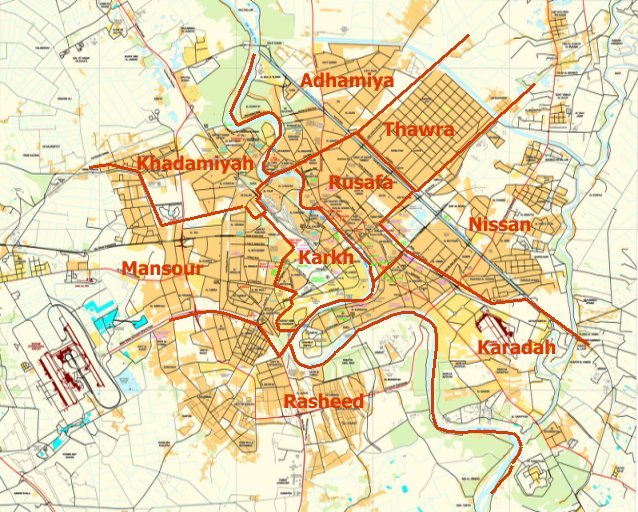
(AP) - U.S. and Iraqi officials Wednesday were investigating yet another shooting of Iraqi civilians by a heavily armed security firm linked to U.S. government-financed work in Iraq. The bodies of Marou Awanis and Geneva Jalal, the Christian women killed in the Tuesday shooting, were taken, meanwhile, to Baghdad's Armenian Orthodox Virgin Mary Church for funeral services. Iraqi authorities blamed the women's deaths on guards working for Unity Resources Group, a security company owned by Australian partners but with headquarters in Dubai in the United Arab Emirates.
Unity provides security services to RTI International, a group based in Research Triangle Park, N.C., that promotes governance projects in Iraq for the U.S. Agency for International Development. Both Unity and RTI acknowledged a security contract between them and both entities said RTI staffers were not present when the shooting occurred in Baghdad's Karradah district. A U.S. Embassy spokeswoman said RTI was under contract by USAID but was responsible for its own security.
Michael Priddin, chief operating officer of Unity, told The Associated Press on Wednesday the firm was working with Iraqi authorities "to find out the results of the shooting incident. ...we are trying to work out a true picture of what happened." In a statement issued Tuesday night, Priddin said, "We deeply regret this incident."
Iraqi government officials, police and witnesses said guards working for Unity fired on a white Oldsmobile as it approached their convoy Tuesday afternoon, killing the two women before speeding away from the latest bloodshed blamed on the deadly mix of heavily armed protection details on Baghdad's crowded streets.
The deaths of the women — including one who used the white sedan as an unofficial taxi to raise money for her family — came a day after the Iraqi government handed U.S. officials a report demanding hefty payments and the ouster from Iraq of embattled Blackwater USA for a chaotic shooting last month that left at least 17 civilians dead.
The Tuesday killings were certain to sharpen Iraqi government demands to curb the expanding array of security firms in Iraq watching over diplomats, aid groups and others. Accounts of the incident — from company statements, witnesses and others — suggested the Unity guards opened fire as the car failed to heed warnings to stop and drifted closer to the convoy near a Unity facility in Karrahah.
Four armored SUVs — three white and one gray — were about 100 yards from a main intersection in the Shiite-controlled district at about 1:40 p.m. As the car moved into the crossroads, the Unity guards threw a smoke bomb in an apparent bid to warn the driver not to come closer, said Riyadh Majid, an Iraqi policeman who saw the shooting. Two of the Unity guards then opened fire. The woman driving the car tried to stop, but was killed along with her passenger. Two of three people in the back seat were wounded.
Priddin's Tuesday statement offered a similar account: "The first information that we have is that our security team was approached at speed by a vehicle which failed to stop despite an escalation of warnings which included hand signals and a signal flare. Finally shots were fired at the vehicle and it stopped."
Iraqi police investigators said they collected 19 spent 5.56 mm shell casings, ammunition commonly used by U.S. and NATO forces and most Western security organizations. The pavement was stained with blood and covered with shattered glass from the car windows. Majid said the convoy raced away after the shooting. Iraqi police came to collect the bodies and tow the car to the local station.
A second policeman, who spoke on condition of anonymity because he feared retribution, said the guards were masked and wearing khaki uniforms. He said one of them left the vehicle and started to shoot at the car while another opened fire from the open back door of a separate SUV.
Iraqi anger has grown against the private security companies — nearly all based in the United States, Britian and other Western countries — as symbols of the lawlessness that has ravaged their country for more than four years.
Ali al-Dabbagh, Iraq's government spokesman, said: "Today's incident is part of a series of reckless actions by some security companies." Unity also has come under scrutiny before. In March 2006, the company issued an statement of sympathy after one of its guards was blamed for shooting a 72-year-old Iraqi-born Australian, Kays Juma, at a security checkpoint in Baghdad. Australian Foreign Minister Alexander Downer said Juma was killed because he was in a car that failed to stop. Unity said multi-national forces and Iraqi police also were present at the checkpoint at the time.
Unity provides armed guards and security training throughout Iraq. Its heavily armed teams are Special Forces veterans from Australia, the United States, New Zealand and Britain — as well as former law enforcement officers from those countries.
Labels: Karradah, Michael Priddin, private security contractors, PSC, RTI, Unity Resources Group, URG


Monday, September 17, 2007
Iraqi government pulls Blackwater's security license
Security
(AP) - The Iraqi government said Monday that it was pulling the license of an American security firm allegedly involved in the fatal shooting of civilians during an attack on a U.S. State Department motorcade in Baghdad. The Interior Ministry said it would prosecute any foreign contractors found to have used excessive force in the Sunday shooting. It was latest accusation against the U.S.-contracted firms that operate with little or no supervision and are widely disliked by Iraqis who resent their speeding motorcades and forceful behavior.
Interior Ministry spokesman Abdul-Karim Khalaf said eight civilians were killed and 13 were wounded when security contractors believed to be working for Blackwater USA opened fire in a predominantly Sunni neighborhood of western Baghdad. "We have canceled the license of Blackwater and prevented them from working all over Iraqi territory. We will also refer those involved to Iraqi judicial authorities," Khalaf said.
The spokesman said witness reports pointed to Blackwater involvement but said the shooting was still under investigation. It was not immediately clear if the measure against Blackwater was intended to be temporary or permanent. Blackwater, based in Moyock, N.C., provides security for many U.S. civilian operations in the country. Phone messages left early Monday at the company's office in North Carolina and with a spokeswoman were not immediately returned.
The U.S. Embassy said a State Department motorcade came under small-arms fire that disabled one of the vehicles, which had to be towed from the scene near Nisoor Square in the Mansour district. An embassy official provided no information about Iraqi casualties but said no State Department personnel were wounded or killed. He spoke on condition of anonymity because he was not authorized to speak to media.
He said the shooting was being investigated by the State Department's diplomatic security service and law enforcement officials working with the Iraqi government and the U.S. military. Prime Minister Nouri al-Maliki late Sunday condemned the shooting by a "foreign security company" and called it a "crime." The decision to pull the license was likely to face a challenge as it would be a major blow to a company that was at the forefront of one of the main turning points in the war.
The 2004 battle of Fallujah — an unsuccessful military assault in which an estimated 27 U.S. Marines were killed, along with an unknown number of civilians — was retaliation for the killing, maiming and burning of four Blackwater guards in that city by a mob of insurgents. Tens of thousands of foreign private security contractors work in Iraq — some with automatic weapons, body armor, helicopters and bulletproof vehicles — to provide protection for Westerners and dignitaries in Iraq as the country has plummeted toward anarchy and civil war.
Monday's action against Blackwater was likely to give the unpopular government a boost, given the contractors' widespread unpopularity. Many of the contractors have been accused of indiscriminately firing at American and Iraqi troops, and of shooting to death an unknown number of Iraqi citizens who got too close to their heavily armed convoys, but none has faced charges or prosecution.
The question of whether they could face prosecution is a gray legal area. Unlike soldiers, they are not bound by the Uniform Code of Military Justice. Under a special provision secured by American-occupying forces, they are exempt from prosecution by Iraqis for crimes committed there. Khalaf, however, denied that the exemption applied to private security companies.
Iraqi police said the contractors were in a convoy of six sport utility vehicles and left after the shooting. A witness said the gunfire broke out following an explosion. "We saw a convoy of SUVs passing in the street nearby. One minute later, we heard the sound of a bomb explosion followed by gunfire that lasted for 20 minutes between gunmen and the convoy people who were foreigners and dressed in civilian clothes. Everybody in the street started to flee immediately," said Hussein Abdul-Abbas, who owns a mobile phone store in the area.
The wartime numbers of private guards are unprecedented — as are their duties, many of which have traditionally been done by soldiers. They protect U.S. military operations and diplomats and have guarded high-ranking officials including Gen. David Petraeus, the top U.S. commander in Baghdad. They also protect journalists, visiting foreign officials and thousands of construction projects. Blackwater has an estimated 1,000 employees in Iraq, and at least $800 million in government contracts. It is one of the most high-profile security firms in Iraq, with its fleet of "Little Bird" helicopters and armed door gunners swarming Baghdad and beyond.
The secretive company, run by a former Navy SEAL, is based at a massive, swampland complex. Until the Sept. 11, 2001 terror attacks, it had few security contracts. Since then, Blackwater profits have soared. And it has become the focus of numerous controversies in Iraq, including the May 30 shooting death of an Iraqi deemed to be driving too close to a Blackwater security detail.
Labels: Abdul-Karim Khalaf, Blackwater Security Consulting, Interior Ministry, Iraqi government, Mansour, PSC, security firm
Tuesday, September 11, 2007
Iraqi oil minister says new U.S. - KRG oil deal is illegal
Oil, Kurdistan
(AP) -- An agreement announced this weekend between U.S.-based Hunt Oil Co. and the self-ruled Kurdish administration of northern Iraq to explore for oil is illegal, Iraq's oil minister Hussain al-Shahristani said Monday. Those comments underscore the central government's view that exploration contracts with foreign companies should be signed only after the adoption of a new national oil law, which has been stalled for months.
"Any oil deal has no standing as far as the government of Iraq is concerned," al-Shahristani said as he arrived for an OPEC meeting in Vienna. "All these contracts have to be approved by the Federal Authority before they are legal. This (contract) was not presented for approval. It has no standing."
Hunt Oil, a privately held independent oil company, and the Kurdish regional government said Saturday they had signed a production-sharing contract for petroleum exploration in the Kurdistan region of northern Iraq. Terms were not disclosed. Dallas, Texas-based Hunt declined to comment Monday. The deal is one of several the Kurds have signed with foreign oil companies in the past few years and the first since they put their own oil law into effect in August.
These deals have angered Baghdad, but the Kurdish region appears determined to advance oil exploration in the three-province area they govern in northern Iraq, as Iraq's long-delayed federal oil law remains hobbled by disagreements -- among others, about the control of revenues. Despite Iraq's vast oil reserves, major international companies have sat on the sidelines, not only for security reasons but because of the absence of legislation governing the industry and offering protection for investments.
Labels: Hunt Oil Co., Hussain al-Shahristani, KRG, Kurdistan, oil, oil exploration, PSC
Monday, September 10, 2007
Texas oil company signs agreement with KRG
Oil, Kurdistan
(Associated Press) - Texas' Hunt Oil Co. and Kurdistan's regional government said Saturday they've signed a production-sharing contract for petroleum exploration in northern Iraq, the first such deal since the Kurds passed their own oil and gas law in August. A Hunt subsidiary, Hunt Oil Co. of the Kurdistan Region, will begin geological survey and seismic work by the end of 2007 and hopes to drill an exploration well in 2008, the parties said in a news release. Terms of the deal were not disclosed.
Hunt is a privately held independent oil company based in Dallas. A third partner, Impulse Energy Corp., also has a stake in the project. "We're very pleased to have the opportunity to be a part of these landmark events by actively participating in the establishment of the petroleum industry," Ray L. Hunt, Hunt's CEO, said in a statement. Revenue will be shared by the KRG throughout Iraq, consistent with the Iraq constitution and the Kurds' new petroleum law, issued by the Kurdistan National Assembly early last month.
Despite Iraq's vast oil reserves, major international companies have sat on the sidelines, not only for security reasons but because of the absence of legislation governing the industry and offering protection for investments. A draft oil law for all of Iraq has been bogged down for months, in part because of disputes over who will control the proceeds.
In August, however, the Kurdish self-governing region in northern Iraq enacted its own law governing foreign oil investments. The move angered the central government in Baghdad, but the Kurds are determined to push ahead with oil exploration.
IEC representative, Mr. Mathew Heysel, added, "We are pleased to partner with Hunt Oil on this important project to develop the oil and gas resources in the Kurdistan Region." Hunt Oil Company of the Kurdistan Region is a wholly-owned affiliate of the Hunt Oil Company, Dallas, Texas, USA which is a part of the Hunt family of companies directed by Ray L. Hunt. Hunt Oil Company is one of the largest privately held independent oil companies and conducts a variety of petroleum related operations in several regions of the world, including a liquefied natural gas (LNG) project in Peru which is considered the largest project ever built in that country. In addition to oil and gas interests, the Hunt family of companies is engaged in real estate; private investments; refining; electrical power, ranching and farming interests.
Impulse Energy Corporation is a private company that invests in the energy sector in developing economies targeting oil, gas, and power.
Labels: Hunt Oil Co., IEC, Impulse Energy Corp., KRG, Kurdistan, Mathew Heysel, petrol exploration, PSC, Ray L. Hunt
Friday, September 07, 2007
Kurdistan Region Oil and Gas Law published
Oil, Kurdistan
(KRG) - The Kurdistan Regional Government (KRG) is pleased to publish the Kurdistan Region Oil and Gas Law in Arabic and English, which has now been approved by the Kurdistan National Assembly (parliament). The parliament approved the Law on 6 August, and the Law entered into force upon the assent of President Masoud Barzani on 9 August.
The first draft of this Law was published in August 2006, and has benefited from extensive comments from petroleum companies, NGOs, and citizens of the Kurdistan Region and other parts of Iraq. It was approved by the Kurdistan Region Council of Ministers in July.
The KRG is also pleased to publish an updated Kurdistan Region Model Production Sharing Contract (PSC), amended to take the new Law into account. The Arabic version of the Law is the official version. The Law will also be published in the Kurdish language in the near future.
Please submit any further comments to: spokesman(at)krg.org
Send any investment related enquiries to mnr(at)krgoil.com
Labels: KRG, Kurdistan Region Oil and Gas Law, PSC