Wednesday, May 16, 2007
Vice Presidents Tariq Al Hashimi and Adil Abd Al Mahdi meet
The President (Talabani’s) Media Office released the following statement:
· Iraq’s two Vice Presidents discussed: DeBaathification, and (they resolved their differences regarding) a number of disagreements.
· Yesterday afternoon, Al Hashimi met with Sayid Amr Al Hakim, the Secretary General of the Al Muharab Martyr’s Organization. They discussed the results of SCIRI’s (a powerful Shiite group’s) ninth annual conference.
· Vice President (Al Hashimi) believes that SCIRI provides the true reflection of Iraq’s current political situation; and, he confirmed the need to unify (bring together) all of Iraq’s “patriotic” (national unity) efforts… in order to solve Iraq’s crises.
· Al Hashimi also met with a Fadhila Party (another Shiite party, which sometimes differs with SCIRI and the Shiite Alliance List) delegation led by Dr. Hassan Al Shimari. They discussed the recent activities in Basrah (demonstrations, clashes, calls to remove the Governor) …and legal ways to resolve these issues. They also discussed a number of political and economic issues.
Labels: Adil Abdul Mahdi, Fadhela party, Sayid Amr Al Hakim, SCIRI, Tariq al-Hashimi


Saturday, May 12, 2007
SCIRI leader calls for 'security agreement'
"We are working toward reaching a security agreement to define the authority of each side," al-Hakim told a news conference after a two-day meeting of his party, the Supreme Council for the Islamic Revolution in Iraq.
Al-Hakim's comments coincided with an ongoing campaign by lawmakers loyal to anti-American Shiite cleric Muqtada al-Sadr to get parliament to adopt legislation demanding a timetable for the withdrawal of the U.S.-led troops in Iraq and a freeze on the number of foreign forces already in the country. Officials said this week the proposed legislation has been signed by 144 members of the 275-member house, but it is not likely to retain the support of all of them if it is put to a vote.
Addressing the same news conference, senior al-Hakim aide Hummam Hamoudi sought to play down the significance of a timetable for the withdrawal of foreign forces, saying it was more important to reach a timetable for the training and equipping of Iraqi troops.
Al-Hakim said his party remained committed to the creation of a semiautonomous region in Iraq's mainly Shiite south, but stressed that such a move hinged on popular support. A federal Iraq is a key plank of the party's ideology, but politicians from the once-dominant Sunni Arab minority insist that federalism would eventually lead to the breakup of the country. Federalism was enshrined in a new constitution adopted in 2005. "We are working for the creation of a region in the center and south ... under the mechanisms provided by in the constitution and with the approval of the people," he said.
Labels: Abdul Aziz Al Hakim, federalism, Hummam Hamoudi, SCIRI, troop withdrawal
SCIRI changes political platform, name
Officials said SCIRI would introduce terms such as democracy and elections into its political platform to reflect what they called the changing situation in Iraq. "There will be a change in two aspects -- the structure of the group and also in its political language, taking into consideration the political facts on the ground," another official who is at the conference said without elaborating.
"On political language, we will introduce terms more like democracy and elections. Those who follow us closely will notice that we have introduced new terms in our speeches for a while, now we are setting it out formally."
Labels: Abdul Aziz Al Hakim, Ayatollah Ali al-Sistani, SCIRI, Supreme Council for Islamic Revolution in Iraq, Supreme Islamic Iraqi Council
Sunday, May 06, 2007
U.S. forces arrest Shiites accused of smuggling bombs from Iran
A U.S. military statement did not identify them as Mahdi Army members but said they were part of a "secret cell" that smuggles powerful bombs known as "explosively formed penetrators," or EFPs, from Iran and sends Shiite fighters from Iraq for training in Iran. U.S. and some Iraqi officials suspect the Iranians may be stoking a growing power struggle among Shiite factions and political parties - despite the Tehran government's insistence that it is working to help bring stability to its neighbor Iraq.
Clashes broke out Friday in Baghdad and in the Shiite shrine city of Najaf when police said Mahdi Army gunmen attacked offices of the Supreme Council for the Islamic Republic in Iraq, or SCIRI, a key member of the U.S.-backed Iraqi government but with strong ties to Tehran. Four people were injured in Najaf, 100 miles south of Baghdad, prompting local authorities to impose a curfew. The clash in Baghdad occurred when Mahdi gunmen fired rocket-propelled grenades and automatic weapons at a SCIRI office in the Habibiya district, injuring two guards, police said.
In Diwaniyah, a Shiite city 80 miles south of Baghdad, suspected Shiite gunmen attacked a joint U.S.-Iraqi patrol late Friday, killing one Iraqi soldier and wounding four civilians, police said. It was unclear what provoked the attacks, but they appeared to be part of an escalating power struggle brewing throughout the dominant Shiite community, which intensified after Britain announced plans to draw down its troops in the mostly Shiite south.
Shiite parties are trying to oust the Shiite governor of oil-rich Basra province, and violence has broken out recently in Kut and other Shiite cities. Some Mahdi Army members in Sadr City have said a pro-Iranian faction has been sending fighters to Iran for training. The members spoke on condition of anonymity because of fears for their own safety.
In another sign of unrest, hundreds of angry Shiites poured onto the streets of Najaf and Basra to protest what they considered insults by Al-Jazeera television against Iraq's most revered Shiite cleric, Grand Ayatollah Ali al-Sistani.
The protesters were angered by an Al-Jazeera talk show this week in which the host, Egyptian Ahmed Mansour, questioned al-Sistani's leadership credentials and whether he authored his own religious edicts.
Unrest in Shiite areas adds a new and dangerous dimension to the challenge facing U.S. forces as they try to restore order in the capital during the 11-week Baghdad security operation.
Attacks using EFPs, the signature weapon of Shiite militias, are on the rise. The increase in attacks using EFPs, which the U.S. says come from Iran, suggest that the Shiite extremists may be shifting tactics, reducing their slaughter of Sunni civilians but focusing more on U.S. and Iraqi forces.
Labels: EFPs, explosively formed projectiles, Iran, Mahdi Army, Najaf, Sadr City, SCIRI, Shiite militants, Sistani, U.S. forces
Friday, April 27, 2007
Round-up of violence across Iraq
Baghdad
- 4 citizens were killed and 10 were injured in a parked car bomb explosion near the house of Abdul Azeez Al Hakeem, the SCIRI head house in Jadiriyah neighborhood south Baghdad at 3,50 pm.
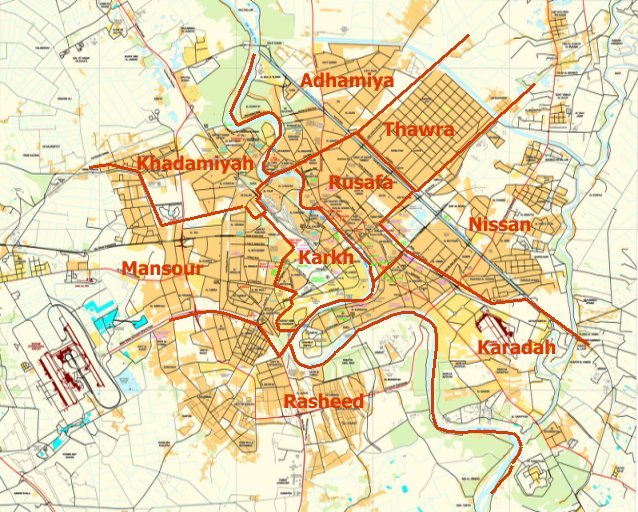
- 26 anonymous bodies were found in Baghdad today. 24 bodies were found in Karkh, the western part of Baghdad in the following neighborhoods ( 4 bodies in Saidiyah, 4 bodies in Amil, 3 bodies in Bayaa, 3 bodies in Elam, 2 bodies in Topchi, 2 bodies in Hurriyah, 2 bodies in Yarmouk, 2 bodies in Mamoun, 1 body in Harthiyah and 1 body in Risala.) 2 bodies were found in Rusafa, the eastern part of Baghdad, 1 body was found in Sadr city and 1 body was found in Nahrawan.
Diyala province
- A military source in Khalis town 10 KMs north of Baquba city said that unknown insurgents assassinated today an officer in the Iraqi army in Al Ghalibiyah area, a part of Khalis town. The source didn’t mention any more details about the incident.
- A military source said that 4 civilians were wounded in clashes between the residents of Al Mjedid area, a part of Khalis town, and insurgents of Al Qaida organization early morning today.
- Medical sources said that 8 citizens including 5 policemen were killed and 12 others including 7 policemen were injured in a suicide car bomb explosion targeted a check point north Khalios town.
Nainawa Province
- Security sources in Mosul city said that 4 Kurdish security members known as Beshmarga had been killed and 15 citizens including Beshmarga members were injured in two suicide car bomb explosions that targeted one of the centers of the PDK party (the party of Kurdistan region president Masoud Barzani in Zomar district north west of Mosul city.
Salahuddin
- Police sources in Tikrit city said that the wife and the daughter of Hashim Hasan Al Majeed, the cousin of the executed former Iraqi president, Saddam Hussein, had been killed today when insurgents attacked them inside their house in Al Qadisiyah neighborhood north Tikrit city early morning today. The source said that the insurgents kidnapped another daughter of Hashim Al Majeed.
Labels: assassination, car bomb, Chemical Ali, Diyala, insurgents, Jadiriyah, KDP, Mosul, Peshmerga, SCIRI, Tikrit
Tuesday, April 24, 2007
PBS Frontline documentary on the training of an Iraqi security force
In addition to sectarian bloodshed, one of the chief problems American trainers are working hard to address is the divided loyalties within the Shi'ite-dominated police and army where Iraqis are loyal not so much to the Iraqi state, but to sheikhs or clerics -- in particular, the powerful rival clerics Moqtada al-Sadr, who has his own 60,000-man militia, the Mahdi Army, and Abdul Aziz al-Hakim, leader of the Shi'ite SCIRI Party and its armed wing, the Badr Brigade.
The first national elections, in January 2005, only fueled the sectarian dynamic. It brought to power an alliance of Shi'a religious parties which moved quickly to secure control of the Sunni-headed Ministry of the Interior. The ministry, in charge of all of Iraq's police, includes the elite units known as the Commandos. The ministry's new head, Bayan Jabr, a top deputy to Shi'ite cleric al-Hakim, began re-staffing commando units with commanders in Badr Corps, the militia loyal to Hakim. Soon, many bodies -- many of them of Sunni civilians -- started turning up on the streets.
Allegations of death squads, secret torture centers and infiltration by militia forces were leveled at the Ministry of Interior. In a revealing interview with Jabr, Smith confronts the former minister with the charges. Jabr vigorously defends his record, but then concedes that abuses have taken place. "I cannot correct the ex-officers of Saddam which work with us," Jabr says. "There is a culture."
Labels: Badr Corps, documentary, Iraq, Iraqi security forces training, Mahdi Army, SCIRI
Saturday, April 21, 2007
Islamic State in Iraq claims Ammar al-Hakim assassination attempt
"By the strength of God, an attack with light and medium weapons and rocket propelled grenades was launched on the convoy," the staunchly Sunni self-styled Islamic State in Iraq said in a statement on the Internet. It called Ammar al-Hakim a villain and Iranian infidel. "He was very close to being killed," the group added.
Abdul-Aziz al-Hakim is leader of the Supreme Council for the Islamic Revolution in Iraq (SCIRI), the biggest party in Shi'ite Prime Minister Nuri al-Maliki's national unity cabinet. Ammar al-Hakim also holds positions in SCIRI. The party had said that Ammar al-Hakim's convoy was fired on as it was travelling in the southern Baghdad district of Doura after leaving the southern holy Shi'ite city of Najaf. In February, U.S. troops detained Ammar Hakim for several hours near the Iranian border, sparking protests in Shi'ite cities. He was later freed.
Labels: Abdul Aziz Al Hakim, Ammar al-Hakim, Islamic State in Iraq, SCIRI
Friday, March 16, 2007
Spokesman denies SCIRI wanted to replace al-Maliki with al-Mahdi
In an interview with Al-Sharq al-Awsat in London, Taqiy denied that "the SCIRI has considered nominating Adil Abd-al-Mahdi for the post of prime minister, instead of Nuri al-Maliki." He noted that "all our efforts are now focused on supporting this government, which enjoys great popular support."
The leading member of the SCIRI admitted that there are "other obstacles besides the security issue; namely, the economic issue. There are also plans to tackle the economic issue. By this, I mean the economic issue, in its services and investment parts, as well as the reconstruction in Iraq. These two issues are linked to the political process, its development, and integration."
We told Taqiy that there are numerous objections by many political forces about the achievements he mentioned, especially with regard to rigging the elections and questioning their fairness. Also, the government is not a national unity government. The parties that participate in this government say that it is a Shi'i government. The most recent of these parties was the Iraqi List, which has threatened to withdraw from the government.
He added: "Concerning the national unity government, a national unity government, which includes the blocs that won and those that did not win in the elections, was formed for the first time in Iraq. By democratic standards, these [defeated] blocs do not have the right to participate in the government. However, all political forces, including the UIC, insisted on the participation of these blocs.
Labels: Rida Jawad Taqiy, SCIRI, Supreme Council for the Islamic Revolution in Iraq
Thursday, March 15, 2007
Talabani - U.S. withdrawal will result in Kurdish-Shia military rule
Labels: Iraqi Islamic Party, Jalal Talabani, Kurds, SCIRI, UIA
Saturday, February 24, 2007
Mass protest over arrest of SCIRI leader's son
The incident could strain good ties between Washington and the elder Hakim's Supreme Council for the Islamic Revolution in Iraq (SCIRI), the dominant party in the Shi'ite-led government. SCIRI supporters held protests in Najaf, Kerbala, Basra, Kut and other towns in the mainly Shi'ite south of Iraq, witnesses and local media said.
Labels: Abdul-Aziz al-Hakim, Ammar al-Hakim, Iran-Iraq border, SCIRI
Friday, February 16, 2007
SCIRI member denounces raid on mosque
Sheik Jalal al-Din al-Saghir, a member of parliament from the Supreme Council for the Islamic Revolution in Iraq (SCIRI), denounced the raid, which the U.S. military said had turned up a cache of illegal weapons. Searching mosques has been a particularly sensitive issue since the 2003 U.S.-led invasion. In delivering the decree that legalized the security plan this week, Lt. Gen. Aboud Qanbar of the Iraqi army said that soldiers would enter mosques only if they were used “for illegal purposes” or to protect citizens from harm.
The U.S. military said that the mosque was raided “during operations targeting illegally armed militia kidnapping, torture and murder activities.” It said the mosque was used “to conduct sectarian violence against Iraqi civilians as well as a safe haven and weapons storage area for illegal militia groups.” Sunnis have reported being held and beaten in the mosque.
U.S. forces provided protection around the mosque while Iraqi soldiers entered it with the cooperation of its security guards, the military statement said. Three Russian PKC machine guns and 80 assault rifles were seized, the statement said. Saghir said that the mosque was raided by Americans who, he alleged, had relied on false intelligence. He said the Americans were looking for “prisons, vaults and torturing operations.”
Labels: mosque raid, SCIRI, weapons cache