Wednesday, October 17, 2007
Erbil suggests talks with Turkey, turns down Iraqi Army in place of Peshmerga
Ankara accuses Kurd held northern province of Iraq of offering refuge to Turkish Kurd rebels. "This is an internal issue and concerning the sovereignty of Iraq, and only the Iraqi government and its Kurdish regional counterpart will handle it," he added.
Sources in the Iraqi army told Gulf News that recent meeting between Iraqi Defence Minister Abdul Qader Mohammad Jasem and the Turkish ambassador in Baghdad focused on the Turkish government's request of sending Iraqi troops to the border to take the place of Kurdish Peshmerga elements which are accused by Ankara of sympathising with Kurdistan Workers Party (PKK) elements.
Mohammad Ehsan said the government in Arbil supports talks between Turkey and the PKK leadership. PKK is listed as a terrorist group. "Dialogue is the right way to solve the PKK problem and not by using excessive military power," the Kurdish minister said.
The minister said that Ankara had informed the United States and the Iraqi government that it would not entertain any representatives of Kurdistan government to attend the Turkish-Iraqi talks. The talks are aimed at resolving the military escalation along common borders between the two countries. "Arbil is more than excited to talk directly with Turkey to find a vital solution to the PKK crisis," the minister said.
"I believe the goal of Turkish government is to escalate the situation on the Iraqi border under the pretext of eliminating the hostile activities by PKK elements," Aaron Kamiran, an Iraqi political analyst, told Gulf News.
"The goal is political because launching a Turkish military operation in the region would not achieve any results because of the difficult and mountainous terrain. Hence the Turks want to send Iraqi and non-Kurdish troops to the border and they will raise problems between Arbil and Baghdad, especially with Arbil's insistence on rejecting the Turkish proposal."
He added: "What is important for Turks is to make sure that Iraq Kurdistan region will not be an independent entity or a confederate state in the future. Besides the non-Kurdish forces in the region may pose a guarantee for Turkey in this region, especially since normalisation situations in Kirkuk is implemented hastily".
Labels: Abdul Qader Mohammad Jasem, Iraqi Army, Kurdistan, Peshmerga, PKK, Turkey


Wednesday, October 10, 2007
Iraqi Defense Minister meets with KRG to discuss creation of Peshmerga platoons
Labels: Abd al-Qadir al-Ubaydi, KRG, Peshmerga
Thursday, August 30, 2007
Clashes Between Peshmerga Forces And Anti-Iranian Fighters
Labels: Bijak, Peshmerga, Soorin Mountains
Wednesday, August 29, 2007
Iranian acts force Kurds to flee homes as the Iraqi govt is blamed for not taking action
Iran has been shelling border areas in Qalaat Daza, 135 km northewest of Sulaimaniya; Haj Omran, 147 km northeast of Arbil; and Banjwin district, 96 km northeast of Sulaimaniya for two weeks now under the pretext of tracking down PJAK fighters. Turkey, also, was shelling border areas in the northern Iraqi province of Duhuk under the pretext of fighting members of imprisoned leader Abdullah Ocalan's Kurdistan Workers Party (PKK). Kurdish sources said the shelling caused damage to property and fires in Kurdish forests.
Homeless families complain of a lack of humanitarian relief from any organization, in light of immense material losses, as the shelling sets their lands on fire. Each of the villages of Maradawa, Arka, Aki, Sirw, Sora Kola, Spilka, Eleih and Rash have received more than 50 Iranian artillery shells. Hundreds of acres of orchards were burnt. The attacks caused no casualties.
In the village of Sora Kola, life seems to have come to a standstill. Only seven houses were still standing and all were vacant except one, where the men of the village gathered together. Their families had fled scores of kilometers away. "We hold (Iraqi Prime Minister Nouri) al-Maliki responsible for the burnt orchards and gardens. These incidents took place only after his (recent) visits to Syria, Iran and Turkey," 56-year-old Hamad Hassan told the independent news agency Voices of Iraq (VOI) while leaning on his pillow and sadly looking at the burnt fields.
A spokesman for the Iraqi Kurdistan region's security force (Peshmerga) had held the central government in Baghdad responsible for any decision representing "a reply to Iranian shelling." "The problem is occurring on international borders. It is Baghdad's responsibility," the Peshmerga spokesman Jabbar Yawir, said.
In one of the PJAK strongholds Amir Kerimi, a member of the Kurdish group's administrative body, said "Iran's attacks began right after Maliki visited Syria, Turkey and Iran and made agreements with those countries." On concerns that Mount Qandeel might turn into a haven for al-Qaeda Organization in Iraq if the PJAK and PKK fighters withdraw, Kerimi replied "No force can ever take Mount Qandeel from us."
PJAK is a splinter group of the PKK. It separated from it after PKK leader Abdullah Ocalan was imprisoned in Turkish jails. The nearly 3,000 PJAK fighters then started their armed struggle against the Iranian authorities, with the aim of "building federalism for Iran's Kurdistan."
Labels: Duhuk, Iran, Mount Qandeel, Nouri Al-Maliki, Peshmerga, PJAK, PKK, Sulaimaniya province, Turkey
Friday, August 17, 2007
Peshmerga sent to Sinjar to restore security
Four truck bombs were detonated on Tuesday evening in Kar Izir area, 35 km south of Sinjar, and at the Siba Sheikh Khidr housing compound, killing and injuring more than 500 people. In the aftermath of the attacks, Iraq's Kurdistan President Massoud al-Barazani called on Peshmerga forces and the Iraqi Ministry of Interior to provide protection for Kurdish minorities and accused a number of countries in the region of being behind the attacks
The Kurdistan Regional Government (KRG) announced on Thursday a day of mourning for the victims of the blasts. Sinjar district, 120 km to the northwest of Mosul, is inhabited by the Yazidis, a religious sect whose followers are generally situated in northern Iraq. Some 350,000 Yazidis live in villages around Mosul, 405 km north of Baghdad.
Yazidis are primarily ethnic Kurds and most live near Mosul, with smaller communities in Armenia, Georgia, Iran, Russia, Syria, and Turkey. They number around 500,000 individuals in total, but estimates of their population size vary, partially due to the Yazidi tradition of secrecy about their religious beliefs.
Labels: Maj. Gen. Aziz Waizy, Peshmerga, Sinjar, Yazidis
Thursday, August 09, 2007
Plan to deploy Pesmerga to Kirkuk creates dissention
Those sites include power facilities and parts of the oil pipeline that leads from Mosul to the port of Ceyhan in Turkey -- the conduit for most oil exports from northern Iraq's oil fields. The forces belong to the government of Kurdish-administered northern Iraq, which is pushing for Kirkuk to be incorporated into the Kurdistan region. The plan to deploy peshmerga troops has therefore provoked controversy among minority groups in Kirkuk Governorate, which is under the control of the Baghdad government and outside the current Kurdish region.
According to Yawir, the deployment can begin as soon as there is a final green light from Iraqi Prime Minister Nuri al-Maliki. It remains uncertain when that approval might come. But in the meantime, the proposal is being received with mixed opinions in multiethnic Kirkuk Governorate. Jawad al-Janabi, a member of the Kirkuk Governorate Council and a representative of the predominantly Kurdish Kirkuk Brotherhood List, said that if peshmerga forces are deployed to Kirkuk, they will succeed in implementing security plans for the region.
"If we recall when the city of Kirkuk was liberated [with the toppling of the Saddam Hussein regime in 2003], for six months during the presence of peshmerga forces there, we had a very good security situation, and people were able to come and go, even after midnight," al-Janabi says. "These forces are Iraqi before being Kurdish; they are sons of the Iraqi people," he continues. "They are regular troops, and will provide support for the security forces in the [Kirkuk] governorate."
But leaders of Kirkuk's other two largest ethnic groups, the Turkoman and Arab communities, disagree. Hassan Toran, a representative of the Turkoman group in the Kirkuk Governorate Council, says any deployment of peshmerga forces to Kirkuk should only be carried out with the agreement of all parties, and warned that the details of the planned deployment remain obscure.
"Some say that they are to protect the pipelines and power lines between Kirkuk and Baiji. And some say that they are to protect the Governorate of Kirkuk," Toran says. "I believe that this should be done only with the agreement of all the parties in the Governorate Council. Whether they agree or not, the subject should be open to discussion because it is a matter that concerns more than one ethnic group or one [party] list; it concerns the whole of Kirkuk Governorate."
Muhammad Khail, a member of the Arab group in the Governorate Council, says any protection force should be composed of all the groups that form the governorate's social fabric. "The [Kurdistan] regional government intends to bring 6,000 peshmerga to Kirkuk, but I believe that this will not solve the problem," he says. "There is a sufficient Iraqi Army [presence] in Kirkuk. They can form units. Why are the other units not being given the proper role in defending Kirkuk in a proper way?"
Khail recalls hearing of the formation of security units from other ethnic groups, such as Turkomans or Arabs, but he says he does not believe that such groups can solve Kirkuk's problems. "They need to form a security force for the national defense of Kirkuk. A national force can obtain information prior to an event, and that's what's important," he says.
Kirkuk, which also has communities of Chaldean Assyrians and Christians, is some 250 kilometers north of Baghdad. The city has seen devastating car bomb attacks, mostly aimed at either of the two main Kurdish political parties in northern Iraq, and repeated sabotage of power lines and the oil pipeline. If the peshmerga deploy to the province, it will not be the first time Kurdish forces have been sent to help secure areas outside the three Kurdish-administered provinces of northern Iraq. Three battalions of peshmerga were sent to Baghdad in March to help with security in the capital.
Labels: Kirkuk, Major General Jabbar Yawir, Peshmerga, Turkomen
Thursday, August 02, 2007
Peshmerga to protect power towers
The Kurdish 2nd Brigade Commander, Anwar Hama Amin, had said on Saturday that Kurdish Peshmerga forces will be deployed in several areas of Kirkuk to protect power towers and oil installations. "Bringing the Peshmarga to the province is part of an agreement and a protocol signed between the General Commander of the armed forces, Prime Minister Nouri al-Maliki, and the President of Iraqi Kurdistan region, Masoud Barazani," said Amin in a press conference held on Saturday at the military training base of K1 in Kirkuk.
Labels: al-Shurqat, Kirkuk, Kurdistan national guard, Major General Jabbar Yawir, Peshmerga, power towers, Taza-Baiji highway
Thursday, July 19, 2007
KRG stations Peshmerga round Kirkuk
The move comes following devastating car bomb attacks in the city, most of them targeting offices of the two main Kurdish factions ruling the region. The Kurds want to add Kirkuk and its prolific oil fields to their enclave in the north despite regional concerns and opposition from certain ethnic groups in the city.
Koran said Kurdish militias will not be stationed inside the strife-torn city but will try to guard areas surrounding it. He said the militias' main task will be the protection of power pylons and oil pipelines which are scenes of repeated acts of sabotage.
Labels: Kirkuk, KRG, Kusart Koran, Peshmerga
Friday, July 13, 2007
Iranian Revolutionary Guards and Peshmerga clash near border
Iranian shelling in the Peshdar region, 60 miles northwest of Sulaimaniyah, hit areas as far as 18 miles from the border, said the regional governor, Hussein Ahmed. He said many of the area's 1,000 families had fled for protection. The other region hit by shelling lay farther north, near the Hajji Umran border crossing, 65 miles north of the city of Irbil, Yawer said. He said the shelling began with an incursion by Kurdish guerrillas into Iran on Tuesday that sparked clashes with Iran's Revolutionary Guards.
"We are not with either side, and we will not allow the lands of Iraqi Kurdistan to become a battlefield in which civilians in Kurdish villages are the victims," he said. The Free Life Party is a breakaway faction of the separatist Kurdistan Workers' Party, also known as PKK, which is dominated by Turkish Kurds but also had Iranian Kurd branches. Its fighters have sparked Iranian shelling into Iraq several times over the past two years, most recently in June.
Turkey has increasingly threatened to take action in northern Iraq, complaining that the Kurdistan government and U.S. forces are not doing enough to stop PKK fighters carrying out attacks on Turkish soil.
Labels: Free Life Party, Iran, Kurdistan protection forces, Peshdar region, Peshmerga, Revolutionary Guards
Monday, July 02, 2007
Kurds offer Kurdish battalion to protect Askariya shrine
The Askariya shrine in Samarra, 95 kilometers (60 miles) north of Baghdad, is one of the holiest places for Shiites, and a February 2006 bombing that destroyed its golden dome sparked retaliation by Shiites and a brutal cycle of sectarian killings. Despite heightened security, it was struck again last month, bringing down its two minarets.
A delegation from the autonomous Kurdish region of northern Iraq made the proposal to Shiite cleric Muqtada al-Sadr, who recently called off a march to Samarra planned for July 5 after the government and Sunni leaders urged him to do so for fear of sectarian clashes.
"A Kurdish delegation visited (the holy city of) Najaf and came forward with the initiative to protect the holy shrine and guarantee security to the companies and workers who will rebuild the shrine," said Saleh al-Aujaili, a legislator from al-Sadr's bloc in parliament. He said the Sadrist movement welcomes the proposal.
Brig. Gen. Jabbar Yawar, an undersecretary for the Kurdish regional Ministry of Peshmerga (Kurdish militiaman), said a predominantly Kurdish battalion of the Iraqi army's 2nd Brigade is ready to go to Samarra to protect the shrine. "The force will be mixed of Kurds, Arabs and Turkomen and does not belong to any (ethnic) group," Yawar said. He added that the force was waiting for a decision by the Baghdad government. Government spokesman Ali al-Dabbagh was not in the country for comment and repeated calls to other government officials went unanswered.
Defense Ministry spokesman Mohammed al-Askari said there is no need for a force to deploy in the area since the Iraqi army's 4th Division, made up mainly of Shiite and Sunni Arabs, is deployed in Salahuddin province, where Samarra is located. He added that an Iraqi army force has deployed around the shrine since the June 13 bombing.
Labels: Askariya shrine, Brig. Gen. Jabbar Yawar, Moqtada Al-Sadr, Najaf, Peshmerga, Samarra
Thursday, May 24, 2007
Iraqi VP meets with Kurdistan's PM on draft oil law, Kirkuk
Iraqi cabinet adopted a draft law on oil investment in Iraq including Kurdistan region and sent it to the Iraqi parliament for debate and voting. The proposed law gives the central government in Baghdad more powers to control investment contracts of oil in the country, a matter rejected by Kurds who demand more jurisdictions be given to the local government when conducting contracts with companies concerning oil in the region.
Also the Kurds urged Iraqi leaders to implement Article 140 of the Iraqi constitution regarding the statues of oil-rich-Kirkuk. Kurds claim that the former regime had changed the demographic distribution of the population by alluring more Arabs to settle in Kirkuk and drive out Kurds during 70-80s. Article 140 stipulates that situation in Kirkuk should be normalized as it was before the alleged Arab migration to the city, to conduct a census and to hold a referendum to decide whether or not the city would join Kurdistan region.
Kirkuk, 250 km northeast of Baghdad, is a mixed city of Arabs, Kurds and Torkmans.
According to the statement, Abdul Mahdi said "we have no differences as to the agreed principles but we need to work out solid mechanisms to secure the good implementation of the article." The meeting also touched upon issues related to the budget of the Kurdish local fighters (Peshmerga) within the Iraqi national budget, the statement added.
"Both sides stressed the importance of continuing concerted efforts to gain security and stability as well as supporting the ongoing political process in the country," the statement added. Abdul Mahdi, according to the statement, said "we should adhere at the mechanisms set up by the constitution to solve all disputable issues."
Labels: Adel Abdul Mahdi, Article 140, draft oil law, Kirkuk, Negervan al-Barazani, Peshmerga
Thursday, May 17, 2007
The growing threat facing Kurdistan
The Islamic State of Iraq claimed responsibility for both attacks in Internet postings. In a statement on the May 9 attack, the Al-Qaeda-affiliated group said the attack came "in response to the participation of the apostate peshmerga forces with the Safawi [a reference to the Shi'ite-led government in Iraq] government of [Iraqi Prime Minister Nuri] al-Maliki in the so-called 'Baghdad law enforcement plan.'"
Addressing Kurdistan region President Mas'ud Barzani and Iraqi President Jalal Talabani, the group promised more attacks, adding, "We will not stop attacking you until you withdraw your mercenaries from the Baghdad province and cease to support the Crusaders [U.S.-led coalition forces] and the Safawis."
The Islamic State of Iraq first warned Kurdish soldiers against taking part in the Baghdad security plan in January. "We tell you that the martyrs brigades of the Islamic State of Iraq, particularly the Ansar martyrs [a reference to the terrorist group Ansar Al-Islam, whose bases in Kurdistan were crushed by a U.S. bombing campaign in the opening days of the war] cannot wait to confront you as to speed your arrival in hell," an Internet statement said.
The Kata'ib Kurdistan (Kurdistan Brigades), a group that pledged allegiance to Al-Qaeda in March, also claimed responsibility for the attack in a statement posted to the Ansar Al-Islam website, the news website Kurdish Aspect reported on May 10. The brigades are reportedly part of Ansar Al-Islam, which is aligned with Al-Qaeda.
According to Kurdish Aspect, a source from within the Kurdish peshmerga said that Ansar Al-Islam and the Ansar Al-Sunnah Army are reorganizing their ranks and deploying their forces along the Iran-Iraq border. Kurdish leaders have also attributed recent attacks against Kurdish forces in the town of Penjwin to Ansar Al-Islam, saying the group moves freely across the Iran-Iraq border. Kurdish security sources told local media that the KRG was on alert for a terrorist attack in the days preceding the two incidents, based on intelligence that included detained terrorists' confessions, as well as the discovery of weapons caches.
Observations of websites and forums frequented by insurgents in Iraq and their supporters suggest that indeed, the Islamic State of Iraq and Ansar Al-Islam/Sunnah are attempting to gain a foothold on areas in the north. Apart from their stated claim of seeking retribution against the Kurds, their presence in the north would provide them with a valuable gateway for foreign fighters and supplies through the porous Iran-Iraq border.
The resurgence of insurgent activity in Kurdistan can be seen in the plethora of statements appearing on insurgent websites and forums in recent weeks, and Kata'ib Kurdistan has issued at least one video documenting its attacks. Moreover, Kurdish-language statements have appeared on forum websites with increasing frequency, suggesting insurgents may be trying to recruit Kurdish fighters to join their cause.
The frequency of attacks against Kurdish targets both in the Kurdish region and neighboring governorates to the south suggest that Kurds will remain under fire for some time to come. The potential consequences of an Al-Qaeda/Ansar campaign would be devastating to the region's economy, stability and governance. It could prompt Turkey to carry out plans for a large-scale incursion into Iraqi Kurdistan to hunt down PKK militants based there. Or worse yet, Turkey might take steps to secure Turkoman control over Kirkuk, a move that would evoke a violent reaction from Iraqi Kurds.
Labels: Ansar al-Islam, Ansar al-Sunnah, bomb attacks, Iran, Islamic State of Iraq, Jalal Talabani, Kata'ib Kurdistan, KDP, KRG, Kurdistan, Kurdistan Brigades, Massoud Barzani, Peshmerga
Friday, May 11, 2007
Kurdistan sends troops to Iranian border
Labels: Al Qaeda in Kurdistan, Ansar al-Islam, Iran-Iraq border, Kurdistan, Major General Jabbar Yawir, Penjwin, Peshmerga
Wednesday, May 02, 2007
Political parties in Kurdistan targeted by insurgent groups
The insurgents have so far destroyed three main offices of the Kurdistan Democratic Party (KDP) of the Massoud Barazin, the president of the Kurdish region. The Kurds have extended their influence and control to the peripheries of Mosul, the provincial capital. Kurdish militias patrol the city’s outlying towns and villages and set up checkpoint on main roads leading to it. Mosul is a major insurgent stronghold and insurgent leaders fear Kurdish practices might choke their supply routes.
A senior Kurdish official is number two in Nineveh provincial council to represent a sizeable Kurdish community in the city. The official, Khisro Koran, a senior KDP member and deputy governor of Nineveh, said the attacks were meant to “embroil the Kurds in the current sectarian fighting” in the country. He said Kurds in Mosul and other areas were being subjected “to a campaign of liquidation,” forcing thousands of them to flee. The insurgents operate conspicuously in Mosul and kidnap or kill officials or residents who do not heed their instructions.
Labels: car bombs, insurgent groups, KDP, Khisro Koran, Kurdish parties, Ninevah, Peshmerga
Friday, April 27, 2007
Round-up of violence across Iraq
Baghdad
- 4 citizens were killed and 10 were injured in a parked car bomb explosion near the house of Abdul Azeez Al Hakeem, the SCIRI head house in Jadiriyah neighborhood south Baghdad at 3,50 pm.
- 26 anonymous bodies were found in Baghdad today. 24 bodies were found in Karkh, the western part of Baghdad in the following neighborhoods ( 4 bodies in Saidiyah, 4 bodies in Amil, 3 bodies in Bayaa, 3 bodies in Elam, 2 bodies in Topchi, 2 bodies in Hurriyah, 2 bodies in Yarmouk, 2 bodies in Mamoun, 1 body in Harthiyah and 1 body in Risala.) 2 bodies were found in Rusafa, the eastern part of Baghdad, 1 body was found in Sadr city and 1 body was found in Nahrawan.
Diyala province
- A military source in Khalis town 10 KMs north of Baquba city said that unknown insurgents assassinated today an officer in the Iraqi army in Al Ghalibiyah area, a part of Khalis town. The source didn’t mention any more details about the incident.
- A military source said that 4 civilians were wounded in clashes between the residents of Al Mjedid area, a part of Khalis town, and insurgents of Al Qaida organization early morning today.
- Medical sources said that 8 citizens including 5 policemen were killed and 12 others including 7 policemen were injured in a suicide car bomb explosion targeted a check point north Khalios town.
Nainawa Province
- Security sources in Mosul city said that 4 Kurdish security members known as Beshmarga had been killed and 15 citizens including Beshmarga members were injured in two suicide car bomb explosions that targeted one of the centers of the PDK party (the party of Kurdistan region president Masoud Barzani in Zomar district north west of Mosul city.
Salahuddin
- Police sources in Tikrit city said that the wife and the daughter of Hashim Hasan Al Majeed, the cousin of the executed former Iraqi president, Saddam Hussein, had been killed today when insurgents attacked them inside their house in Al Qadisiyah neighborhood north Tikrit city early morning today. The source said that the insurgents kidnapped another daughter of Hashim Al Majeed.
Labels: assassination, car bomb, Chemical Ali, Diyala, insurgents, Jadiriyah, KDP, Mosul, Peshmerga, SCIRI, Tikrit
Saturday, February 17, 2007
Peshmerga controlling Kirkuk
In June 2004, the American Coalition Provisional Authority issued an order outlawing militias and calling for their members to integrate into Iraq's security forces. An exemption was made for the Peshmerga, provided that they remained in Kurdistan, a semi-autonomous state in northern Iraq, and not move to outside areas like Kirkuk. Armed groups across Iraq reacted to the 2004 measure by enlisting in the army and police and maintaining large contingents of stand-alone militia groups, making them significantly more powerful.
"The Kurds who surround Kirkuk claim to be Iraqi army, but their extensive presence on the outskirts of Kirkuk is designed to affect the ethnic balance of the city," said Ali Mahdi, a senior Turkmen political leader in Kirkuk and a member of the provincial council. "They are protecting their sect and working for the benefit of the Kurds in the city and not the others. This is dangerous for the future of the city."
The situation has serious geo-political implications: Neighboring Turkey, a crucial U.S. ally, fears that the Kurds will eventually declare independence if they gain Kirkuk, a move that could lead the large Kurdish population in Turkey to agitate for secession. Former dictator Saddam Hussein displaced tens of thousands of Kurdish families from Kirkuk, replacing them with Arabs, mainly from the Shiite south.
Iraq's constitution provides for a referendum to decide the matter of who will control Kirkuk by the end of this year; meanwhile, tens of thousands of Kurds have moved into the city since 2003, urged by Kurdish political parties to set up homes there. And the Peshmerga have continued to have deep ties with the Iraqi security forces.
"If the heavy presence of Peshmerga in Kirkuk and its outskirts continues as it is now, it will lead to a civil war in Kirkuk," said Abdullah al Obeidi, a Sunni Arab tribal leader and a member of the Kirkuk provincial council. Senior Kurdish leaders have said in public that they'll pursue only peaceful means to wrest control of the city. That same leadership has intentionally stocked Iraqi security forces with Peshmerga, said Fadil Haider, a senior member of the Kurdistan Islamic Union, a small but powerful political party, and a former member of the Iraqi national parliament.
The two main Kurdish parties - the Patriotic Union of Kurdistan (PUK) and the Kurdistan Democratic Party (KDP) - have done so as an insurance policy, he said. "I can give you two scenarios: If Iraq is in an all-out civil war, then the PUK and KDP have put themselves in a position to protect Kurdistan by very quickly taking Kirkuk and making it a part of an independent Kurdistan," Haider said. "Or, if we exhaust the peaceful, political means of gaining Kirkuk for Kurdistan, we will take it by force."
Kurdish officials are confident that when Kirkuk becomes a part of the Kurdish regional government, its security will be maintained by Peshmerga, a process that presumably would be made easier by the fact that so many Iraqi police and army there are former members, said Suzanne Shahab Nouri, a member of the regional Kurdish parliament. "The Kurdish Peshmerga forces are the strongest (Iraqi) military force in Iraq," said Jafar Mustafa Ali, the minister state for Peshmerga affairs - essentially a defense minister - in Sulaimaniyah. "If they (Kurdish opponents in Kirkuk) don't respect the democratic process, we could take over Kirkuk and they could do nothing."
Labels: Arabs, Iraqi Army, KDP, Kirkuk, Kurds, Peshmerga, PUK, Turkomen
Tuesday, February 13, 2007
Peshmerga deployed to Baghdad for security plan
The growing role of the Kurdish Peshmergas forces inside the Iraqi capital might be considered reassuring to the strong Sunni political forces which accused Iraqi forces of affiliation to Shiite political parties and involvement in sectarian violence against Sunni neighbourhoods during the previous security plans. Also, the US forces distrust the Iraqi Interior Ministry troops which are accused of allegiance to Shiite armed militias and Iran. It was also said that enhancing Kurdish military coexistence in Baghdad is a US request.
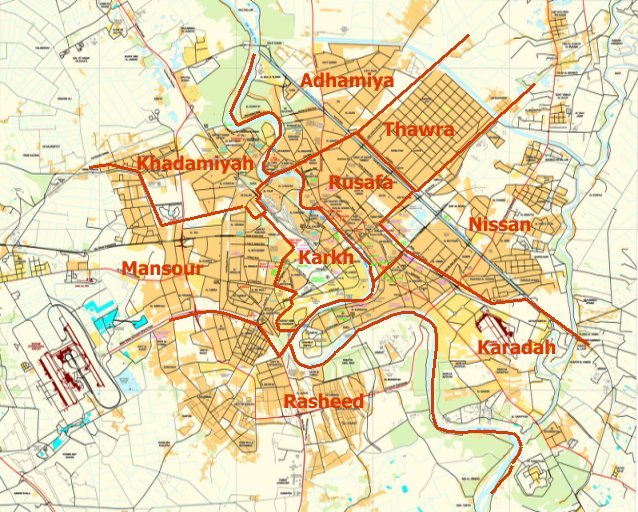
Citizens of Adhamyia, the Sunni neighbourhood in Baghdad which has been besieged by Iraqi-American troops told Gulf News that Kurdish forces from the Iraqi army are participating with US troops in enclosing the neighbourhood which is believed to include Sunni armed men. Amer Al Hussaini, a prominent figure in the Shiite Sadr group, told Gulf News: "Some Kurdish forces are seen stationed in some entrances of the Sadr Shiite neighbourhood."
The Kurdish Peshmergas forces which most of the Iraqi army brigades are formed from, stationed in Dohuk, Arbil and Suleiymaniya, amount to 80,000. This might rise to 120,000 because of the escalation of security threats in Baghdad and also Turkey's threats to the federal Kurdistan region regarding ownership of Kirkuk. The parliament in Kurdistan is witnessing disagreement on the issue of sending Kurdish brigades to Baghdad amid strong pressure from Kurdish clans, who do not want their sons to be involved in the sectarian bloody quagmire.
Labels: Baghdad, Peshmerga, security